What may be derided as sterile archaism in the West is all too often considered as the most venerable spirituality when found in the East.
Sunday, 22 November 2015

Reflection on Charity
While charity may cover a multitude of sins, it is a cloak for neither stupidity nor blindness.
Reflection on The Left and Multiculturalism
The Leftist's belief in diversity is limited to citizens looking different but believing and acting in ways identical.
Saturday, 21 November 2015
Reflection on Temperament
A peaceful temperament caused by general indifference is a worse vice than one marked by passionate outbursts.
Friday, 20 November 2015
Reflection on Being Moderate
The "moderate" path in religion and politics in pursuit of a higher consensus tends by its own force downwards. Pusillanimity of soul and base self interest is commonly disguised by so-called principled toleration.
Friday, 13 November 2015
Reflection on the Faith in the Modern World
Since the last Council our prelates have very consciously adopted the language of the Revolution. Instead of presenting the clarity and force of the Sacred Deposit, they have been reduced to pleading that the Faith is not as offensive as it seems. Our hierarchy have been even striving for simply a place at the table of dialogue. Scraps from their Master's table (let the reader understand) they will gladly accept. Our Blessed Lord did not request a hearing out of politeness; He demanded obedience to His words.
Thursday, 12 November 2015


Tuesday, 3 November 2015
Reflection on the Reign of Christ
To deny the divine Personality of Christ to be snatch His rod of iron and strike Him with a feeble reed.
Reflection on Attaining Salvation
The Fiat of the generous Catholic soul to God is the ordinary and sufficient path to sanctity.
Saturday, 31 October 2015
Reflection on Michael Voris and the Popes
The refusal of Voris to criticise a pope while he is so, is like remaining silent when an evil man wrecks havoc, but then digging up his bones and burning them.
Sunday, 25 October 2015
Reflection on the Feast of Christ the King
Wherever there is an intellect or will, human association or collaboration, solitude or public expression, may Christ be known and honoured. Through Him, all was created and all was redeemed by the sprinkling of His royal and priestly blood. To Whom else, does man owe his gratitude and worship?
Reflection on Conscience and the Synod
It was once said that the exercise of religion must be restricted to one's private home, yet now they go even further. The internal forum must today be a refuge from even the rudiments of Christian morality.
"Hail King of the Jews!" And they mocked and scourged Him.
"Hail King of the Jews!" And they mocked and scourged Him.
Saturday, 24 October 2015
Reflection on Decentralisation of the Catholic Church
The Church is most appropriately named "Catholic", signifying her universality. The unity of the Faith is to be held by all who cling to her bosom. The definition of the Faith can therefore never be restricted to historically formed borders of the nation state. A local bishop has a jurisdiction limited to his own diocese, therefore he can not define the Faith of the universal Church. One Faith was delivered to the Apostles, once and for all nations and for all times. It belongs to the solemn function of the Roman Pontiff who has universal and immediate jurisdiction over the Catholic Church to bind the faithful in the orthodox Faith. In addition, a General Council may share in his office when their decrees are approved by Peter. A decentralised Church is one detached from the Apostolic Faith.
Thursday, 15 October 2015
Reflection on God's Mercy
The twin faults of presuming on God's mercy and despairing of it can be repaired by fruitful meditation on a crucifix.
Saturday, 10 October 2015
Reflection on the Passion of Our Lord Jesus Christ

In His wounds, we find our refuge, in His blood, our life, in His cross, the trophy of our victory.
Friday, 25 September 2015
Reflection on Neo Catholics and Francis
If one is to defend Francis solely because he occupies the throne of St. Peter, is one not under the same obligation to defend Benedict IX, Stephen VI and the Borgia for the same reason? Catholic sense appears to have gone the way of the red shoes.
Sunday, 30 August 2015
Reflection on the Cross and Mercy
The marvellous mercy of the Eternal Father is shown in that He regards the wounds and not the nails.
Sunday, 23 August 2015
Reflection on Catholic Spain

The Iberian kingdoms were forged in harmony solely by their Catholicism. Once this sense of divine mission of Faith fails, these disparate lands degenerate to their previous state of corruption and dissension. A condition ripe for exploitation by atheists and socialists. Without the Faith of Rome, Spain does not exist.
Reflection on Daily Life
The monotony of daily tasks performed with patience and resignation to the will of God is a great workshop in sanctity. The anvil that molds the generous soul into the likeness of our Lord.
Sunday, 2 August 2015
Reflection on Fraternal Correction
To be remiss regarding the truth is to love little your erring brother and God, not at all.
Tuesday, 28 July 2015
Reflection on the Absence of God
The silence of God may be a terrifying judgement or indulgent patience.
Sunday, 26 July 2015
Reflection on the Reception of Holy Communion

Since Christ is the source and form of Holiness, if follows that one, single well-received Holy Communion, if He so wills, is sufficient to raise a fervent and suitably disposed soul, to the heights of sanctity.
Saturday, 25 July 2015
Reflection on Climate Change
The Earth will burn no sooner than the souls of the neglected faithful.
Saturday, 23 May 2015
Reflection on Democracy and Voting
The idiocy of democracy is shown in that it assumes that a man has wisdom and common sense simply because he has survived 18 years on earth without being killed.
Friday, 22 May 2015
Reflection on Equality and Progress

Nothing could be duller or more uninspiring that the notion of "equality". Superiority and excellence were the pillars of civilisation.
Wednesday, 22 April 2015
Reflection on the Catholic Church
The barque of Peter is constructed from the wood of Christ's Cross.
Sunday, 12 April 2015
Reflection on "Divine Mercy Sunday"
In the Wounds of Christ are the roots of justice submerged, and from which mercy sprouts forth.
Reflection on the Jubilee of Mercy 2
When ignores the reality of sin, one passes over the excellence of sanctity to which all are called. If man is only in need of "education" to be a worthy citizen, what is left of grace and the divine action?
Tuesday, 7 April 2015
A Synod on Grace
''If anyone says that the grace of God can be conferred because of human prayer, and not rather that it is grace itself that prompts us to pray, one contradicts the prophet Isaiah or the apostle who says the same thing: ''I have been found by those who did not seek me: I have shown Myself to those who did not ask for Me.''
''If anyone contends that God awaits our will before cleansing us from sin, but does not confess that even the desire to be cleansed is aroused in us by the infusion and action of the Holy Spirit, he opposes the Holy Spirit Himself speaking through Solomon: ''The will is prepared by the Lord'' (Prov 8:35) and the apostle's salutary message: ''God is at work in you, both to will and to work for His good pleasure.''
''If anyone says that mercy is divinely conferred upon us, without God's grace, we believe, will, desire, strive, labour, pray, keep watch, endeavour, request, seek, knock, but does not confess that it is through the infusion and inspiration of the Holy Spirit that we believe, will, or are able to do all these things as is required; or if anyone subordinate the help of grace to humility or human obedience and does not admit that it is the very gift of grace that makes us obedient and humble, one contradicts the apostle, who says, ''What have you that you did not receive?'' (1 Cor 4:7); and also: ''By the grace of God I am what I am''
(Second Council of Orange, approved by Pope Boniface II)
Comment: So many of the errors of the post-Conciliar era have stemmed from the failure to distinguish between the orders of nature (or reason) grace (or the supernatural). It is utterly damning for a cleric charged with defending the Apostolic Doctrine to confound the two orders which results in the nullification of our Redemption and the demands of purity and mortification.When one is incapable of contrasting (not as opposed, but as distinct) the two orders, what is offered by Christian morality other than apparent good manners? This would not be beyond the reach of the Stoic or Epicurean. After all, the requirements of Christian sanctification would appear entirely absurd is we were to omit the supernatural end to which we are called, particularly in light of our fall from original integrity and justice in Adam. If man has a purely natural end, to which his faculties are adequately proportioned and to which is nature lends a claim, what is left for Christ to accomplish?
Since the substance of a act is determined by its object, it follows that if our object is supernatural, our acts of faith, hope and charity must exceed the province of nature and reason. As man has fallen from his supernatural integrity in Adam, it is necessary for man to be elevated and directed to this end solely by God's vital assistance. Man's natural capacities have been vitiated which make his adherence to the natural law and with more reason, he is completely unable to raise himself by his own powers to the supernatural. It is for reason that we state that the beginning of faith proceeds from divine operating grace. It is not as a result of our faith (supernatural in substance due to its supernatural end) that God confers grace as though we are to be rewarded for our efforts. Accordingly it is due to His conferring of grace that we are able to exert any effort in the supernatural sphere. From his grace, we will, desire, strive, seek and ultimately accomplish due to His good pleasure.
If we fail to acknowledge this truth, it would follow that there is no necessity of belonging to the Catholic Church for our salvation. What would the Church provide other than ''moral guidance'', which man can profit from without entering her formally? We can see the disaster in this when we witness the canonization of someone at their funeral, by a well meaning but evidently oblivious priest. Regardless of someone's striving for Christian perfection (that is, in the supernatural order), independently of their adherence to the basis demands of purity, we are told that their ''good heart' suffices for salvation. Are we to hold that God owes it to us to allow us entry to the Beatific Vision (if this is even admitted)? Is God under obligation to us? What is the use of baptism, of the Eucharist, of Penance? The Crucifixion is therefore superfluous and unfitting.
Let us not fail to admit our utter dependence on God in the natural sphere (Who moves our intellects and wills according to a natural concurrence), and even more in the supernatural realm.What do we have that we have not received? What could we desire that God has not moved us to desire? Who will bring us to that end unfailingly, other than the Author of Grace?
''If anyone contends that God awaits our will before cleansing us from sin, but does not confess that even the desire to be cleansed is aroused in us by the infusion and action of the Holy Spirit, he opposes the Holy Spirit Himself speaking through Solomon: ''The will is prepared by the Lord'' (Prov 8:35) and the apostle's salutary message: ''God is at work in you, both to will and to work for His good pleasure.''
''If anyone says that mercy is divinely conferred upon us, without God's grace, we believe, will, desire, strive, labour, pray, keep watch, endeavour, request, seek, knock, but does not confess that it is through the infusion and inspiration of the Holy Spirit that we believe, will, or are able to do all these things as is required; or if anyone subordinate the help of grace to humility or human obedience and does not admit that it is the very gift of grace that makes us obedient and humble, one contradicts the apostle, who says, ''What have you that you did not receive?'' (1 Cor 4:7); and also: ''By the grace of God I am what I am''
(Second Council of Orange, approved by Pope Boniface II)
Comment: So many of the errors of the post-Conciliar era have stemmed from the failure to distinguish between the orders of nature (or reason) grace (or the supernatural). It is utterly damning for a cleric charged with defending the Apostolic Doctrine to confound the two orders which results in the nullification of our Redemption and the demands of purity and mortification.When one is incapable of contrasting (not as opposed, but as distinct) the two orders, what is offered by Christian morality other than apparent good manners? This would not be beyond the reach of the Stoic or Epicurean. After all, the requirements of Christian sanctification would appear entirely absurd is we were to omit the supernatural end to which we are called, particularly in light of our fall from original integrity and justice in Adam. If man has a purely natural end, to which his faculties are adequately proportioned and to which is nature lends a claim, what is left for Christ to accomplish?
Since the substance of a act is determined by its object, it follows that if our object is supernatural, our acts of faith, hope and charity must exceed the province of nature and reason. As man has fallen from his supernatural integrity in Adam, it is necessary for man to be elevated and directed to this end solely by God's vital assistance. Man's natural capacities have been vitiated which make his adherence to the natural law and with more reason, he is completely unable to raise himself by his own powers to the supernatural. It is for reason that we state that the beginning of faith proceeds from divine operating grace. It is not as a result of our faith (supernatural in substance due to its supernatural end) that God confers grace as though we are to be rewarded for our efforts. Accordingly it is due to His conferring of grace that we are able to exert any effort in the supernatural sphere. From his grace, we will, desire, strive, seek and ultimately accomplish due to His good pleasure.
If we fail to acknowledge this truth, it would follow that there is no necessity of belonging to the Catholic Church for our salvation. What would the Church provide other than ''moral guidance'', which man can profit from without entering her formally? We can see the disaster in this when we witness the canonization of someone at their funeral, by a well meaning but evidently oblivious priest. Regardless of someone's striving for Christian perfection (that is, in the supernatural order), independently of their adherence to the basis demands of purity, we are told that their ''good heart' suffices for salvation. Are we to hold that God owes it to us to allow us entry to the Beatific Vision (if this is even admitted)? Is God under obligation to us? What is the use of baptism, of the Eucharist, of Penance? The Crucifixion is therefore superfluous and unfitting.
Let us not fail to admit our utter dependence on God in the natural sphere (Who moves our intellects and wills according to a natural concurrence), and even more in the supernatural realm.What do we have that we have not received? What could we desire that God has not moved us to desire? Who will bring us to that end unfailingly, other than the Author of Grace?
Friday, 3 April 2015
The Pope Speaks
Pope Leo XIII on the New Church, ''Testem Benevolentiae''
''The basis of the new opinions that We have mentioned is established is essentially this: In order that those who dissent may more easily be brought over to Catholic wisdom, the Church should come closer to the humanity of a more mature age and, relaxing her old severity, manifest indulgence towards the beliefs and the opinions of the people that have recently been introduced. Moreover, many think that this should be understood not only with regard to the standard of living, but even with regard to the doctrines in which the deposit of faith is contained. For, they contend that it is opportune, to win over those who are in agreement, if certain topics of doctrine are passed over as of lesser importance or are so softened that they do not retain the same sense as the Church has always held.
Now the history of all past ages is witness that this Apostolic See, to which not only the office of teaching but also the supreme government of the whole Church were assigned, has indeed continually adhered ''to the same doctrine, in the same sense, and in the same mind'', but, on the other hand, that it always been accustomed to regulate the rule of life so as to never overlook the manners and customs of the various peoples it embraces, while keeping the divine law unimpaired. If the safety of souls demands this, who will doubt that it will do so now?
Comment: The glory of the Apostolic See is the Apostolic Doctrine. The net of Peter has been cast over the whole world to bind all lands in the one faith of the one Lord. The zealous guarding of the Deposit of Faith, wherein is contained fidelity to the revelation of Our Lord and the Holy Ghost, is the chief duty of Eternal Rome. May the current occupant of the Throne of Peter not be ashamed before his predecessors! What benefit may a soul accrue by coming to possess the name of Catholic if not the faith and grace of one?
''The basis of the new opinions that We have mentioned is established is essentially this: In order that those who dissent may more easily be brought over to Catholic wisdom, the Church should come closer to the humanity of a more mature age and, relaxing her old severity, manifest indulgence towards the beliefs and the opinions of the people that have recently been introduced. Moreover, many think that this should be understood not only with regard to the standard of living, but even with regard to the doctrines in which the deposit of faith is contained. For, they contend that it is opportune, to win over those who are in agreement, if certain topics of doctrine are passed over as of lesser importance or are so softened that they do not retain the same sense as the Church has always held.
Now the history of all past ages is witness that this Apostolic See, to which not only the office of teaching but also the supreme government of the whole Church were assigned, has indeed continually adhered ''to the same doctrine, in the same sense, and in the same mind'', but, on the other hand, that it always been accustomed to regulate the rule of life so as to never overlook the manners and customs of the various peoples it embraces, while keeping the divine law unimpaired. If the safety of souls demands this, who will doubt that it will do so now?
Comment: The glory of the Apostolic See is the Apostolic Doctrine. The net of Peter has been cast over the whole world to bind all lands in the one faith of the one Lord. The zealous guarding of the Deposit of Faith, wherein is contained fidelity to the revelation of Our Lord and the Holy Ghost, is the chief duty of Eternal Rome. May the current occupant of the Throne of Peter not be ashamed before his predecessors! What benefit may a soul accrue by coming to possess the name of Catholic if not the faith and grace of one?
Saturday, 28 March 2015
On Opposition to the Death Penalty, Pope Francis and Catholic Tradition
The recent pronouncements by Pope Francis and certain bishops of the Catholic Church on ending capital punishment have far more reaching consequences than a particular condemnation of a singular practice. I would argue that their words, fully of fallacy and intellectually devoid, touch on the very interpretation of the fundamentals of revelation.
It is not for a pope to ascertain whether a teaching, held always and everywhere, to be in conformity with his understanding of some more ''fundamental Christian approach'' to human life. A I have stated before, the Supreme Pontiff is the most bound of the servants of God. He is to present the Faith of Peter, the Faith of the ages to the Christian body, whole and entire, without wavering. His salvation ultimately depends on his obedience to the Apostolic doctrine, always and everywhere the same, as revealed by our Lord and the Holy Ghost. It is a given from heaven. Where the pope attempts to put his own stamp on the Faith, creating a legacy for himself, he errs far from his predecessors. How few times has Francis quoted the Fathers, the Doctors, the General Councils and the popes before 1962 in his neutered evangelisation? All appears new and yet already cliched, His disregard for the sacred liturgy demands that we ask whether the Church was a creation of a human mind or formed from the open wound of Christ? His conjuring up of a Christianity embarrassed by the past undermines his own authority. What is the Petrine office other than the fidelity of the successor of the Prince of the Apostles to the revelation of the uniqueness and necessity of Christ and His sacrifice?
The Faith is essentially objective and need not be interpreted anew by the current occupant of the throne of Peter according to the ''demands'' of an age so transient even to be remembered by its own generation. It is faithful adherence to the revelation granted to the apostles that gives the Supreme Pontiff his glory. May Constantinople flee, may Antioch crumble, may Alexandria whither! May Old Rome remain steady in its course to eternity. May the pope wear what he is meant to wear, say what he is meant to say. May he live and may he die. May another take his place. Viva il Papa! The continuity of the papacy is guaranteed by the promise of Christ and not due to the adapting of the Body of Christ to the whims and dictates of the many mediocre men who have been permitted by our Lord to bear the name of pope.
How dangerous is it for a Catholic to be held in the obedience of faith to the opinion of a man who will soon disintegrate in the ground? On the issue of the death penalty is the faithful Catholic to regard the Catechism of Trent to be polluted with the promotion of institutionalised murder? Is he to hold that Pope St Pius V was less of a pontiff than Francis? This amnesia of the past, particularly when it is welded blindly to the notion of the unquestionable obedience to the magisterium, undermines itself fatally. Are we to blast the Doctor of the Gentiles, St Paul, was writing that the state has the power to punish with the sword evil doers, as God's ministers? Are we to deride Innocent I? Or Innocent III? Perhaps more recently, denounce Pius XII? Not to mention, Ss Augustine and Thomas? In effect, is the ordinary and universal (that is, the infallible) magisterium in error? If so, any teaching of it on submission to the bishop of Rome may be in error too.
In summation, Francis has no more authority to condemn the death penalty in principle than he has to regurgitate monothelitism. Far from the Christian mind be the love of novelty, the love of the crowd, the praise of the various sort of Guardianistas. Francis may be popular but are we to forget the acclaim in the presence of our Lord was simply ''Crucify him!''?
This senseless experiment in reinventing Catholicism since the 1962s has cost the Church the perennial understanding of herself, and still in many ways, the sneer of the princes of this age. All updating has been in vain and even the most third rate sociologist considering the objective data can conclude that the human element of the Church has committed suicide.
The solution is fidelity to Tradition. A love of the Faith of the ages and the Mass of the ages.
It is not for a pope to ascertain whether a teaching, held always and everywhere, to be in conformity with his understanding of some more ''fundamental Christian approach'' to human life. A I have stated before, the Supreme Pontiff is the most bound of the servants of God. He is to present the Faith of Peter, the Faith of the ages to the Christian body, whole and entire, without wavering. His salvation ultimately depends on his obedience to the Apostolic doctrine, always and everywhere the same, as revealed by our Lord and the Holy Ghost. It is a given from heaven. Where the pope attempts to put his own stamp on the Faith, creating a legacy for himself, he errs far from his predecessors. How few times has Francis quoted the Fathers, the Doctors, the General Councils and the popes before 1962 in his neutered evangelisation? All appears new and yet already cliched, His disregard for the sacred liturgy demands that we ask whether the Church was a creation of a human mind or formed from the open wound of Christ? His conjuring up of a Christianity embarrassed by the past undermines his own authority. What is the Petrine office other than the fidelity of the successor of the Prince of the Apostles to the revelation of the uniqueness and necessity of Christ and His sacrifice?
The Faith is essentially objective and need not be interpreted anew by the current occupant of the throne of Peter according to the ''demands'' of an age so transient even to be remembered by its own generation. It is faithful adherence to the revelation granted to the apostles that gives the Supreme Pontiff his glory. May Constantinople flee, may Antioch crumble, may Alexandria whither! May Old Rome remain steady in its course to eternity. May the pope wear what he is meant to wear, say what he is meant to say. May he live and may he die. May another take his place. Viva il Papa! The continuity of the papacy is guaranteed by the promise of Christ and not due to the adapting of the Body of Christ to the whims and dictates of the many mediocre men who have been permitted by our Lord to bear the name of pope.
How dangerous is it for a Catholic to be held in the obedience of faith to the opinion of a man who will soon disintegrate in the ground? On the issue of the death penalty is the faithful Catholic to regard the Catechism of Trent to be polluted with the promotion of institutionalised murder? Is he to hold that Pope St Pius V was less of a pontiff than Francis? This amnesia of the past, particularly when it is welded blindly to the notion of the unquestionable obedience to the magisterium, undermines itself fatally. Are we to blast the Doctor of the Gentiles, St Paul, was writing that the state has the power to punish with the sword evil doers, as God's ministers? Are we to deride Innocent I? Or Innocent III? Perhaps more recently, denounce Pius XII? Not to mention, Ss Augustine and Thomas? In effect, is the ordinary and universal (that is, the infallible) magisterium in error? If so, any teaching of it on submission to the bishop of Rome may be in error too.
In summation, Francis has no more authority to condemn the death penalty in principle than he has to regurgitate monothelitism. Far from the Christian mind be the love of novelty, the love of the crowd, the praise of the various sort of Guardianistas. Francis may be popular but are we to forget the acclaim in the presence of our Lord was simply ''Crucify him!''?
This senseless experiment in reinventing Catholicism since the 1962s has cost the Church the perennial understanding of herself, and still in many ways, the sneer of the princes of this age. All updating has been in vain and even the most third rate sociologist considering the objective data can conclude that the human element of the Church has committed suicide.
The solution is fidelity to Tradition. A love of the Faith of the ages and the Mass of the ages.
Friday, 27 March 2015
Reflection on Discrimination
Discrimination is the mark of the man of intellect, in effect, of the man of civilisation.
Wednesday, 18 March 2015

Monday, 16 March 2015
Reblog: Reflection on the Duties of a Bishop
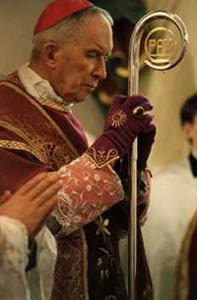
The bishop must steadily move between altar, pulpit and confessional in order to be a true pastor of souls. May the devil take the conferences and committees.
Reflection on the Jubilee of Mercy
A call to mercy that is not focused on the stripes of the Sacred Humanity is a call to moral indifference.
Reblog: On The Papal Canonisations. Neo Catholic Triumphalism.
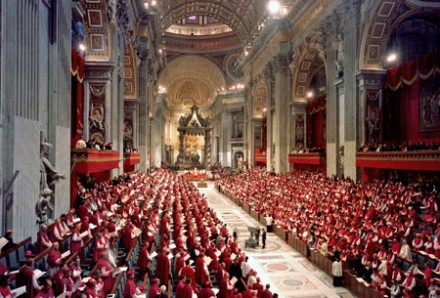
It has been announced that Pope Paul VI, of unhappy memory, is to be beatified at the close of the Synod of the Family in October. One may ask why the rush to canonize three recent popes, is it the case that their value of models of holiness will diminish with the passing of the ages? Or is it that with the sober judgement of time these men will appear to be no more than adequate as Roman Pontiffs and more probably, less than suitable for the heroic task of the papacy?
I will say rather clearly that this set of ill-thought out and rushed canonizations has nothing at all to do with the men themselves. Apart from the case of Pope John Paul II, there has been little attempt to highlight and proclaim the great holiness of either John XXIII or Paul VI. Who has relate their heroic virtues? Are they worthy models of imitation for Christians? Who could possibly know as even the proponents of their raising to the altars are at a loss to explain exactly why they are deserving of this great honour. I set aside consideration of John Paul II as at least his firm faith and hope during tremendous suffering could be imputed to him as great virtue combined with his lively sense of piety.
These canonizations have nothing to do with the men themselves. They are pawns in the defense of a crumbling council. The council needs defenders. It needs canonization. What fruit of the Council can be detected? A vernacular liturgy that few attends? A new priesthood that men shy away from? A theology that is no more than sentimental mush that ill prepares even the keenest of intellect to defend the Faith against even the dullest of detractors? Point out to me a fruit of the Council and I will reply that it is laced with poison. The Roman Rite? Trivialised. Theology? Sentimentalised and no more than sentimental anthropology. Vocations? Few. Catholic nations? Just as atheistic and socialist as any other land. The popes travel, the popes wave, the crowd cheers...the crowd return home and live etsi Deus non daretur.
Would not one expect the Church to have canonized the various popes that were involved in the Council of Trent and those who strove to implement it? Frankly speaking, few of them were worth it. If we are to ascribe to the Bishop of Rome, supreme, universal and immediate jurisdiction over the whole Bride of Christ are we not to demand great holiness, wisdom and fortitude in exercising the petrine ministry? The faithful of those ages should have been even more triumphalistic about their Pontiffs considering the danger of the Reformation and the Protestants attack on the institution of the papacy. Yet, they wisely avoided this further danger. The vast majority of Roman Pontiffs have been no more than adequate. Plenty have been utter scoundrels and rascals who divided the garments of Christ among them for their own personal good. The traditionalist is not embarrassed by these scandals. Our Blessed Lord did not promise that Peter himself would never fall. All too often the popes have occupied the throne of Satan instead. On the other hand, great men have been chosen to succeed Peter and have dutifully carried out their mission with rectitude and courage. Where is the clamouring for the canonization of the superb Leo XIII? Or the much forgotten Benedict XV? The fate of souls was too pressing a matter for those involved in the Counter Reformation to divinize the Council of Trent and avert their eyes to the misery of heresy and schism. At least this sixteenth century Council produced great art and architecture? The Second Vatican Council? No more than the modernistic Scandinavian ''spaceship'' that is my local parish.
We are to raise three men to the altars, yet where have the men gone? The Faith proclaimed by these men has proven so ineffective to the evangelization and retention of young Catholic men who have therefore found solace in practical agnosticism at best. Where are the young men who will offer the Holy Sacrifice, who will raise families in the face of hostile secularism, who will teach boys to be men? These three pontiffs were more than negligent in presenting the Catholic Faith of the ages to these souls. The militancy of the baptised soul was to be purged in favour of a spirit of vain dialogue that has only created indifferentism and has made secular humanism the pinacle of moral consciousness. The Church seeks only a place at the table of discussion. She seeks fairest and an opportunity to speak in her turn. What a pathetic institution that these men have presided over! The bishops may be criticised but the popes? The popes who are of the same mould as their brother bishops are to be immune from criticism even when the same guilt belongs to them for the same acts and omissions!
Paul VI, a wretched, indecisive figure, divested himself of the papal tiara and in turn abrogated the kingship of Christ. Where in our Lord acknowledged? In the inter religious meetings? At Assisi? Certainly not before journalists where Francis refused to bless them in the Name of the Trinity, 'respectando la conciencia de cada uno''. Even a third rate sociologist appraising the numbers of the faithful who attend Mass, who can articulate a modicum of the Faith, the size and health of families and the state of such Catholic nations as Spain, Italy, Portugal and Brazil, can see that the Council failed in almost every aspect.
The Neo-Catholic can only demand fidelity and ''obedience''. He is entirely incapable of defending the Faith in the light of tradition. It is contrary to the spirit and greatness of the Fathers and Doctors to angrily assert ''The magisterium holds such and such, believe it or you're disobedient!'' Did not these great men of old labour earnestly to explain the Faith suitably so that the doubters and deniers could reach an understanding of the mysteries of faith or the philosophical underpinnings of it? No such effort is considered by these apologists. Threats of suspension, excommunication and of being ''uncharitable'' are their stock in trade.
I await eagerly a true explanation of the the continuity of the Council with immemorial tradition, especially in the areas of religious liberty and ecumenism. There is nothing to be triumphalistic about in these matters. Millions of souls have perished due to the effects of the Council, whether the 'real' one or the virtual Council that Benedict XVI recently spoke about.
When facts are of little use, cries of ''disobedience!'' resound. Let the Neo-Catholic consider why we need a New Evangelization if the Council were not a complete failure? To them, it appears the New Evangelization is nothing more than a new buzz phrase which allows them to consider themselves faithful to the latest pontiff.
It is urgent that we realise the damage of the Council. Even if we are to hold that the Council has not been implemented correctly, are we to state that the Pontiffs were not involved in this ''bastardization'' of the Council? Were they not the ones who promoted and tolerated every novelty, heresy and extravagance? It is their Council and their implementation, their souls must mirror it.
Sunday, 15 March 2015
Reblog: On Criticism of Pope Francis

It will not do to confer universal dominion on the Vicar of Christ and deny him responsibility for anything. The episcopal order is of divine origin and must not be considered to be mere delegates of a neglectful pope. He can not dispense with them, in justice, at his leisure, be vindictive in suppressing them, nor can he shelter himself from criticism at their expense. This latter point appears to be the methodology of Michael Voris, where he is conscious of it or not. Our Church Militant TV friend may rightly blast the bishops of being faithless, effeminate, cowardly, enamoured of the media spotlight, but they are merely in the mould of the former Jorge Mario Bergoglio. I would certainly like to discover Voris' opinion of that former cardinal archbishop of Buenos Aires and the sham of a Catholic territory he left behind.
With such visibility that modern technology provides, foolish, unguarded words by a pope can cause immense damage and confusion, particularly when they are recklessly uttered by a man who appears to have arrived in the Eternal City unscathed by any notion of sound theology. Doesn't Voris ridicule Cardinal Dolan, who plays the buffoon before Meet the Press? Yet, who has greater popularity among the media and metropolitan elite than the pope himself? Who has prostituted themselves more to opinion formers and hack activist journalists? It is an act of great injustice to bypass the pope and lay blistering blame on the Cardinal Archbishop of New York for doing what would please the soul of Francis. He will no judged no more harshly than Bergoglio.
Let the Faith be upheld, preserved and handed on. Let God be glorified and the pope will save his soul and a multitude of his children.
Let the Faith be upheld, preserved and handed on. Let God be glorified and the pope will save his soul and a multitude of his children.
Perhaps it was better when technology was as limited as the lifespan of the pontiffs? Perhaps we were more fortunate when the popes wouldn't travel much further than St Paul Outside the Walls?
Let the pope be the pope. Let him speak like the pope, dress like the pope, teach like the pope, sanctify and govern like the pope. His personality is no more than straw.
Saturday, 14 March 2015
Reflection on Prayer

(St. John of the Cross)
In prayer, it is not that we persuade God to act but rather He swiftly moves our will to His.
Reflection on Interior Humility
The truly humble man is oblivious to his wearing of red shoes.
Wednesday, 11 March 2015
Reflection on Spiritual Progress

Advancement in the spiritual life will come when the soul learns to love God Himself more than the consolations He supplies.
Friday, 6 March 2015
Reflection on Charity
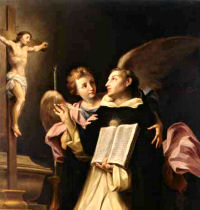
(St. Thomas Aquinas)
Charity, the bond of perfection, quickens us to the One we already possess. Such is the beginning of eternal life.
Theological note: Properly speaking, sanctifying grace as the formal and actual participation in the divine nature is the possession of eternal life. It is for this reason that it is known as the semen gloriae. We must be careful not to confound charity with sanctifying grace as the former resides in the faculty of the will while the former is a habitual quality that permeates the essence of the soul. This actualises the obediential capacity of the soul for the supernatural. Nevertheless, no man can attain to God who has fallen away from charity which unites man to his proper end, namely God. Sinning against charity ipso facto, destroys habitual grace. Conversely the man who loves God above all, possesses this incalculable treasure within him.
Saturday, 28 February 2015
Reflection on Godless Morality
Behaving well without reference to God may suffice to keep one out of trouble but it will hardly lead one to moral perfection.
Tuesday, 24 February 2015
Latin Doctor Quote of the Day - St. Robert Bellarmine on Prayer

(St Robert Bellarmine)
First prayer enlightens the mind. For man cannot intently fix the eye of the mind upon God who is light and not be enlightened by Him. ''Come to Him,'' says David, ''and be enlightened'' (Ps 33:6). Second, prayer nourishes faith and trust. For the more frequently one converses with another, the more confidently he approaches him. Third, prayer kindles love and prepares the mind to receive greater gifts, as St. Augustine says. Fourth, prayer increases humility and holy fear. For one coming to prayer realises he is a beggar before God and, as a result, usually stands more humbly before Him. And one who needs God's help in all things is most careful to avoid offending Him. Fifth, frequent prayer leads to a contempt for all temporal things in the heart of one who prays. For all earthly things inevitably become cheap and soiled for one who steadily gazes upon things heavenly and eternal, as St. Augustine shows in book nine of the Confessions. Sixth, prayer brings forth an incredible delight since by its mean a man begins to taste the sweetness of the Lord. The greatness of his sweetness can be grasped from the fact that we know that some have not only spent whole nights, but were even able to spend whole days and whole nights without effort. Finally, besides its usefulness and pleasure prayer also confers upon one who prays no small dignity and honour. Even the angels honour the soul they see so readily and so frequently admitted to converse with the divine Majesty'' - The Art of Dying Well
Comment: The prayer of the just man is in some sense the continuation of his adoration at the Altar. The acceptable oblation is one made in humility before the Father of our Lord Jesus Christ as the Latter offered on the Cross. If we so define the Christian life as the configuration of the justified man to the likeness of His Saviour, should we not imitate the virtues and example of Jesus in every instant? He who spent whole nights in prayer and in the most intimate union of love with His Heavenly Father. How are we to be moulded into the likeness of the Word made flesh, unto the renewal of our minds, if the Archetype is completely absent from our desires? How are we to come to know Him? Through prayer. Through simplicity and humility before God. Through asking for His continual pardon and conferring of grace. All this and more shall not be denied to the man who approaches God. After all, who could deny that such a holy work could be performed without the sweet motion of efficient grace?
His Divine Majesty does not tire in blessing and showing mercy to the ones He calls to seek His face. Who can be saved? The man who prays. A slothful and negligent soul who tires of prayer is a sure sign of reprobation.
Saturday, 21 February 2015
Reflection on the Action of the Holy Spirit
Docility to the inspirations of the Holy Ghost confers the greatest of activity.
Reflection on Populism
The populist is like the man who has read a thousand books and has not understood a single line of them. A concatenation of phrases does not confer eloquence nor insight.
Wednesday, 18 February 2015
Reflection on the Spiritual Life
By the theological virtues we are raised, rooted and directed to our end. By the infused virtues we are quickened and guarded towards It. The Beatific Vision is the culmination and flourishing of the seed of glory granted by our baptism.
Saturday, 14 February 2015
Reflection on War and Peace
Pacifism proceeds from no stronger felt principle than contented indifference.
Reflection on Altar Girls
The right to serve at the altar is curtailed not so much by one's sex but rather as the co-essential condition of being created. Mankind has no right of its own order to approach the sanctuary due to
the fundamental distinction between nature and grace. If our Lord elects only males upon whom to bestow certain favours, who is a creature to clamour over "discrimination"? He can dispense with his own gifts at His good pleasure.
the fundamental distinction between nature and grace. If our Lord elects only males upon whom to bestow certain favours, who is a creature to clamour over "discrimination"? He can dispense with his own gifts at His good pleasure.
Monday, 2 February 2015
On Neo Conservatism

A self-described conservative who accepts the principles of the Revolution is no more than a dim-witted liberal. He has ushered in the Turk at the gates.
Wednesday, 21 January 2015
Reflection on the Passion of Christ
While His blood cries out to heaven for vengeance, His wounds plead to the Father for mercy.
Saturday, 17 January 2015
Reflection on the Far Right
When the radical left proclaims itself as moderate, the man of common sense can only be considered as an extremist.
Friday, 16 January 2015
Reflection on "Corporate Greed"
It should be openly noted that liberal condemnation of "corporate greed" does not extend its reach to the self-promoting oligarchy of Hollywood. Mutual mores must militate against many morals.
Sunday, 11 January 2015
Reflection on Animal Rights
The animal rights movement does not derive from some long overdue estimation of the true nature of brute beasts but rather from a depreciation in the understanding of humanity. When all is attributable to matter, specification gives way to degree.
Tuesday, 6 January 2015
''On the Amorality of Atheism/Agnosticism''
Such is the logical consequences of agnosticism as regards the duties more properly called religious. Its logical effects on the observance of the moral law are also fatal. We maintain that in the great mass of mankind, were agnosticism ever universally accepted, its effect, moral and social, would be most pernicious. Individuals of the average human type canna machine madof matterot lose the belief in an all-seeing and infinitely holy and just God without being exposed to commit many crimes which they would not have committed if they had not persevered in that belief. If God does not exist, no one is able to point out any sufficient principle of morality, which he can prove that man is absolutely bound to abide by. Of course certain actions will be more becoming than others, because more suited to rational nature. If a man is a man of good taste he will so far forth abide by these actions and abstain from their opposites. But suppose he does not care to be a man of taste, what is to oblige him to it? On that supposition, no one has a right to blame his fellow-man for enjoying life as he sees fit. What is man, if you take God away? What else but a machine made of matter, held together by material forces? What shall oblige me to have more respect for that machine called man, than for another called ox or sheep or monkey, which anatomy proves to be constructed on quite a similar plan and to be made of the same organic elements? Why is it a greater crime to destroy a man-machine than to destroy a monkey-machine? Unless there is an immaterial Divine Spirit, there cannot possibly be an immaterial human soul, and if there is not an immaterial human soul, our so-called freedom of will is an illusion. But if our freedom is an illusion, moral responsibility is an empty name, and if that is an empty name, nobody is to be blamed, however erroneous may be the misdeeds by which, in the opinion of men, he sins against the dignity, as it is called, of man. These and the like are the practical lessons which logically follow from agnosticism. How can they be put into practice without giving free rein to the most revolting vices in the mass of men? - Natural Theology, Bernard Boedder S.J.
Reflection on Political Correctness
The most deleterious aspect of political correctness is that every degenerate and any kook may claim moral superiority over the honest man.
Saturday, 3 January 2015
Reflection on the Intellectual Life

The study should be the soul's portal to eternity. The mind should neither be listless nor harried. Alive but never busy. The flight into solitude should never be the refuge of the irritable and sullen soul. Communion is to be its sole aim, communion of the mind with truth and reality. The study is the home of the ages.
Sunday, 28 December 2014
Reflection on the Mosaic Law and the Sacraments
The Law of Old could only signify and foretell the grace in the bosom of the Father that was to be conferred unto sanctification by the Passion of the Incarnate Logos.
Friday, 26 December 2014
Reflection on the Mother of God

The honouring and exaltation of the Mother of God is the surest safeguarding of the dignity and unity of the Person of Christ.
Wednesday, 24 December 2014
Reflection on Egalitarianism
A nation that permits its peasants to hang their king would happily hang a thousand peasants more.
Monday, 22 December 2014
Reflection on Family Life
The homophiles and the gender theorists have merely progressed the decay of family life that the divorced and the selfish began to pervert many years before. The radical cause of all division is the prideful separation of man from God.
Sunday, 14 December 2014
Reflection on Gratia Christi
There is no grace which may make man pleasing to God or to increase him in holiness that does not proceed from the merits of Christ and His Passion. There can no be just community of mankind before God other than through Christ our Lord.
Sunday, 7 December 2014
Reflection on Deism
The apparently rational proposition of Deism is fundamentally opposed to the simple and necessary philosophical principle of a real distinction between act and potency. Deism may account for a being's production but not its conservation in being. Without the latter, all logical force of the former is incoherent.
Tuesday, 2 December 2014
Reflection on the Evangelization of Pope Francis

A faithful and fruitful approach to evangelization is to bring man to his knees. It appears that the method of the current Sovereign Pontiff is to drag God to His knees in the interests of accommodation to obstinate man. The majesty of God is contemptible to the sinner who wishes to remain so, we must therefore dethrone our Lord to placate our bristling conscience.
The Divine Trinity as the Summit and Source of Beauty
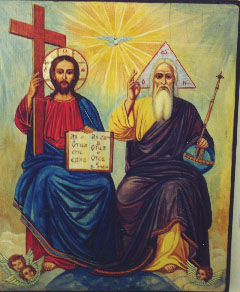
I leave the following for your fruitful meditation without further comment.
The Divine Beauty shines most perfectly and sublimely in the Blessed Trinity, which is the highest development of Divine perfection; in It we can easily detect all the elements of beauty, viz, unity and multiplicity, the splendour of perfection and life, the resemblance of the image to the ideal or prototype. In fact, there is no greater unity in multiplicity than the perfect identity of the Three Divine Persons; no more perfect unfolding of essential perfection and life than the trinity fecundity in God, wherein the whole Divine Essence is communicated - the whole wisdom of the Father uttered in His Word, the whole love of the Father and the Son poured forth in the Holy Ghost; and there is no greater resemblance of any image to its prototype, than the resemblance of the Divine Word to the Eternal Father. By appropriation, beauty is especially attributed to God the Son, because He is the splendour of the glory of the Father, the perfect expression of the Divine perfection.'' A Manual of Catholic Theology, Volume I, Based on Scheeben's ''Dogmatik''
Reflection on Divine Faith
A multitude of natural acts, whether they form empires or shake them, whether they produce fruit of enduring and laudable proportions or whether they obtain the progression of all mankind are to be regarded as straw in comparison with one supernatural act of Faith.
Sunday, 30 November 2014
On Christ Our Saviour
''The only begotten Son of God...''whom God made our wisdom, our righteousness and sanctification and redemption (1 Cor 1:30), ''entered once for all into the Holy Place, taking not the blood of goats and calves but His own blood, thus securing an eternal redemption'' (Heb 9:12). For ''you were ransomed...,, not with perishable things such as silver or gold, but with the precious blood of Christ, like that of a lamb without blemish or spot'' (1 Pet 1:18f). Immolated on the altar of the Cross though He was innocent, He shed not merely a drop of His blood - although this would have sufficed for the redemption of the whole human race because of the union of the Word - but a copious flood, like a stream, so that ''from the sole of the foot even to the head, there was no soundness in Him'' (Is 1:6).
What a great treasure, then, has the good Father acquired for the Church Militant, if the merciful shedding of blood is not to be empty, meaningless, and superfluous. He wanted to lay it up for His children, so that there might be ''an unfailing treasure for men; those who get it obtain friendship with God'' (Wis 7:14) - Pope Clement VI, Unigenitus Dei Filius.
Here follows Scholasticism without the expected systematisation.
It is from this bull of 1343 that I proceed on a short theological treatise consistent with the mind of the Angelic Doctor on De Christo Salvatore. The bull itself is a justification of the legitimacy of the offering of indulgences, but let it not be thought that this point of departure is a an opportune twisting of the sense of the document. The treasury of merits belongs to the Body of Christ due to the abundant satisfaction of Christ the Head and only from that. Incidentally I have elected to comment upon this text due to my recent study of the popes residing in Avignon. Clement VI was probably the most interesting of the seven, vivacious, pleasure loving, a connoisseur of fine wine, admirer of sublime architecture and the man who bought Avignon for 80,000 gold florins from Queen Joanna of Naples.
The suppositum is the ultimate subject of attribution. The person, the hypostasis, is the foundation of all activities which proceed from it as from an agent. It is from this principle that we can appreciate the sufficiency and superabundance of Christ's atonement for man's sins. The importance of the Chalcedonian definition manifests itself clearly in the necessity for a ''hypostatic union'', that is, an union in the Person.As regards a moral union as posited by such as Nestorius, there would be no true unified act whereby the divine would supply the defect and the human would contribute to its own restoration. The intrinsic efficacy and validity of the sacrificial act of Christ depends essentially on the hypostatic union, whereby the divine Word assumed to Himself, a particular human nature to terminate it and grant it existence. There was never a time when this human nature possessed a personality of its own, even though with a fully formed soul and physical body nothing was lacking for it. Rather in this singular case, this human nature found its highest perfection in being taking up into the divine personality. It is good to exist according to one's own nature; it is more excellent to be elevated to what is superior. As per Cajetan, personality is a substantial mode which terminates a singular nature so that it may become the immediately capable of existence.
The human nature of Christ is not to be overlooked as though He only took on the semblance of humanity or rather that the created nature was swallowed up in the divinity. Such would be contrary to the decree of Chalcedon and the tome of Leo. The human nature truly belongs to Chirst (and remains so at the right hand of the Father) and is the highest degree of predestination that God has decreed by His ordinary power. If it were not for the assumed nature, man would not be redeemed. As St. Athanasius never tired of proclaimed, what is not assumed is not healed. The Divine Person certainly is the agent of all acts, yet He performs vitally human acts in virtue of His humanity. Man is saved due to being consubstantial with the Word who offers Himself as a ransom for the debt incurred by His brothers.
Let us now more explicitly consider why this act of sacrifice was more than sufficient for our salvation. The Father's love for His only begotten Son is exceedingly spontaneous and loves Him who proceeded from Him with an ineffable love. The Son is the perfect image and likeness of the Father and is begotten by means of intellectual generation. Since it was through the Word that the world was brought into being, so it is eminently fitting that it should be through the Word that the world be restored to God. The offering of Christ, which is ultimately the sacrifice of the Divine Son who subsists in this assumed human nature is abundantly pleasing to the Father who possesses the numerically identical divine nature. Merit proceeds from charity, and there is no greater charity than that which proceeds from the divine Person. Christ's human will in intimate subjection to the divine will, never wavered in its assent to the mission of redemption. The dignity of the one making reparation is essential to its acceptance by the one offender. In this case, our High Priest offers His charity for the Father and for mankind to that same Father who is pleased to accept it as sufficient (and more than sufficient on our behalf). The merit of Christ is condign which is a strict equivalence between the act and the reward to be bestowed. The merits of any creature, even of the Blessed Virgin, are to be no more than congruous which is consequence upon (at least the foreseeing) of the satisfaction of Christ, proceeding from the friendship or liberality of God.
It is to be stated that mortal sin is an infinite offence against God. Some may consider this troublesome as surely a created act can in no way be viewed as infinite. On the part of the act itself subjectively, I concede, on the part of the offended, I deny. An absolute negation is a greater offence than a truth stated inadequately. A genuflection to the emperor is his due and is of slight note compared to his dignity, a boxing of his ears is an outrage. To deny God His due majesty is a most grave sin and is infinitely greater than a thousand praises when many more are demanded because of His glory.
In man, an intellectual conception of himself is always accidental, insufficient and usually provisional. In God, the divine word is the adequate and substantial conception of the godhead. The divine nature is fully generated without diminution or numeral division. From this eternal begetting of the Son proceeds the future merits of the Incarnate Christ. Due to this, no creature, however elevated (outwith the hypostatic union) could possibly perform an act which is proportionate to the offence to be atoned for.
The merest suffering of Christ would be sufficient for our redemption as it is a true theandric act, that is, an offering made by the divine Word. It was not absolutely necessary for Christ to undergo death but such was His great love for us that He did not shun the ignominy of the Cross. Christ could not increase in virtue, merit or perfection as though His final act were intrinsically of greater sufficiency than the first moment of His conception. Merit proceeding from charity, becomes satisfaction when combined with suffering. Infinite charity in suffering satisfies infinitely.
Thursday, 27 November 2014
Reflection on the Necessity of the Church

As the revelation of Christ was to be public and enduring it is eminently fitting that He should institute a visible teaching authority to maintain His mission until the consummation of the world. His guarantees to the Apostolate prevents His life giving blood from decaying on the barren wood.
Saturday, 22 November 2014
Reflection on the Renaissance Papacy
If one could reproach the Renaissance papacy it would not be for it being too medieval but rather for being too modern. The overwhelming interest in secular pursuits, sex, reputation, greed and good food, what else would be needed to make the modernist mind merry?
Note: As I am reading about the papal self-imposed dwelling at Avignon, I considered that this deserved a repost. I had originally written it about Borgia and company, yet it equally applies to Bertrand Got and his hapless successors, perhaps excepting Jacques Fournier (of decent memory).
Reflection on Progress and Capitalism
An accumulation of commodities makes neither a community nor a civilisation.
Saturday, 15 November 2014
Thursday, 13 November 2014
Latin Doctor Quote of the Day - Our Redemption in the Thought of St Anselm of Canterbury
St Anselm of Canterbury.
''On the basis of these considerations it is easy to recognise, that with regard to the nature of mankind, there are two alternatives; either God will complete what He has begun, or it was to no avail that He created this life-form - so sublime a life-form, and with such great good as its purpose. But, if it is recognised that God has made nothing more precious than rational nature, whose intended purpose is that it should rejoice in Him, it is utterly foreign to Him to allow any rational type of creature to perish utterly.'' - Cur Deus Homo (Why God Became Man)
Comment:
We are here discussing the fittingness of our redemption in lieu of its necessity. God is under no obligation, whether metaphysical or moral to effect our salvation. He would be neither less wise or less good if He abandoned man to his own willing guilt. His proffering of salvation is entirely gratuitousness and is based solely on His own good pleasure and mercy. For certain, He would have remained the Supreme Good even it He had never uttered the creative words, ''Fiat Lux''.
The only 'necessity' that God incurs in His (logical) relation to creation is the binding He freely undertakes by promising to man His forgiveness which is assured for all eternity. He has bound Himself to man by His own decree of mercy.
It is with this in mind that we acknowledge the fittingness of God redeeming man, the microcosm of creation. Man may be said to be, pardon any excess, the summation of creation, inasmuch as he unites matter which does not remain dumb but is almost ''deified'' by its assumption by the intellectual soul which informs it. As we know adequate species of the angels were confirmed in good and attained their beatitude. The mineral and animal kingdoms are to give glory by their existence. What could we say of man if he was permitted to remain in his own guilt, far from salvation, with a rational will utterly enslaved to a perverse sensual appetite? It could be said that the condemned human race would present an unseemly obstacle to the integrity of the hierarchy of creation.
In addition, our redemption is not merely the resumption of a just order, but more gloriously, the elevation of human nature to the divine. God's nature is the radical principle of His knowledge and love and in accordance with this, by our formal and actual participation in the divine nature, we come to know and love God as He is in Himself as the Author of grace which surpasses the realm of what is due to nature.
''On the basis of these considerations it is easy to recognise, that with regard to the nature of mankind, there are two alternatives; either God will complete what He has begun, or it was to no avail that He created this life-form - so sublime a life-form, and with such great good as its purpose. But, if it is recognised that God has made nothing more precious than rational nature, whose intended purpose is that it should rejoice in Him, it is utterly foreign to Him to allow any rational type of creature to perish utterly.'' - Cur Deus Homo (Why God Became Man)
Comment:
We are here discussing the fittingness of our redemption in lieu of its necessity. God is under no obligation, whether metaphysical or moral to effect our salvation. He would be neither less wise or less good if He abandoned man to his own willing guilt. His proffering of salvation is entirely gratuitousness and is based solely on His own good pleasure and mercy. For certain, He would have remained the Supreme Good even it He had never uttered the creative words, ''Fiat Lux''.
The only 'necessity' that God incurs in His (logical) relation to creation is the binding He freely undertakes by promising to man His forgiveness which is assured for all eternity. He has bound Himself to man by His own decree of mercy.
It is with this in mind that we acknowledge the fittingness of God redeeming man, the microcosm of creation. Man may be said to be, pardon any excess, the summation of creation, inasmuch as he unites matter which does not remain dumb but is almost ''deified'' by its assumption by the intellectual soul which informs it. As we know adequate species of the angels were confirmed in good and attained their beatitude. The mineral and animal kingdoms are to give glory by their existence. What could we say of man if he was permitted to remain in his own guilt, far from salvation, with a rational will utterly enslaved to a perverse sensual appetite? It could be said that the condemned human race would present an unseemly obstacle to the integrity of the hierarchy of creation.
In addition, our redemption is not merely the resumption of a just order, but more gloriously, the elevation of human nature to the divine. God's nature is the radical principle of His knowledge and love and in accordance with this, by our formal and actual participation in the divine nature, we come to know and love God as He is in Himself as the Author of grace which surpasses the realm of what is due to nature.
Sunday, 9 November 2014
Reflection on Freedom
You must liberate yourself from the notion that freedom positively presupposes the necessary capacity to sin. It is true, however, that psychological freedom is the sine qua non condition of sin. Otherwise the impeccability of God would eternally determine Him to be an unhappy slave to His nature.
Saturday, 1 November 2014
Latin Doctor Quote of the Day - St Bonaventure on the Beauty of Creation
_-_Saint_Bonaventure.jpg)
Whoever wishes to ascend to God must first avoid sin, which deforms our nature, then exercise his natural powers mentioned above: by praying, to receive restoring grace; by a good life, to receive purifying grace; my meditating, to receive illuminating knowledge; and by contemplating, to receive perfecting wisdom. Just as no one comes to wisdom except through grace, justice and knowledge, so no one comes to contemplation except by penetrating meditation, a holy life and devout prayer. Since grace is the foundation of the rectitude of the will and of the penetrating light of reason, we must first pray, then live holy lives and thirdly concentrate our attention upon the reflections of truth. By concentrating there, we must ascend step by step until we reach the height of the mountain where the God of gods is seen in Sion (PS 83:8).
Since we must ascend Jacob's ladder before we descend it, let us place our first step in the ascent at the bottom, presenting to ourselves the whole material world as a mirror through which we may pass over to God, the supreme Craftsman. Thus we shall be true Hebrews passing over from Egypt to the land promised to their fathers (Exod. 13:3ff); we shall be also be Christians passing over with Christ from this world to the Father (John 13:1); we shall be lovers of wisdom, which calls to us says: Pass over to me all who long for me and be filled with my fruits (Ecclus. 24:26). For from the greatness and beauty of created things, their Creator can be seen and known. - St Bonaventure, ''The Soul's Journey into God''
Comment:
What is creation other than the external and often physical manifestation of the inherent beauty and majesty of the Godhead? Consider the divers beings of various orders that exist, move, breath, speak, sing or shine. A single creature could not adequately manifest the plenitude of perfection that God is, and even a whole universe of beings could not exhaust His greatness. Considering even natural beauty should be enough to cause us to marvel at the goodness of God expressed in created reality in even such a finite way. All are glimmers and reflections of that infinite glory that is entirely sufficient and self-subsisting. The sinner who is enthralled by pleasures proceeding from nature does not love nature enough. He does not glimpse the Author and Sustainer who is infinitely fecund in His being and goodness. All may be dust before Him but all is gold because of Him. The saint does not consider creation to be a threat to his soul if all he sees is the divine traces of love and mercy in all that is visible.
Friday, 31 October 2014
On Criticising the Pope - The Remnant and Church Militant TV
It will not do to confer universal dominion on the Vicar of Christ and deny him responsibility for anything. The episcopal order is of divine origin and must not be considered to be mere delegates of a neglectful pope. He can not dispense with them, in justice, at his leisure, be vindictive in suppressing them, nor can he shelter himself from criticism at their expense. This latter point appears to be the methodology of Michael Voris, where he is conscious of it or not. Our Church Militant TV friend may rightly blast the bishops of being faithless, effeminate, cowardly, enamoured of the media spotlight, but they are merely in the mould of the former Jorge Mario Bergoglio. I would certainly like to discover Voris' opinion of that former cardinal archbishop of Buenos Aires and the sham of a Catholic territory he left behind.
With such visibility that modern technology provides, foolish, unguarded words by a pope can cause immense damage and confusion, particularly when they are recklessly uttered by a man who appears to have arrived in the Eternal City unscathed by any notion of sound theology. Doesn't Voris ridicule Cardinal Dolan, who plays the buffoon before Meet the Press? Yet, who has greater popularity among the media and metropolitan elite than the pope himself? Who has prostituted themselves more to opinion formers and hack activist journalists? It is an act of great injustice to bypass the pope and lay blistering blame on the Cardinal Archbishop of New York for doing what would please the soul of Francis. He will no judged no more harshly than Bergoglio.
Let the Faith be upheld, preserved and handed on. Let God be glorified and the pope will save his soul and a multitude of his children.
Let the Faith be upheld, preserved and handed on. Let God be glorified and the pope will save his soul and a multitude of his children.
Perhaps it was better when technology was as limited as the lifespan of the pontiffs? Perhaps we were more fortunate when the popes wouldn't travel much further than St Paul Outside the Walls?
Let the pope be the pope. Let him speak like the pope, dress like the pope, teach like the pope, sanctify and govern like the pope. His personality is no more than straw.
Latin Doctor Quote of the Day - St. Ambrose on Confession

''They affirm that they are showing great reverence for God, to Whom alone they reserve the power of forgiving sins. But in truth none do Him greater injury than they who choose to prune His commandments and reject the office entrusted to them. For inasmuch as the Lord Jesus Himself said in the Gospel:
Receive the Holy Spirit: whosesoever sins you forgive they are forgiven unto them, and whosesoeversins you retain, they are retained,John 20:22-23 who is it that honours Him most, he who obeys His bidding or he who rejects it?'' (On Repentence 6)
Gloss: It pertains to the Church of Christ to perpetuate the Incarnation of her divine founder. Our Lord descended as Saviour, the formal motive of which was mercy for miserable man in view of the ultimate end of manifesting the goodness of God. If man were to remain just and in the state of innocence, the Word would not have become flesh. Jesus did not constitute a community to merely call to mind His deeds but rather to apply the merit of those deeds to divers men throughout all nations. Satisfaction and reconciliation were the purpose of the Incarnation and this end is to be pursued in the Catholic Church until the Day of Judgement. The infinitely worthy sacrifice of the altar and the reconciliation of penitents are the two chiefs functions of the priests of our Lord, all else is secondary. The divine sending of the Apostles and their successors and collaborators is urgent and admits of no delay. Who are we to deny the commission of our Lord to men and consider this to uphold the divine majesty? What great power and dignity He has conferred upon His priests to apply to needful man today what Christ obtained for us under the sentence of Pilate?
Reflection on the Papal Tiara

The day Paul VI abdicated the tiara, he crowned the papal personality. The Vicar of Christ is no longer a force inasmuch as he is the Vicar of Christ but inasmuch as he is a captivating figure of seeming modernity. And this will always be perched uneasily upon the head of Peter.
Cajetan on the Hypostatic Union

Considering the mode of union in the Person instead of in the nature
''The reply is confirmed by the reason of the fact...that the union of the human nature in the mystery of the Incarnation does not add anything to the meaning of nature, but it does indeed add something to the notion of person, because it adds the notion of subsisting in the human nature...Just as it is nobler for the sensitive life to have its complete specific nature by a form of a nobler order, namely, by the rational soul, so a greater dignity was bestowed upon the human nature of Christ from the fact that it was assumed by the divine personality'' - Cardinal Thomas Cajetan
Monday, 20 October 2014
Reflection on the Church and the Modern World
Even if the Church were to be reduced to a single low Mass she would still triumph over the "modern" world.
Sunday, 19 October 2014
Reflection on the Synod on the Family
The Church has all too often abandoned dogmatic certainly in favour of a waffling and banal "spirituality" as a self-conceited profundity. When a synod makes no attempt to unite itself with Scripture, the Fathers, the Doctors and the General Council, you are confronted with a modernist sham. Contempt of Tradition is the hallmark of all wreckers of order and justice.
Sunday, 12 October 2014
Reflection on Forgiveness and the Cross of Christ
Even if a flood of sins were to obtain incessantly throughout a lifetime comparable to that of Methusalah, it still would not be worth the smallest drop of blood shed by Christ on Calvary.
Friday, 3 October 2014
Reflection on ISIS and Beheadings
It belongs to a shallow mind to use "medieval" as a pejorative. Parliaments are medieval. The universities are medieval. The Magna Carta is medieval. On the other hand, beheadings are very much modern. After all it was from the guillotine that the "civilised" and "enlightened" world sprang.
Saturday, 20 September 2014
Reflection on Celibacy
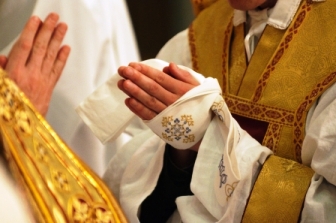
Sacerdotal celibacy is founded on no mere expediency of availability but rather from a worthiness to stand in the Person of the High Priest to offer the unblemished Victim. The offering is heavenly and so much be his delight.
Reflection on History
The Catholic can have no contempt for history and tradition as his worldview should be essentially sacramental. The action of God pervades the material and communicates meaning to it. He has overseen the course of all human history with as fatherly care in less "refined" ages as He continues to bestow now. He is the same yesterday, today and forever.
Reflection on Equality and Autocracy

The abolition of all social and economic distinctions can only be obtained through a totalitarian regime that would assume in itself all the former privileges, in the interests of fairness after all.
Friday, 19 September 2014
On Naturalism and Moral Matters: Against the National Catholic Reporter

http://ncronline.org/blogs/grace-margins/synod-family-and-grace-self-doubt
Such people are insufferable. More tolerance would be afforded these shallow thinkers if they did not possess the audacity to consider themselves Catholics. The death of Catholicism in the public square is quickened by this naturalism posing as mercy and acceptance of every and any deviance that would astonish their own master. A fundamental principle of Catholic theology is the distinction between nature and what is owed to it, and grace which is essentially of the supernatural order. These self-proclaimed saviours of Catholicism are not even capable of grasping the necessity of such a differentiation. On the contrary, they mesh the two realities together in confused fashion, polluting their integrity and perverting man's ends. When one is unable to discern what pertains to man as his due, one is liable to claim that salvation is his right.
There is a primordial error in their attitude towards the Faith whose only existence is to serve as a cultural inheritance or to grant a mushy feeling of goodness or the obligatory niceness. Their faith is a pride in themselves and their ability to overcome the bonds of history, tradition and objectivity. The faith is there to serve as the guarantor of their fabricated reality, a reality sown together by discordant threads of unconscious prejudices, fears and the need for a good fame among the 'respectable'. For them the Faith originates within man (or person, for they hate such ''exclusivity'' of expression), fulfilling his needs and projecting his confused hopes of reassurance and happiness. It is a great wonder that the word most on their lips is ''mercy''. For what do they ask mercy? They proclaim no wrong-doing. A hypocritical superficiality can only request mercy when sin is a construct of history and goodness is a feeling. Surely for someone with a Masters in Divinity, these basic premises of Sacred Theology should be rooted deep in her intellect. Alas, this would be a threat to her security as a happy sinner.
For these people nothing of substance is ever serious, is never urgent. They ascribe transcendental importance to the interpretation of words which would embarrass the worst caricatures of a dialectician of the Schools.Self-doubt in matters of theology is more than heresy, it is utter madness. A desire to consider one's faith as provisional leads to the obvious conclusion that one should never die or sacrifice for this pleasing fantasy. It is for this reason that they only wish to consider the 'diverse experiences' of groups that they have pinned together without any realisation that they are individuals with no more in common than the labels relentlessly applied to them. The love of God is cold in them, it never surpasses a natural and inefficacious complacency in the benevolence of the Lord as manifested in creation and His general providence. God is made in the likeness of man and as man is never settled in his nature, the divine being is infinitely fertile for manipulation.
Man can only obtain a true understanding of moral theology after he has mastered the treatises of De Deo Uno and De Trinitate and de Deo Creatore. All too often moral theology has been reduced to the most banal presentation of civic ethics imaginable. Without a knowledge a man's end, how can he attain to this end? What steps should he take? How will he know when he has reached it? De Christo Salvatore and De Gratia provide the means. However these are intrusions into his secularism, where Faith can only embarrass him among his contemporaries. A hindrance to be snubbed until the all too necessary cliche is required to be recited as evidence of piety and niceness. Your ''own moral discernment'' is founded on nothing other than your progressive acquiescence in sin.
The aim of man is sanctity, not accommodation, nor tolerance nor diversity. If the formal motive for faith is the authority of God revealing, the rejection of elements of it is self-belief and self-deception. Have you noticed that the reasons for abandoning the fullness of faith pertain to the moral? Who leaves the Church for Monothelitism nowadays? But how many will depart for the sake of ''LGBT issues''? This shows the falsity of their position which they claim to be intellectual and rational. The effect of original sin is stronger on those who do not believe in it.
I converted to Catholicism when I was 17 after going through the expected teenage upheavals in matters sexual. A conversion that lead to the bemusement of friends and family, a suspicious respect from some and ridicule of others. Such upheavals were hindrance to my embrace of Catholicism and if I am to abandon my Faith it will be due to that. It is all or nothing. Sanctity or returning to where I was those few years ago. Purity or normalcy. Heaven or Hell. There is no in-between, no accommodation, no middle ground for dialogue. God or Satan.
It is for this reason that Mason and her ilk disgust me. Doesn't the ''average sinner'' deserve to hear the call to holiness or are we to be so condescending to snatch away hope from such unworthy and incapable beings?
Monday, 8 September 2014
My Thoughts on Scottish Independence
This article has been wandering around lost in my mind for quite a few months. In fact I have just taken a few minutes pause after writing that first line to consider what to write next. To be entirely honest, I have no clue how I am going to vote, if at all, on September 18th. The ''arguments'' wielded by either side have left me as they found me, entirely indifferent and sceptical. Maybe I will make the Yes box, maybe I will tick the No box, with good probability I will do nothing and remain at home and channel surf.
I have been rather intrigued about my passivity towards this referendum. If anyone had asked me prior to the bombardment of this cliche ridden campaign, I would have labelled myself a Scottish nationalist. Although to be honest I still do. I have never considered myself British and have only ever felt disgust and irritation at selecting ''Great Britain'' while filling out online registration forms. Yet, my Scottish patriotism does not extend much beyond a general suspicion of the English. It is true that I fought a few times for Scotland as a martial artist however there is no strong feeling either way other than the usual annoyances living in a culture dominated by English and American television and attitudes. I believed that I would have been energised by the campaigns, involving myself in the debates and attempting to convince my friends and colleagues to see the issues as I do. Alas that has not occurred.
Like most matters I consider, they exist entirely as a concept. For someone so pessimistic my idealism, especially of the past, governs my principles of how the world should be. It is for this reason that you may observe to the right of my blog the Cross of Burgundy. My social and political tenets find a natural home in the Carlist movement but my contribution to such initiatives is the odd aphorism and grumbling infront of the television. I am content to scribble down some thoughts and express briefly my mild exasperation at the idiocy of a social commentator who has trotted out the latest platitude in vogue.
The world is certainly wicked and the transformation, nay restoration, is not to be. Original sin has reached its zenith in this generation. The terms of the debate do not appeal to me at all. It is a matter of complete indifference to me if the NHS should be privatised at all. Or if income inequality has breached a tolerable distance. The irascible comments on social media and on television debates show a superficiality that should be mocked. It has not occurred to these stalwarts of the NHS whether such an institution needs scrapped or reworked. Whether the system actually works has not strayed across their radar. They only consider preservation, they are the traditionalists of short memory. What issue is it to me whether London is prosperous as thought by levelling the City to the condition of a sink estate to match our own would be to increase happiness across the board. Yet the cliches and ill judged assumptions will be proclaimed as though the mere mention of them is enough to clinch the debate provided compassionate and socially aware men are present.
Will Scotland prosper outwith the Union of Parliaments? Who knows. That is not the issue. As I saw recently it does appear that as the economic strength of a nation increases so does their degeneracy. I will provide you with one thought to consider. I truly do fear that there will be some socialist takeover of this nation. The influence of the socialist movement is far more than latent in Scotland. In many places it is considered the mark of good taste and compassion. However much I may dislike the political union of this island I will always detest socialism, the plague that ravages the rights of God, of the family and property. It can only promote economic misery and a progressive degeneration of our morals. Such men will seek to enshrine their vices as constitutional principles. We shall see the deification of rights of sodomy, ''marital'' perversity and the removal of all mention of the Faith in the public square. The mush that our archbishops have written betray their all too naturalistic conception of society. They have disgraced their episcopal orders by their promotion of democracy in the 21st century where Catholicism in public is banished. The revolution does eat its own after all. The misery of socialism, the paralysis of trade unionism and the perversity of the sexually uninhibited will rule this land. A wasteland. A land which cries freedom but will soon kowtow to Brussells and Strasbourg.
What is to become of the monarchy? In its current state it is worth no more than a tourist trinket.
Yet how long can we rely on back bench Tory MPs to uphold even vestiges of Christendom when they will abandon all moral principle if they get a whiff of a promise by Cameron of a free vote on fox hunting? In or out, the decline will be steep and the brakes will be cut.
After all what chance will there be of the King over the Water taking any notice?
Subscribe to:
Comments (Atom)