Showing posts with label Reflection. Show all posts

Saturday, 26 July 2014

On The Seventh Sunday After Pentecost


Being, movement and perfection are all under the dominion of the providence of God. No creature, however lowly or however magnificent can remove itself from the intimate and steady hand of Divine Providence.
 The Aristotelian philosophical principle of the real distinction between act and potency is of immense value to us and serves as a great aid to elucidating the divine motion upon all created being. No act, however insignificant can be performed without at least the natural concurrence of God. No agent is unable to rouse itself to movement without the exercise of God's motion upon their natures. Ignoring this truth would reduce all action and change to absurdity where no sufficient external causality could account for an outbreak of direction less transition without purpose. This natural concurrence is due to man's nature  and God owes it to Himself to assist nature as a whole to attain to its purpose as designed and implemented by His liberality in creating everything ex nihilo. This demonstrates that all thought, willing and acting can only be actualised by the consent and motion of God. Let us not confuse this with the higher inspiration of the Holy Ghost, or the formal participation in the divine nature of habitual grace or the transient participation in the same that is actual grace. Grave theological errors have been committed by the lack of due distinction between the orders of grace and nature. Yet gratitude should be shown for both.

 If we were to imagine the possibility of a completely natural state of creation, where Adam has no higher gift of divine life in his soul where his end is the purely nature knowledge and love of God above all things, he would still be utterly dependent upon his Creator for his being and movement. He would have all his faculties untainted by sin and the loss of original justice in grace, where these powers would be directed with rectitude to goodness. Yet after all this he would still require the assistance of God for any movement whatsoever.

 Let us then consider how much more imperative is the grace that is given for man in a fallen world to attain to holiness. We speak here not of general divine motion upon nature to reduce its potentiality to act but grace that is substantially supernatural not just modally. Without grace, the sinner may still be orientated towards universal good as his human nature is not destroyed, and he may attain to knowledge concerning the material world around him, but he is utterly incapable of raising himself beyond this. This is not to say that unfallen Adam could have elevated himself by pure will and discipline to the domain of the supernatural. The human soul has an obediential capacity to participation in the divine life which far excels the proper objects of its faculties yet is not entirely repugnant to its nature.

Oh happy fault that merited us so great a redeemer! With the School of Salamanca, I state sin was permitted by God for the greater good of the Incarnation. Slaves are to become sons and heirs too. Where sin abounded, grace abounded even more. Mercy and justice were the wounds of our Lord. Although the baptised may have entered into a formal participation in divine life (baptism being the seed of glory whose culmination is the beatific vision), the intellect is still darkened and the will remains vitiated. However, in this redeemed world, even greater helps are given to man than was available to Adam. The Holy Sacrifice of the Mass is greater than the worship in Eden. The Incarnation is far superior to when God 'walked' in the garden with our first parents. Striving through pain and vicious temptation with these magnificent supernatural graces man can attain to greater holiness than Adam possessed before his sin.Through these actual graces and the possession of sanctifying grace man comes to know his subjection to God in both the natural and the supernatural spheres and he is glad of it. He recognises the mercy and bountiful goodness that has been shown to him. He marvels not that some are damned but that any at all have been elected for glory.

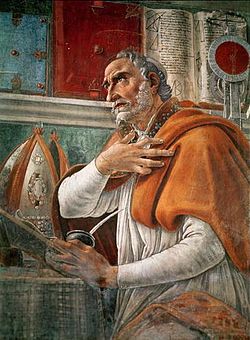
 His faculties and his body are understood now to be in the service of his Redeemer and Lord. Of his own, belongs sin. To God, belongs his virtue. Even when he was astray from God, the latter was near to him. To echo Saint Augustine, that doctor of grace, God was nearer to him than he was to himself! His thoughts although at least generally moved by God was not concerned with God. By the infusion of the theological virtue of faith, he begins to view matters not in the shadow of practicality but in the light of eternity. He comes to acknowledge humbly his vast plans and triumphs are as straw being blown towards the pit.

As he journeys along the path of spirituality, he can only respond with gratitude to the saving mercy of Jesus Christ on the Cross. His labours of sanctity can never now be seen as burdensome but rather as a joy and a free offering to almighty God. O clap your hands, all ye nations: shout unto God with the voice of joy!Who is God but our Father and Protector? His past deeds disgust him and by continual actual graces he resists the curiosity to consider what his life could now be like etsi Deus non daretur. No more will he be enclosed within himself but will deny himself and serve as Christ served according to the will of the Father.

 He shall live for God as Jesus died for him. 

Tuesday, 1 October 2013

Theological Shorts 2 - The Necessity of Theology

Today's theological short is taken from the Summa Theologica, Part 1, Question 1, Article 1.

Whether besides Philosophy, Any Further Doctrine is Required?
Saint Thomas answers in the affirmative. Let us proceed along a line of argumentation to consider the boundaries and limits of both philosophy and theology. Objection 1 remarks that we must not go beyond what man is capable of. It is certainly true that the proper object of the human intellect is the essences of sensible beings. Human knowledge is said properly to be 'rational', in comparison we say that the knowledge of the angels and most eminently of God is 'intellectual'. For human beings, reason is a perfection, a quality that is essential to man, in fact it is what distinguishes man as a species from his wider genus of animal. As reasoning beings we proceed from what we know to what we are ignorant of. This is a process of imperfect knowledge, often uncertain, towards a firm grasp of truth. It is clear here that we must not ascribe this process to God as it would attribute imperfection and ignorance to Him. There is much stumbling and darkness along this path which the Angelic Doctor highlights later on in the article.
 Human beings are utterly dependant on experience to gain knowledge as it is through the senses that we come to develop an understanding of the world around us, the particulars, but also to reach a comprehension of universals. Not being angels we are unable to grasp conclusions inherent in principles, but we must proceed step by step to arrive at an end point. We may even be wrong in our destination. For the Catholic there must be no disparaging of creation as our faculties are attuned to them to arrive at knowledge. This pertains to philosophy.
 However, is it not true that philosophy does treat of God? Without a doubt. Does that mean that there is no requirement of different disciplines? Absolutely not. The justification for this negative is that theology considers God under a different light from philosophy. The material object of both sciences is God, however it is the formal object that distinguishes all disciplines. Saint Thomas remarks that both the physicist and the astronomer may reach the conclusion that the Earth is round (N.B. He wrote this in the 13th century!!!), but it is under different aspects or methods that this truth is reached. Let us apply this to philosophy and theology. Philosophy reaches a knowledge of God, such as the certainty that He exists, but this is obtained through a process of reasoning, a movement from effect to cause. Theology treats God under the formal aspect of revelation. It is founded upon the authority and certainty of God, the revealer of Himself. There are many truths that man can not apprehend by reason alone which God must show us so that we may come to know it, eg, the Incarnation, the Trinitarian nature of the Deity etc. As a corollary, supernatural mysteries can not be proven intrinsically, objections to them may be shown to be unconvincing but reason alone can not show definitively their truth value. We may know that God is, but not what He is. We 'know' the articles of revelation through Divine Faith. This surpasses the proper object of our intellects.
 The Angelic Doctor remarks that revelation is for our salvation. God even reveals truths that could have been obtained through human reason alone, such as His existence. In His gracious mercy He has revealed them to us so that our reason processes which have to cope with 'an admixture of many errors' may not condemn us entirely. Our eye must be directed to God, our end but this end surpasses our reasoning capacities. Human beings make errors in thought through tiredness, inexperience, logical fallacies, the darkening of the intellect or the inclination to sin itself. It is for our own good and His glory that God willed to reveal Himself.

We conclude that theology is a necessary discipline that is formally distinct from philosophy.

Wednesday, 25 September 2013

Some Thoughts on Pope Francis


I have been holding off on writing this short article which I have been planning on doing for a while now, but I believe that it would be appropriate to contribute something of my own to the debate about His Holiness Pope Francis, his vision for the Church and his manner of approaching the key issues of our age. I am not going to grade the Vicar of Christ on his performance but I do wish to state my unease, discomfort and nervousness every time he attempts to detail with loaded issues. 

 The first statement that I believe we must recognise is that Jorge Mario Bergoglio does not understand what it means to be pope, to be the Successor to Saint Peter in the See of Rome. We live in a world where our politicians, celebrities and of course, religious leaders are covered 24/7. The first two can benefit from such extensive coverage to promote their agendas and to advertise their products. Yet it is a different matter for the pope. It can be a wonderful opportunity for the faithful to observe the Holy Father and listen to his teaching and counsel, and this is provided for by wide coverage of his every move. However this presents a unique danger to the pope who is not prudent enough to consider that those who report on him are generally hostile to the Faith. He must be aware how his words will be twisted or utilised to meet a certain agenda. He must tailor his words so that no doubt may remain as to his intention. Should he speak as much as he does or would like to? My answer is probably not. At least in the manner that he has been engaging in. Pope Francis, I am sure, has a number of personal attributes that we could all benefit from, but it is obvious that clarity is not one of them. Perhaps he should have stuck at the 'decadent Thomist manuals' that he recently decried.  

 On this blog I may stumble out some garbled teaching or offer an opinion that is too harsh or too lenient, but I have no authority whatsoever. Few will ever come across my words, fewer still will bother to read and consider them. My thoughts are derived from my own reading, conversations and interpretations about the Church and the world.
 Pope Francis on the other hand, does not possess such a luxury. I may state an opinion or belief that is fantastical or downright wrong but the newspapers will not publish my thoughts with bold headlines stating, 'Charles Milligan decrees XYZ'. The pope as the Supreme Pastor of the Universal Church must recognise his public role and the necessity of presenting clear doctrine for the sanctification of the people entrusted to his care in these times. He is no longer simply Jorge Mario Bergoglio. Of course he can not do away with his personality and natural attributes, we should never demand that he do so, but he must have a new vision and realisation about his task.
So much about the papacy is its public face. How it presents itself to the world. It is rather obvious that Pope Francis is struggling to come to terms with that. Within hours of his election, the newspapers and the blogsphere were alight with claims that he would completely disregard tradition (and therefore likely to alter Church doctrine) simply as he refused to wear the mozetta upon appearing on the loggia. How dull of understanding are they! Yet I say he should be conscious of their likely reactions to his actions. The papacy is not about the personality of a Bergoglio, a Ratzinger or a Wotyla. It surpasses all possible names and personality types. The Faith will endure many years after he has died. I understand that ceremony and formality may be foreign to Bergoglio, but as Pope Francis he must make them his own for the sake of the Church. Pope Saint Pius X certainly was humble and poor in his origins, but you will not find a man who has ever assumed such an aristocratic poise or formality for the sake of the Church than he. He must present an image of the Church that is strong and faithful to its constitution, the proclamation of our redemption in Jesus Christ. He has to be stubborn for the sake of the truth.

 In the modern world there is far too much consideration for the forging of a personal legacy. The press demands that the man who assumes the papacy that he must make it his own. He must distinguish himself from the public face of the papacy and from his predecessors. But I state, I am sure to the horror of the ''neo-Catholic'', maybe Pope Francis will have no legacy whatsoever. This may seem impious to them but I ask them how many popes do they really know about in the twenty centuries of the Church? The post-Vatican II bishops of Rome? Before that? Maybe Leo XIII because of Rerum Novarum? Perhaps Saint Gregory the Great? There so called piety is misplaced.

 Quickly I wish to trace some key lines of how Pope Francis the man wishes to approach the world. I would have a different approach, probably threatening excommunications and suspensions and alienating potential collaborators. Rightly or wrongly, Pope Francis is attempting to show the human face of Christ to a world that is lost and confused. He believes that his simplicity and his off-the-cuff manner will prove attractive to men of good will. He probably sees the Church as suffering from a public image crisis. Certainly the fame of the Catholic Church has been besmirched by the ineptitude and downright evilness of some of her pastors and Pope Francis believes this is the right way to present an alternate face of the Church. But I warn that he must not fall into the trap of the liberal elite. They have a particular vision of the Church which reduces the Bride of Christ into a mere humanitarian organisation. To his credit the Holy Father spoke out about that very quickly after his election. His approach seems entirely natural to him and he is very different from Pope Emeritus Benedict XVI. That is not to say that Benedict lacks humility, which is patently absurd to those who have watched him closely. Papa Bergoglio is no intellectual which suits the modern world as it does not make them uncomfortable and his lack of clarity is ripe for twisting. 

Much more can be written about His Holiness and perhaps he will surprise us. Occasionally the bluntness of his words condemning certain aberrations are refreshing as he does not employ the nuances of his predecessor. Let us continue to pray for him so that he learn to assume the papacy with a strong sense of duty the Faith handed onto the saints once for all. May the Lord grant him prudence in his words and actions.
In Domino,

Charles Stuart.

Tuesday, 24 September 2013

Episcopal Consecration of Archbishop Leo Cushley and the Duties of a Bishop


This Saturday I was privileged to assist at the Episcopal Consecration of Mgr Leo Cushley as our new Archbishop of St. Andrews and Edinburgh. I will pass over with a mental 'tut' the presence of Protestant guests standing in the sanctuary or the fact that a young school girl read the Epistle when you had plenty of clerics present to do their job. I wish however to focus on the duties of a bishop in this short reflection.
 The Apostle tells us that it is legitimate to desire the office of the episcopate (I Timothy 3) but he sets out the qualifications for one who follows in the path of an Apostle, namely that he should be prudent, vigilant, sober, of sound mind and live an impeccable life among men. The crisis of confidence in the uniqueness of Christ's Church and of a firm commitment to her saving mission must be known by all of us. Let us not be so naive to believe that all is well with the flock Christ has entrusted to the shepherds of His Bride. Our parishes have declining numbers, seminaries are empty (apart from the various traditionalist ones), nuns have fled from their habits and prayers and have turned into activists, ignorance pridefully reigns among the laity. How many souls have perished already or will perish if this sad state continues to exist? What will happen to our bishops, the primary teachers of the Faith in their jurisdictions? There is far more to the office of bishop than purple buttons! Although it is a holy desire to be consecrated as a successor to the Apostle, to receive the fullness of the priesthood, to be able to lead a diocese to salvation, the man elevated to such an angelic state must be fully aware of his duties and responsibilities. His own salvation depends on the salvation of the flock entrusted to his care. 
 He must enter the sanctuary daily with a pure heart to offer the unblemished Sacrifice to the glory of God and for the salvation of his flock. He must counsel prudently those who seek his advice and spiritual expertise. He must bear patiently with sinners, console the grieving, attend to the poor and sick, all without complaint. His preaching of the Faith must be clear and concise. He must alert the faithful to the errors and dangers of the day. He must show the face of Christ to those who have defaced their own divine likeness through sin. His first concern upon awaking should be to praise God and to beg Him for the grace to carry out his duties with due diligence.
 St. John Chrysostom remarks that a man would be better to flee such a burden. After all, when much has been given, much is expected (Luke 12:48). I do not offer my advice to His Grace, I am simply setting out the duties of a bishop as they are.
 The patron saint of our nation is St. Andrew and this name in Greek signifies 'manly. Oh how we need men in the episcopate! We need fearless leadership among the clergy, who will state clearly the truth and be unashamed of the Faith handed onto the saints. He must be a man first to be an effective father. He should abandon as a grave danger the meetings and summits with politicians and dignitaries. He should not seek the company of such people who utilise the Church to their own ends. Our politicians endlessly blaspheme the Lord while proclaiming religiosity and moderation. The bishops must be aware of this deception, calling out their errors, especially if they claim to be Catholic. I am not calling for our bishops to abandon the public sphere I am urging them to be cautious and aware of the devices of politicians. Too often our shepherds launch onto the latest social justice craze whether it be 'green' light bulbs or carbon emissions. He becomes a servant too frequently of those who support the greatest evil of our time, abortion. Usually he does not realise what kind of company he has entered.
 I also speak out against the 'trendy cleric' who seeks to be friends with the world in order, as he claims, to make the world more disposed to accepting the Church. Such a false Church would not be worthy of accepting. It would offer nothing as it demands nothing. Truth and holiness should be attractive enough to people.
 The Church universal and triumphant celebrated with joy the consecration of Leo Cushley but we must not neglect these sober truths outlined above. Let us pray without ceasing for our shepherds that they may first know Christ to lead us to Him.

I also ask for prayers for our former Archbishop, Keith Patrick Cardinal O'Brien. He has done immense harm to our Church but I do feel terribly sorry for him. Remember him and all others who have failed.

I managed to greet His Grace after Mass and he did not pull away his hand as I and others kissed his ring, a small but good sign.


In Domine,

Charles Stuart.

Saturday, 24 August 2013

The Doctors Speak...


Saint Augustine, on Psalm 99.

The Psalmist says: 'Be joyful in the Lord all you lands!' Have all the lands heard this invitation. Already all the lands are making a joyful noise to the noise to the Lord. If one part is not yet praising Him, it soon will. 
 The Church going out from Jerusalem is spread out among all peoples. The good are mixed in with the wicked. Through the mouth of the wicked all the lands are murmuring against the Lord: through the mouth of the good all the lands are making a joyful noise to the Lord.
 And what is this joyful noise? Another Psalm exclaims: 'Blessed are the people who know the festal shout!' (Ps. 89:16) It must then be something very important if the experience of it brings happiness. Let us run towards this happiness, let us take careful note how to achieve this joyful noise.
 One who is making a joyful noise does not utter words. No words are needed to make his joy heard. It is the song of a soul overflowing with joy, expressing its feelings as it may, above the level of discourse. 

We find ourselves in this state of jubilation when we are glorifying God and we feel incapable of speaking of Him - when for example we are considering the whole creation which makes itself available for us to know and to act in. The soul then asks: 'Who has made all this? And who has put me here? What are these truths that I am understanding? And who am I that understands? Who is it who has made it all? Who is He?'
 If you want some idea of who He is, you must draw nearer to Him. To look from a distance is to risk being deceived. It is the spirit that perceives him and the heart that sees Him. What sort of heart? 'Blessed are the pure in heart: they shall see God.' (Matt. 5:8)
 You must draw nearer to Him by becoming like Him. You will feel His presence to the extent that love grows in you, because God is Love.
 Then you will not be able to do anything but praise Him. And if you make a joyful noise to the Lord, you will understand the joyful noise that all the lands make to Him.


Comment: How blessed are we to live in the time after the proclamation of the Gospel! A young man may dream of leading a cavalry charge in Alexander the Great's army, discoursing with the philosophers in Ancient Athens, forming the first cities in Mesopotamia. But we possess a pearl of even greater worth that these men could possibly have dreamt of, the Catholic Faith, the belief in the Incarnation and Redemptive Sacrifice of our Lord! The news of His Resurrection has reached our insignificant country of Scotland, a poor land of former barbarians. We have come to believe and proclaim the wonders and deeds of the Lord, the Lord Who has decreed mercy for us who worshipped the works of our own hands. What hope would be have had before the spread of the Gospel through the operation of the Holy Ghost?

Theological Shorts


A new feature here at Filioque where a few times a week I will write a very short commentary on a particular article of the Summa Theologica from Saint Thomas Aquinas.

The first summary is taken from Part I, Question 95, Article 1.


'Whether the first man was created in grace?'

Thomas answers in the positive, the first man was created in grace by God. The reason the Angelic Doctor gives for this is that the Adam was created in complete rectitude, where his body was subjected to his reason and his reason was ultimately in harmony with his creator, 'God made man right' (Eccles. vii. 30). This state of rightly ordered reason could only occur with the first man being in a state of grace, as ''it is clear that such a subjection of the body to the soul and of the lower powers to reason was not from nature; otherwise it would have remained after sin.'' This statement is vital for a correct understanding of our state after the Fall. The Pelagians believed that Adam was created in a natural state, a state in which death and decay was a reality and would come to affect our forefather in due course. But the Catholic proclaims the initial rectitude, the original righteousness of man, which existed because of the presence of grace in his soul. The withdrawal of his great state was due simply to the deliberate sin of  Adam, a sin for which he could claim no excuse due to any stain of concupiscence. This is necessary as otherwise man's original nature would have been faulty if we were to answer in the negative. Saint Augustine commented that because of man's disobedience to God he began to feel that same disobedience in his own flesh. With the removal of grace, the flight of our original duly ordered nature, the lower powers of man started to rise up against him, provoking him, taunting him about his most terrible fall from his initial, God-given righteousness.
 It must be stated that the grace given to man was not an efficacious grace in the moment of his temptation, whereby man would have, by the power of God moving swiftly and sweetly, rejected the offer of Satan to sin. Grace was certainly given to man to overcome, but the flowering of the bud was crushed by his rejection of it. Adam could claim no excuse, no human weakness for his abandonment of his creator.

Sunday, 15 April 2012

A Conversion Story

I have been considering whether to write an entry this like for a long time. It has sat uneasy with me as I did not wish to stray beyond matters of the Faith, theology, Church life or spiritual meditations. Yet, I believe that it may bring about some spiritual good to myself and to those who stumble across this piece. I wish in a few simple words to offer a reflection on my own life as a Catholic and its trials, worries and confusions. I hope to do this without the usual pretentious attempts of erudition that frequently appear in my writing, or the various half-jumbled up from memory, scriptural quotations.
 My 'knowledge' of the Catholic Faith before 2005 was limited a recognition of suspicion towards those followers of the pope and that the father of a friend spoke a funny language (I would now assume that it was Latin). I was completely oblivious to anything of true substance of the Catholic Church. Of course I had seen some foreign footballers enter the pitch by touching the ground and tracing a cross upon themselves, yet the purpose and importance of such acts of faith were beyond me, even though I had until the age of around 11 attended a Protestant church.
 The first contact I had was an intriguing one, the usual starting point for the telling of my conversion story. In 2005 I was on holiday to Mallorca with my mother and grandmother and since the only English channel that was available to us was the news, I became engrossed in the last moments of the life of H.H. Blessed Pope John Paul II and the sentiments of love and emotion that he evoked from my soon to be brother Catholics. I will pass over in silence the various criticisms of his pontificate that many in the traditionalist movement may make. Suffering was in fact the reason I stopped attending my church, along with, I suppose, a general indifference. Modern liberal Protestantism is hardly a faith to sacrifice for. My auntie died when I was around 11 and it hit me hard. It was probably the first death that I had experienced of a close family member. I mention this as it can only be inspiring to see a man remain steadfast to what he believed God had called him to do and be even when great suffering overtook him. To him (a fellow Charles) and His Master, I can only say thank you. My first proper correct with the Faith was a positive one that will remain with me for the rest of my days.
 I will leave out here the process of R.C.I.A. and my reception into communion with the Catholic Church and offer some considerations I have had.
The Christian life is not easy. It has been a struggle these 4 years with many ups and downs, with great enthusiasm and much lukewarmness. The beauty of Christianity is that it is not merely exterior, a cloak to wear but by the action of the Holy Ghost man is truly renewed and made like to the Son. Many can claim to be Catholic or Christian yet many in the mind, in the heart are untouched by the reality. I have found my greatest difficulty here. I hold the Orthodox Faith with a decent knowledge of theology, yet I could never say with honesty that I am what I believe or know. Hypocrisy is a charge frequently launched at believers (although often such an accusation is an attempt to destroy any intelligent discussion) and I know the problem in my own person. I know my sins, they make me shiver at times.Too often waves of memories of some sin attacks me and disturbs me in spirit. On the outside, many are impressed with me, I can act with piety with devotion and serving at Mass. A cert for sanctity, probably by means of the priesthood. It would be reckless and foolish for me to truly believe them. I can often receive the feeling that I am living insincerely which at times is probably correct.
 However, on the whole, I can only be grateful and filled with joy that I was given the efficacious grace to convert when I did. I wonder in what state I would be today if this had not been given. Huge errors, false beliefs and missteps have occurred since the night of the 22nd of March, 2008. Very frequently I feel that very little progress has been made and it does shame me. I can only recognise that the Faith is a greater treasure than I knew before 2008. It is even more profound that I could ever imagine and I pray that I will remain true to it until my last breath.
 These words are sombre, a sinner's words. I am certain that many have felt the same and have taken the necessary steps in grace to overcome them. I am heading in the same way as many of my brothers today and in the past. May I continue this journey with greater sentiments of faith, hope and charity until He comes.

Reflection on the Piety of the Young

It is a rather unfortunate sign of the times that when a young man shows some degree of piety that they consider him almost papabile.

Friday, 13 April 2012

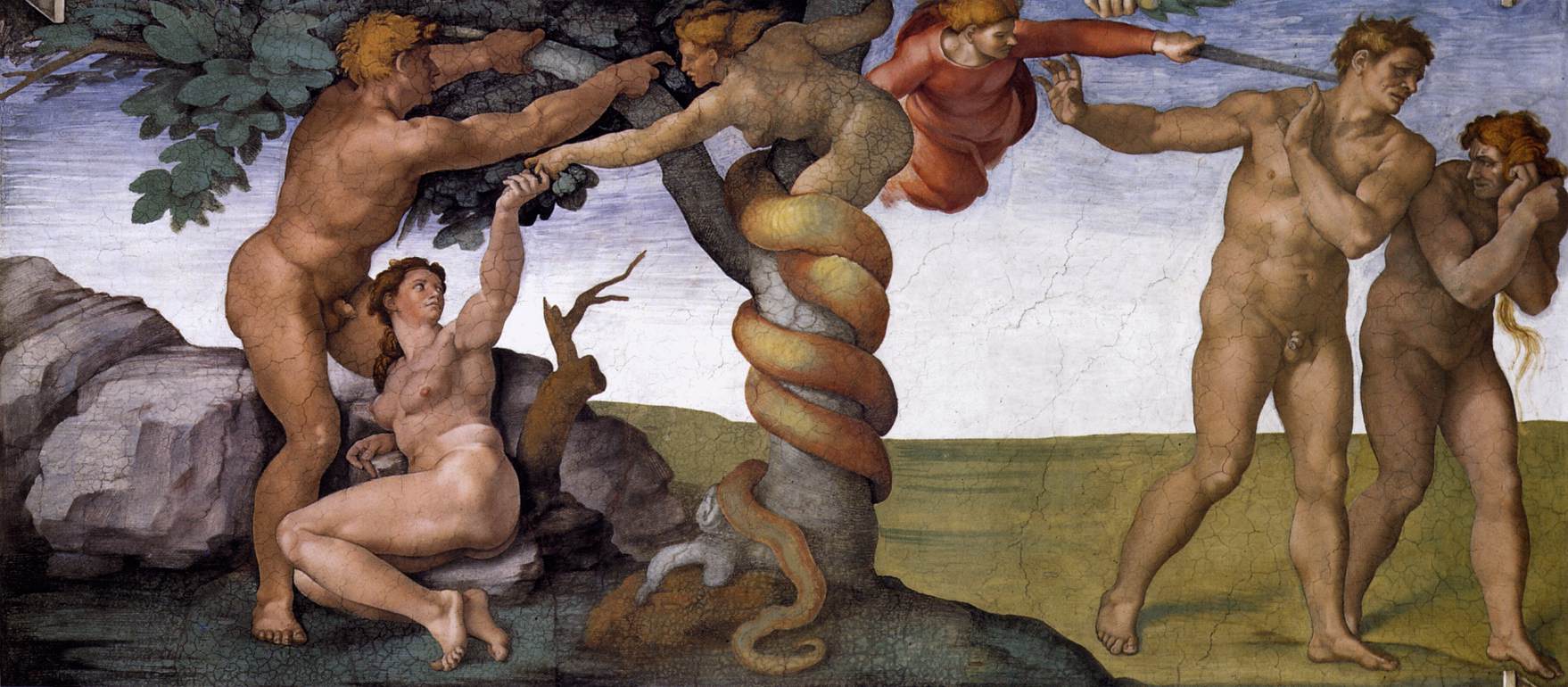
Reflection on Paradise and Sin

No saint was ever created in paradise. Infact, out of there, came two sinners.

Thursday, 12 April 2012

Reflection on Sacrifice

It is often said of this generation that it does not know the reality of sacrifice. Yet the truth is that each generation does know how to sacrifice. Unfortunately, it is usually for the wrong things.

Wednesday, 13 July 2011

Reflection on Good and Evil

Before one can hate evil, it is necessary to first come to know and to love the Good. A natural irascibility is not a virtue.

Monday, 20 June 2011

Reflection on Christ, the Cross and the Church

Christ, Church and Cross are inseparable. Man cannot be saved by one without the other two.

Monday, 13 June 2011

Pentecost - A Pneumatologically Conditioned Christology.

It is a deficiency in much theology when one considers the Person of the Holy Ghost and His operations. Too often He is seen as a mere auxiliary, as one who assists in some indefinite way in our Christian pilgrimage. How can we correct this view? How can we truly appreciate the infusion of the Holy Ghost without viewing Him as an afterthought? One will often hear something said of discernment, ''...with the help of the Holy Ghost', but what is this help and how essential is He to the oneness of God and the salvific will of God? I will not attempt to answer all of these questions as they are certainly above my ability but I would like to refer to some of the insights of an Eastern Orthodox theologian, the Metropolitan John (Zizioulas) of Pergamon on this crucial matter.

In the Creed it must be seen that the Third Person of the Holy Trinity should never be considered as an optional extra or a name to be inserted out of a certain form of piety. We sing each Sunday while kneeling, 'et Incarnatus est de Spiritu Sancto ex Maria Virgine: et homo factus est'. The Oblation of our Redemption could not occur unless the Logos united Himself with a human nature so that He could offer Himself as a propitiation for our sins. This is the key point of our Faith. In other religions, man raises himself up by his own will through his own energy often through some form of 'purification'. On the other hand, the beauty of the Christian Faith is that the Son of the Eternal Father descended out of love to dwell amongst us as man by the power and work of the Holy Ghost. By the work of the Holy Ghost. It was the same Paraclete that overshadowed the Holy Virgin so that she may conceive and bring forth the holiest of all fruit, Jesus, that fell upon the disciples on the day of Pentecost.
His Excellency states in this respect that Christ is conditioned 'Pneumatologically', and that this is absolutely essential to His becoming man. According to this theologian, Jesus Christ is inconceivable as an individual by is ontologically relational. In first place, He is the only-begotten Son of the Father, and without this filiation the Father could not be Father. He descended not as an individual but with a body, a body that was to unite the dispersed people so that they may become holy. He came with one intention, for our sanctification in obedience to the Father's will.
So how is man, once redeemed by the shedding of the blood of the Lamb, to be united to this propitiatory offering? Through Holy Baptism, the ''individual'' (as opposed to person in Zizioulas' thought) enters into and shares the Son's essential relation to the Father existentially. Yet, this laver of regeneration can only occur by the work of the Holy Ghost. It was through Him that the world began to be renewed by His overshadowing of the Woman, it was He that led Jesus into the desert to prepare for His ministry and redemptive work and it was in He that Christ offered Himself on the Cross to the Unbegotten One. Our baptism is by water and the Spirit. Not by water alone. But the Spirit presupposes the blood and the blood presupposes the Spirit. In fact, they are simultaneous. Christ dwells in our hearts by faith with the Father and the Paraclete. We are temples of the Holy Ghost. There can be no opposition.

In the life of the Blessed Trinity considered apart from creation, the Holy Ghost precedes (primarily/principaliter) from the Father through the Son. There is a one-ness in the immanent Trinity and this is manifested in the work of the economic Trinity. It is absolutely true that the redemption, regardless of appropriation, is conducted in common. The Three Persons act.

How then does this relate to Pentecost? It is certain that on this solemn day we celebrate the Birthday of the Church. By the appearance of the tongues of fire, the Apostles depart with a firm conviction and a new awareness of the uniqueness of the Person of their Saviour and His divine mission. This only occurs because of the illumination of the Holy Ghost. Apart from Him, Jesus can only be regarded as an individual from the past, someone subject to historical constraints and prejudices. This is entirely false. If the Third Person were not to be shed above the disciples gathered in prayer, how could we possibly reach the one that had ascended to the Father?
While Christ instituted the Church, we may say truly that she is constituted by the Holy Ghost.

In conjunction with this truth there can be no discord between the spirit and the institution. Amt und (oder?) Geist can never enter into our consideration of the Church and the world. Just as the doctrine of Christ is not His own by that of the Father, so the Holy Ghost only reveals what He has heard from the Father. The unity of the Godhead consists in the Monarchia of the Unbegotten. That same Spirit is not a liberator considered apart from Christ (the institution-maker) but is sent by the Son to convince the world of sin, justice and judgment. He has the same mission as the Son, as 'One sent', ''He shall glorify Me (Jesus): because He shall receive of Mine and shall show it to you.''

Therefore in accordance with the words of the Saviour, we must continue to rejoice in that same Spirit Who is building up the Body of Christ unto the fullness of the man. He still works in souls to unite them to the Death of the Lord so that we may be taken up to the dignity of sons of God in the Holy Ghost. There is no other name in heaven or earth that man can be saved under except Christ and no one can proclaim Christ is Lord apart from in the Holy Ghost.

Friday, 10 June 2011

The Ascension of the Lord - With H.H. Pope Benedict XVI


From his recent book 'Jesus of Nazareth - Part 2'. I only have the Spanish edition and the following imperfect rendering into English is my own:

''In the gesture of the hands in blessing, the lasting relation between Jesus and his disciples and the world is expressed. In His Ascension, He comes to elevate us above ourselves and to open the world to God. Therefore, the disciples were able to rejoice when they returned home from Bethany. In faith we know that Jesus blessing, has his hands extended over us. This is the permanent reason for Christian joy.''

Thursday, 9 June 2011

The Ascension of the Lord - With St. Thomas Aquinas.


S.T. Pt. III. Q57, A1.

We must in this short article reflect upon the fittingness of our Lord's Ascension.
Since the humanity assumed by Christ had passed into incorruptibility as a result of His true Resurrection from the dead and that the Godhead remained perfect as it always was, how is it apt that our Lord should undergo movement into Heaven when He had nothing lacking here below? In this movement, nothing possibly could be gained as He was (and still is) truly God consubstantial with the Father and in His human soul delights in the beatific vision in the highest degree for a created nature. Furthermore, would it not be for our benefit that He remain to console the Apostles with His physical and sensible perceptible appearance, performing miracles and wonders to convert the whole Empire?


I must allow the Angelic Doctor to comment on this mystery:

''The place ought to be in keeping with what is contained therein. Now by His Resurrection Christ entered upon an immortal and incorruptible life. But whereas our dwelling place is one of generation and corruption, the heavenly place is one of incorruption. And consequently it was not fitting that Christ should remain upon earth after the Resurrection (after confirming His true triumph over death); but it was fitting that He should ascend to heaven''

And:

''By ascending into heaven Christ acquired no addition to His essential glory either in body or in soul: nevertheless He did acquire something as to the fittingness of place, which pertains to the well-being of glory: not that His body acquired anything from a heavenly body by way of perfection; but merely out of a certain fittingness. Now this in a measure belonged to His glory; and He had a certain kind of joy for some fittingness. not indeed that He then began to derive joy from it when He ascended into heaven, but that He rejoiced thereat in a new way, as at a thing completed...''

He states then that the Ascension of our Lord was to our benefit as:

1) It increases our faith in invisible reality. From the right-hand side of the Father He will send the Holy Ghost to convince the world of sin and justice and judgement.
2) Uplifts our hope. The end of human life is to rejoice in the Trinitarian communion of life and love in eternity. One can not establish a paradise upon earth, a place of corruption.
3) To direct our charity to things in the heavenly places. It is where Christ is that we must long to be and the Paraclete, the best gift of God above inflames our breast with a constant love of what truly is.

These truths are admirably exposed in the collects of the Mass for this period. For instance:

''..our Redeemer, to have ascended on this day into heaven, may also ourselves dwell in mind amid heavenly things.' (Mass for the Ascension of our Lord)

''grant to Thy people the grace to love what Thou dost command and to desire what Thou dost promise, that amid the changes of the world, our hearts may there be fixed where true joys are to be found''. (Fourth Sunday after Easter)

Let nothing during this pilgrimage distract us from the only end of human life. Once we come to realise the marvels of our Divine Lord's promise, how can we walk away untouched by His mercy?

Vado ad eum qui misit me: sed quia haec locutus sum vobis, tristitia implevit cor vestrum.

Short Reflection on the Ascension of the Lord - 1


It appears that the life of the Christian is characterised by several fundamental oppositions and antagonisms, for instance, in the world but not of the world and salvation that has been wrought already for us yet we must wait patiently to enter into the fullness of the Kingdom. Therefore it must be asked how are we to understand this glorious occasion? It may truly be said that even though a great joy overcame the Apostles when the Risen Lord rose above in might to return to the Father, a sadness or a time of unknowing, maybe of fear, could have followed.
In considering the Mystery of the Ascension of our Divine Saviour and the period afterwards until the day that the Holy Ghost descended upon our fathers in the Faith, we may justly liken it to Holy Saturday.
After the shedding of the blood of the Divine Victim upon the Tree of Life, the paying of a debt that man could not offer to the Father, our Lord descending to the depths left the Apostles dispersed and scattered. One would struggle to imagine their thoughts during this 'abandonment' by the Lord who had brought together this motley bunch of no-hopers. Should we return to our ships and nets? To collecting taxes? Should we attach ourselves to another teacher in the hope of him achieving the restoration of the Kingdom of Israel?
The Lord Himself had declared His Resurrection openly to these men but it is only in light of the actual event and the subsequent Descent of the Paraclete that they could enter into this mystery with the required Faith to proclaim in their turn the Kingdom of God.
Likewise, we here live far removed from the time when the Logos humbled Himself to take flesh from the spotless Virgin, yet through our baptism and our incorporation into our Lord's Mystical Body we are enabled to experience the same. However it will not do to assign a facile historical approach to this mystery just as it will not do to assign a psychological understanding to our putting on of Christ.
Our Saviour has ascended on high with jubilee and with the sound of a trumpet to prepare a place for us. At this moment He is still risen and acts in us to will and to accomplish. Although seated at the right-hand of the Eternal Father with His Mother on His own right, He is not far removed from us where we could only hope to be united with Him in some indeterminate point in the far-off future. Such an approach is not fidelity to Christianity and reduces the grace given to us to a sentimentalised humanism. Whoever eats the flesh of the Son of Man lives in Him and receives life and immortality from Him just as He lives by the Father. Is this not such close union that man seeks? He dwells in us through sanctifying grace, He is the Priest of the Mass, the One who removes our bounds in Penance and speaks through the universal, ordinary and extraordinary magisterium. He has certainly been removed from our sight yet He is now closer to us rather He was simply by physically appearing to the men of Galilee.
'But I will see your again and your heart shall rejoice: and your joy no man shall take from you'. What a consolation we have in these words. However, what is the difference between now if Christ is present in our midst as He promised and the lot of the resurrected bodies and glorified immortal souls of the saints in light? We are still on pilgrimage here before, our bodies grown for their redemption and we are still to be what we shall appear as. Salvation can be lost on this earth but there our wills and intellects will be terminated by the One Who created them and Who brought us to Himself out of His abundant mercy and love. We long to see Him with full glory unveiled not as under appearances but just as He is. Our time here is image but there is reality.
Without the operations of the Holy Ghost and His gifts, without the renewal of the Sacrifice of the Cross in an unbloody manner in the Mass et cetera, the glory of the sons of God would remain far-off and unattainably so. It is only because He lives in us that we can come to Him for a happy eternity unmoved from bliss.

Where He is, our treasure must be. Where our hearts are, so shall we.

Monday, 6 June 2011

Random Thoughts

The true master of himself is the servant of God.

A triangle will continue to possess three sides whether the majority recognise it or not.

Friday, 31 December 2010

Random Thought

I have never known a man to have more Gods than an atheist.

Thursday, 23 December 2010

A Christmas Meditation 1


''Misit verbum suum, et sanavit eos, et eripuit eos de interitionibus eorum.'' (Ps 107:20)

There is much one can write concerning this sacred time in our liturgical calender, yet I was unable to fix my mind on anything in particular to sketch a meditation upon. No clear idea entered my mind until this afternoon, when I came across a passage from an Eastern Orthodox theologian, Vladimir Lossky, and this opened up a series of thoughts in my mind, so I have decided to type some out, more or less at random, take whatever is good in it and ascribe honour to God, Who is blessed forever.

In the English language, it is very unfortunate that our term 'salvation' denotes a negative concept. One may often imply 'salvation from something', or have some idea of this. Unlike German (das Heil) or the Latin tongue (salus), English will force the unreflective to adopt this notion. In those other two languages, the term 'salvation' includes a 'wholeness', or 'health', a completion. In our case, it is salvation from hell, we preach.
Our salvation has to consist of more than a Descent of the Logos so that man who be prevented from degrading himself more fully, irrevocably (although, this certainly plays some role). In fact, the katabasis of the Second Person of the most merciful Trinity, enable mans to enter into the divine life of trinitarian love by grace and participation. The kenosis of Jesus our Lord, leads to our fullness. As the Servant of God, Archbishop Sheen used to say, while we came to live, He came to die. This was the purpose of the Incarnation so that we may be absolved from sin, and enter into our Master's joy.
By the assumption of the Sacred Humanity, elected from all eternity by a gratuitous decree of mercy, through and only through the Holy Virgin, the process of man's healing and restoration commences. As Saint Irenaeus wonderful describes, Christ, the Second and true Adam, recapitulates the life of the first, binding up the bounds through His humble obedience to the Father's decree, where Adam strayed.
This salvation is applied to our souls through the laver of regeneration, and the continual renewal of the inner man by the Paraclete, so that we may come to the lot of the saints in light. God in no way simply wishes to declare us just in His Sight, without us truly becoming conformed to the likeness of His Son through Whom we are adopted. Through humility and piety, the soul is stregthened by His graces and blessings, while the Holy Trinity dwells within man freely.
Humility shown, par excellence, in the Incarnation of God, was a favourite theme in the preaching and writings of Saint Augustine of Hippo, and through our frequent meditations on the Descent, let us practice this with ever-increasing ferver. No man can enter heaven unless he be cleansed of all arrogance, which brought the Light Bearer low. By recognising the need for a Saviour, this is the first step.
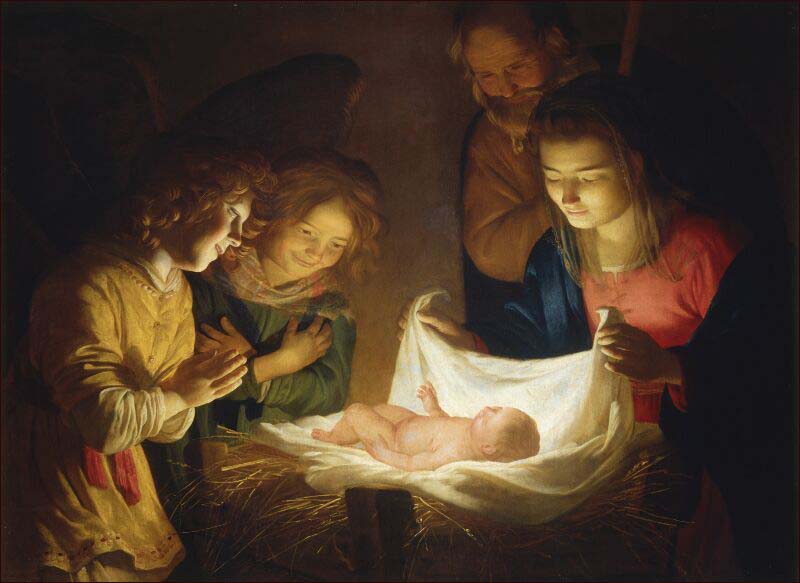
What we have in the Nativity Scene, is not merely a sentimental image, which allows us to experience a glow within our breast, rather one for which we must have an unbounded gratitude. God although merciful, was in no way, obligated to send His Son to die on behalf of sinful men. The clay that rose up against its Potter, deserved nothing more than to be tossed aside in His just anger. Yet He chose to do so for us.

Saturday, 18 December 2010

Random Thought

The lover of self does not love himself enough.