Tuesday, 3 September 2013

Wednesday, 28 August 2013
The Fathers Speak

St. Prosper of Aquitaine.
Thus human nature, vitiated in the first man's sin, is always inclined, even when surrounded by God's mercies, with His precepts and aids, towards a degenerate will, to surrender to which means sin. This will, then, is unsettled, uncertain, unsteadfast, unwise, weak to accomplish, quick to risk, blind in desire, conceited when honoured, agitated with cares, restless with suspicions, more desirous of glory than of virtue, more solicitous of a good reputation than of a good conscience, and through all its experience still more unhappy when enjoying what is coveted than when deprived of it. It has of its own nothing but a readiness to fall; for a fickle will which is not ruled by the changeless will of God, runs the more quickly into sin the more keenly it is bent on action.
The Popes Speak...

Pope Benedict XVI, Christmas Address 2012.
The great joy with which families from all over the world congregated in Milan indicates that, despite all impressions to the contrary, the family is still strong and vibrant today. But there is no denying the crisis that threatens it to its foundations – especially in the western world. It was noticeable that the Synod repeatedly emphasized the significance, for the transmission of the faith, of the family as the authentic setting in which to hand on the blueprint of human existence. This is something we learn by living it with others and suffering it with others. So it became clear that the question of the family is not just about a particular social construct, but about man himself – about what he is and what it takes to be authentically human. The challenges involved are manifold. First of all there is the question of the human capacity to make a commitment or to avoid commitment. Can one bind oneself for a lifetime? Does this correspond to man’s nature? Does it not contradict his freedom and the scope of his self-realization? Does man become himself by living for himself alone and only entering into relationships with others when he can break them off again at any time? Is lifelong commitment antithetical to freedom? Is commitment also worth suffering for? Man’s refusal to make any commitment – which is becoming increasingly widespread as a result of a false understanding of freedom and self-realization as well as the desire to escape suffering – means that man remains closed in on himself and keeps his “I” ultimately for himself, without really rising above it. Yet only in self-giving does man find himself, and only by opening himself to the other, to others, to children, to the family, only by letting himself be changed through suffering, does he discover the breadth of his humanity. When such commitment is repudiated, the key figures of human existence likewise vanish: father, mother, child – essential elements of the experience of being human are lost.
The Chief Rabbi of France, Gilles Bernheim, has shown in a very detailed and profoundly moving study that the attack we are currently experiencing on the true structure of the family, made up of father, mother, and child, goes much deeper. While up to now we regarded a false understanding of the nature of human freedom as one cause of the crisis of the family, it is now becoming clear that the very notion of being – of what being human really means – is being called into question. He quotes the famous saying of Simone de Beauvoir: “one is not born a woman, one becomes so” (on ne naît pas femme, on le devient). These words lay the foundation for what is put forward today under the term “gender” as a new philosophy of sexuality. According to this philosophy, sex is no longer a given element of nature, that man has to accept and personally make sense of: it is a social role that we choose for ourselves, while in the past it was chosen for us by society. The profound falsehood of this theory and of the anthropological revolution contained within it is obvious. People dispute the idea that they have a nature, given by their bodily identity, that serves as a defining element of the human being. They deny their nature and decide that it is not something previously given to them, but that they make it for themselves. According to the biblical creation account, being created by God as male and female pertains to the essence of the human creature. This duality is an essential aspect of what being human is all about, as ordained by God. This very duality as something previously given is what is now disputed. The words of the creation account: “male and female he created them” (Gen 1:27) no longer apply. No, what applies now is this: it was not God who created them male and female – hitherto society did this, now we decide for ourselves. Man and woman as created realities, as the nature of the human being, no longer exist. Man calls his nature into question. From now on he is merely spirit and will. The manipulation of nature, which we deplore today where our environment is concerned, now becomes man’s fundamental choice where he himself is concerned. From now on there is only the abstract human being, who chooses for himself what his nature is to be. Man and woman in their created state as complementary versions of what it means to be human are disputed. But if there is no pre-ordained duality of man and woman in creation, then neither is the family any longer a reality established by creation. Likewise, the child has lost the place he had occupied hitherto and the dignity pertaining to him. Bernheim shows that now, perforce, from being a subject of rights, the child has become an object to which people have a right and which they have a right to obtain. When the freedom to be creative becomes the freedom to create oneself, then necessarily the Maker himself is denied and ultimately man too is stripped of his dignity as a creature of God, as the image of God at the core of his being. The defence of the family is about man himself. And it becomes clear that when God is denied, human dignity also disappears. Whoever defends God is defending man.
Comment: His Holiness delivered a very profound and timely speech last December that was inevitably decried by the media as an attack on same sex marriage. Very predictable of them. How shallow of them. What the Holy Father spoke about was the underlying crisis affecting modern society, a society that sees itself as 'constructive' but is ultimately destructive of its most important constitutive parts, the individual and the family. Human nature is just as ignorant, violent, deceitful, noble and magnificent as it always has been. We lie to ourselves to consider contemporary society to have reached a new era, a fresh start, a period of transition to liberty, a rejection of the constraints of a restrictive and archaic age. In order to build a plane that is capable of flying, one must know and acknowledge fundamental laws of physics. To build a society based on liberty, justice and a future, man must know and humbly acknowledge fundamental laws of humanity and the natural law.
Comment: His Holiness delivered a very profound and timely speech last December that was inevitably decried by the media as an attack on same sex marriage. Very predictable of them. How shallow of them. What the Holy Father spoke about was the underlying crisis affecting modern society, a society that sees itself as 'constructive' but is ultimately destructive of its most important constitutive parts, the individual and the family. Human nature is just as ignorant, violent, deceitful, noble and magnificent as it always has been. We lie to ourselves to consider contemporary society to have reached a new era, a fresh start, a period of transition to liberty, a rejection of the constraints of a restrictive and archaic age. In order to build a plane that is capable of flying, one must know and acknowledge fundamental laws of physics. To build a society based on liberty, justice and a future, man must know and humbly acknowledge fundamental laws of humanity and the natural law.
Tuesday, 27 August 2013
Reflection on Humanitarianism and Abortion
Perhaps a truly humanitarian country should invade the US who kill over a million children a year, believing their victims to be inconvenient, too disabled to be worthy, female and undesirable, a burden as a sufferer of Down syndrome, or just too oppressive at the time. Assad would have been thought more humane, a true servant of liberty if he followed our practices instead of his own.
Sunday, 25 August 2013
The Popes Speak
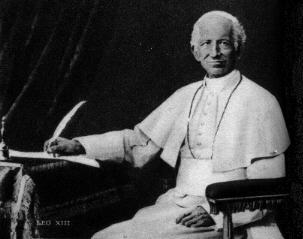
Pope Leo XIII, Rerum Novarum, 1891.
It is surely undeniable that, when a man engages in remunerative labor, the impelling reason and motive of his work is to obtain property, and thereafter to hold it as his very own. If one man hires out to another his strength or skill, he does so for the purpose of receiving in return what is necessary for the satisfaction of his needs; he therefore expressly intends to acquire a right full and real, not only to the remuneration, but also to the disposal of such remuneration, just as he pleases. Thus, if he lives sparingly, saves money, and, for greater security, invests his savings in land, the land, in such case, is only his wages under another form; and, consequently, a working man's little estate thus purchased should be as completely at his full disposal as are the wages he receives for his labor. But it is precisely in such power of disposal that ownership obtains, whether the property consist of land or chattels. Socialists, therefore, by endeavoring to transfer the possessions of individuals to the community at large, strike at the interests of every wage-earner, since they would deprive him of the liberty of disposing of his wages, and thereby of all hope and possibility of increasing his resources and of bettering his condition in life.
Saturday, 24 August 2013
The Doctors Speak...
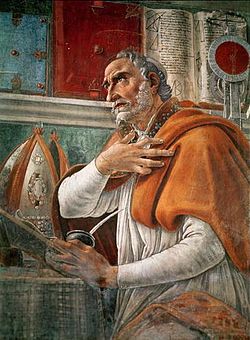
Saint Augustine, on Psalm 99.
The Psalmist says: 'Be joyful in the Lord all you lands!' Have all the lands heard this invitation. Already all the lands are making a joyful noise to the noise to the Lord. If one part is not yet praising Him, it soon will.
The Church going out from Jerusalem is spread out among all peoples. The good are mixed in with the wicked. Through the mouth of the wicked all the lands are murmuring against the Lord: through the mouth of the good all the lands are making a joyful noise to the Lord.
And what is this joyful noise? Another Psalm exclaims: 'Blessed are the people who know the festal shout!' (Ps. 89:16) It must then be something very important if the experience of it brings happiness. Let us run towards this happiness, let us take careful note how to achieve this joyful noise.
One who is making a joyful noise does not utter words. No words are needed to make his joy heard. It is the song of a soul overflowing with joy, expressing its feelings as it may, above the level of discourse.
We find ourselves in this state of jubilation when we are glorifying God and we feel incapable of speaking of Him - when for example we are considering the whole creation which makes itself available for us to know and to act in. The soul then asks: 'Who has made all this? And who has put me here? What are these truths that I am understanding? And who am I that understands? Who is it who has made it all? Who is He?'
If you want some idea of who He is, you must draw nearer to Him. To look from a distance is to risk being deceived. It is the spirit that perceives him and the heart that sees Him. What sort of heart? 'Blessed are the pure in heart: they shall see God.' (Matt. 5:8)
You must draw nearer to Him by becoming like Him. You will feel His presence to the extent that love grows in you, because God is Love.
Then you will not be able to do anything but praise Him. And if you make a joyful noise to the Lord, you will understand the joyful noise that all the lands make to Him.
Comment: How blessed are we to live in the time after the proclamation of the Gospel! A young man may dream of leading a cavalry charge in Alexander the Great's army, discoursing with the philosophers in Ancient Athens, forming the first cities in Mesopotamia. But we possess a pearl of even greater worth that these men could possibly have dreamt of, the Catholic Faith, the belief in the Incarnation and Redemptive Sacrifice of our Lord! The news of His Resurrection has reached our insignificant country of Scotland, a poor land of former barbarians. We have come to believe and proclaim the wonders and deeds of the Lord, the Lord Who has decreed mercy for us who worshipped the works of our own hands. What hope would be have had before the spread of the Gospel through the operation of the Holy Ghost?
Theological Shorts
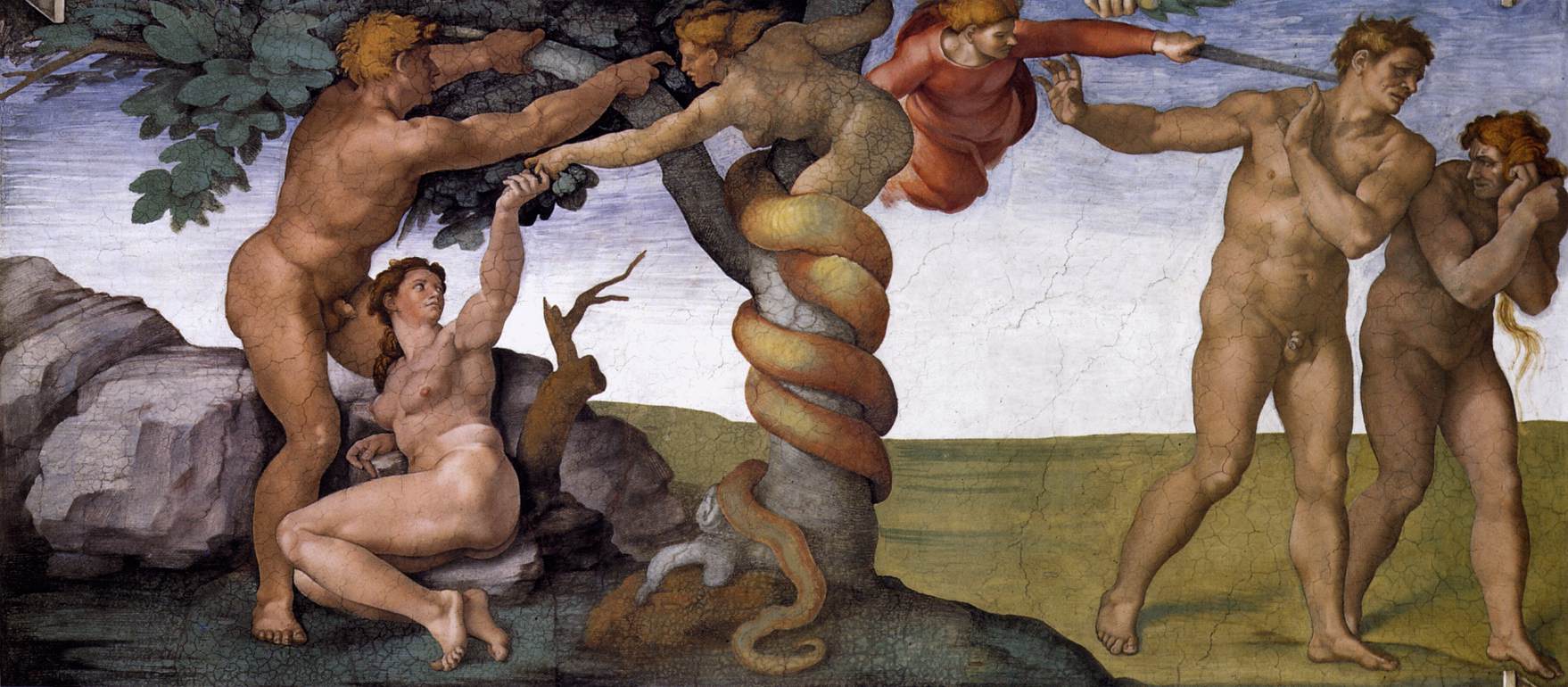
A new feature here at Filioque where a few times a week I will write a very short commentary on a particular article of the Summa Theologica from Saint Thomas Aquinas.
The first summary is taken from Part I, Question 95, Article 1.
'Whether the first man was created in grace?'
Thomas answers in the positive, the first man was created in grace by God. The reason the Angelic Doctor gives for this is that the Adam was created in complete rectitude, where his body was subjected to his reason and his reason was ultimately in harmony with his creator, 'God made man right' (Eccles. vii. 30). This state of rightly ordered reason could only occur with the first man being in a state of grace, as ''it is clear that such a subjection of the body to the soul and of the lower powers to reason was not from nature; otherwise it would have remained after sin.'' This statement is vital for a correct understanding of our state after the Fall. The Pelagians believed that Adam was created in a natural state, a state in which death and decay was a reality and would come to affect our forefather in due course. But the Catholic proclaims the initial rectitude, the original righteousness of man, which existed because of the presence of grace in his soul. The withdrawal of his great state was due simply to the deliberate sin of Adam, a sin for which he could claim no excuse due to any stain of concupiscence. This is necessary as otherwise man's original nature would have been faulty if we were to answer in the negative. Saint Augustine commented that because of man's disobedience to God he began to feel that same disobedience in his own flesh. With the removal of grace, the flight of our original duly ordered nature, the lower powers of man started to rise up against him, provoking him, taunting him about his most terrible fall from his initial, God-given righteousness.
It must be stated that the grace given to man was not an efficacious grace in the moment of his temptation, whereby man would have, by the power of God moving swiftly and sweetly, rejected the offer of Satan to sin. Grace was certainly given to man to overcome, but the flowering of the bud was crushed by his rejection of it. Adam could claim no excuse, no human weakness for his abandonment of his creator.
REPOST: TEN KEY STEPS TO THEISM

Let us note some articles of truth which should enlighten Hawking:
1) For something to be it must either exist through itself or be brought into existence and sustained by another. It has to be sustained as there is no reason for it to exist and its essence and existence must be held together.
2) If the universe came into being at one point, it is not therefore eternal.
3) As it is not eternal, it is subject to change and decay.
4) There is nothing of the 'essence' of the universe that necessitates its existence. Otherwise it would be eternal. It would simply BE, rather than Becoming.
5) Therefore, the universe is situated in time and space. Otherwise it would remain as it is, rather than being changed and altered frequently. Outside time and space, it would not be subject to certain factors that would cause it to actualise a potentiality which would be impossible as it would be the Supreme. As it came into being, it is not the Supreme.
6) It is accordingly constrained by what it occupies and does not exist independently from them.
7) No thing could possibly cause itself. God exists necessarily as His essence is the same as His existence (He does not create Himself!). This is because, in order to act as the Supreme Good (or whatever) from which all good (or whatever) derives (which they do), it must exist (even if nothing else did). For something to cause itself, it would have to exist prior to this 'creation' which contradicts itself.
8) The laws of gravity are properties of space, and therefore describe what goes on within this space. It is not independent of this. These properties must be caused by another
9) The universe can only be caused by an external agent who brought it forth out of nothing. Nothing can not form itself into something, as it would lack all capability to do such a thing. Ultimately it would lack existence.
10) God created the universe...
REPOST: Saint Augustine on Divine Election and Predestination

The great Doctor's doctrine of predestination is often unpalatable to our modern era where a vague, superficial hope of salvation for all men without even the necessary metanoia on man's part dominates Catholic thought. The Augustinian scholar, Gerald Bonner regarded the last period of the Bishop of Hippo's life as having been a terrible mistake, preferring for him to have toned down his ever-increasing 'harshness' against the heretic Julian, in favour of a more balanced and 'compassionate' theory on such a mystery.
However uncompromising it may seem to some, the Saint's position is, for the most part at least, compatible with the Catholic Faith, regardless of the horror some may have in likening it to Calvin's.
First of all, we must state that God is under no obligation to save any man whatsoever. In creating us as Lord, He does not assume a 'moral responsibility' to man in the same sense that we have to each other. He is Lord of life and death, the Holy One in our midst. Especially as a consequence of man falling from his state of union with God, we find ourselves in a perilous situation, where hearts are hardened, evil is openly promoted and defended, and man is left with an aberrant attachment to his foul misery. The true mystery is that He elects to save even a remnant of sinful man:
'There was one lump of perdition out of Adam to which only punishment was due; from this same lump, vessels were made which are destined for honour. For the potter has authority over the same lump of clay (Romans 9:21). What lump? The lump that had already perished, and whose just damnation was already assured. So be thankful that you have escaped! You have escaped the death certainly due to you, and found life, which was not due to you. The potter has authority over the clay from the same lump to make one vessel for honour and another for contempt...(They) have deserved nothing good; but the potter has authority over the clay, of the same lump to make one vessel for honour, and the other for contempt'
As we heard from the divine Paul on Sunday, let us rejoice for the hope to which we have been called. As so chosen, He called them, so called, He justified them, so justified, He glorified them.
Even though, as blessed Augustine states the Lord is supreme and no one may argue with his just decree, 'Who are you who argues with God?' (Romans 11:33), man's condition is far more complex than the seemingly capriciousness of God's will Who (arbitrarily) elects one man (on no basis of foreseen merit) while passivly opting out of decreeing eternal glory for another. Man possesses a will that is free in some sense, yet severely subject to the effects of our initial apostasy from justice. But it is of Catholic Faith that we acknowledge the presence of a free will in man, which is inalienable to his constitution. Contrary to Calvin, who wrote, 'For not all are created in equal condition; but eternal life is foreordained for some, and eternal damnation for others. Therefore, as any person has been directed to one or the other of these ends, we speak of him or her as predestined to life or to death'. The later aspect of this quotation is where the error lies. God predestines no one to eternal shame. If He truly wishes for the salvation of all, His 'desire' must exceed a 'pious hope' or sentimentality.
Yet why does He elect one man to grace, while passing over another, who like the first is in no more need of eternal damnation. Both are sinners and deserving of punishment. It may be, that God could be said to love one man more than other. We should not understand this in the sense that God comes to 'appreciate' a value of a person's actions, enticing Him to grant bliss.After all, the goodness of man only consists in the fact that He has been brought forth from nothing by the lavish mercy and goodness of God, sharing in some way in His life. If the former were true, salvation would not be considered a grace or a mercy, but a debt due to the performance of a worthy deed. If we say that God loves one more than another, we must understand by this that He, justly and without any whim in volition, elects for one to a higher and more fitting (to a rational being) end than another. He hates nothing of His own making. However, if we wish not to err, a judgement on our part must be withheld out of reverence for His most holy decrees.
I truly believe that if God willed to bring about the salvation of man, He would do so. Surely, Stuart, you must posit the pivotal element in man, his will, for consideration? God can drag no man to heaven, His love would burn rather than console.
Certainly I consent to this interjection. Yet, as He foresees all conditions of men, their free decisions as efficient causes, the situation He places them in, the fact that nothing happens on the face of the earth that His will does not permit (or least His permissive will), we must assert that all could have been saved. Whether you assent to the position of the Thomists, Molinists or any other school, one must approbate the truth that God is sole master of the cosmos, His will being unfrustrated. The 'mode' of His salvation remains the mystery. For the Molinist, one may say that grace becomes efficacious simply as the free will consents. We see the transition from sufficient to efficacious by the approval of the will of man. Such a view seems to have 'common sense' behind it, yet it is no more 'compassionate' in bringing more men to salvation than does, Thomism (or Augustinianism). Or for the Thomist, the free will consents as the grace is intrinsically efficacious.
We are left with the conundrum however why God does not organise events in such a way that a person be more disposed to accepting the grace? A child brought up in the fear of the Lord, with saintly parents, a devout holy parish priest, the reception of baptism and living in a time without utter scandal in the Church, is more likely to endure faithfully to the end than the average person.
Lastly, I will insert an extract from Augustine on the issue of the so-called 'irrestible grace', which I prefer to call efficacious for the sake of not been misunderstood, or as being labelled a Calvinist. Although I have read the term 'assault' used for God's activity in approaching man, converting the will to Himself (operating grace), we must do away with any notion of 'unjustified violence' which destroys the liberty of man. On a side note, our free will is only given so that man may freely love and choose to serve the Good. Saint Thomas Aquinas states rightly, that the souls of the elect in paradise do not turn from their bliss, (unlike in Origenism, before falling to earth) as they have achieved the end they long for. The intellect was created purely for coming to know God with a joy that even surpasses all expectation.
The Doctor of Grace continues:
'Now two kinds of assistance are to be distinguished. On the one hand, there is an assistance without which something does not come about, and on the other there is the assistance by which something does come. We cannot live without food, but the fact that food is available will not keep people alive if they want to die. But in the case of blessedness, when it is bestowed on people who are without it they become perpetually blessed. Now Adam was created upright, in a state of good; he was given the possibility of not sinning, the possibility of not dying, the possibility of not losing that state of good: and in addition, he was given the assistance of perseverence, not so that by this assistance it might come about that he should in fact persevere, but because without it he could not persevere through his own will. Now in the case of the saints who are predestined to the kingdom of God by the grace of God, the assistance of perseverence which is given is not that (granted to the first man), but that kind which brings the gift of actual preseverence. It is not just that they cannot persevere without this gift; once they have received this gift, they can do nothing except persevere.'.
Yet, one must recognise the truth that one man may come to 'salvation' temporally, then fade from the Faith and an upright life, as Ezechial says, he will die for his sins. As noted here, sufficient grace was given to Adam yet he denied himself the fruits of it. This, I believe, is given to all men by God Who wills the salvation of all. Such is the mystery of the will and providence of God, to Whom be power and glory for ever in the Holy Church.
REPOST: The Grace to Pray

I wish to write a short clarification about a matter that annoys me terribly that I have heard or read recently a few times. I would be unwilling to attribute this grave error to heresy, but simply as laxity in theology or lack of due diligence in speech and word.
Too often people will state that God would grant man grace if he were to will it, or that you should pray and God will then come and assist you. The first part is erroneous and the second is ambiguous.
No man can will or do anything truly good without the grace enabling him to carry it out, which as the term 'grace' signifies, is freely given without any consideration of our merits. The divine will is not forced into acting because we have done something worthy of reward independent of His vital assistance. As Saint Augustine states in the Perseverance of the Saints, such a case would be not be 'grace', but the due bestowal of a reward for a work.
Saint Thomas elaborates on this matter in considering the meritorious nature of true prayer:
''...like any other virtuous act, is efficacious in meriting, because it proceeds from charity as its root, the proper object of which is the eternal good that we merit to enjoy. Yet prayer proceeds from charity....As to its efficacy in impetrating, prayer derives this from the grace of God to Whom we pray, and Who instigates us to pray. Wherefore Augustine says, He would not urge us to ask, unless He were willing to give; and Chrysostom (Thomas attributes this text to him, not found in his corpus currently) says: He never refuses to grant our prayers since in His loving-kindness He urged us not to faint in praying. Neither prayer nor any other virtuous act is meritorious without sanctifying grace. And yet even that prayer which impetrates sanctifying grace proceeds from some grace, as from a gratuitous gift, since the very act of praying is a gift of God, as Augustine states.'' II-II Q83, A16.
In addition as Fr. Garrigou-Lagrange at pains to emphasis in his wonderful work, 'Providence', states, the principle of merit is not itself merited. Sanctifying grace is normally infused at Baptism, where we are plunged into the death of Christ and made a new creation, both of which we have no natural right to. All is of grace and mercy.
''Let us therefore love God, because God first hath loved us.'' (I John 4:19)
REPOST: The Fallacy of the Opposition and the Credo of the Scientist

I plan to repost certain key articles as some of my main work is buried beneath a pile of aphorisms....
The Fallacy of the Opposition and the Credo of the Scientist
One can no more argue that science has disproved the existence of God any more than one can claim that the conjugation of the French verb pouvoir destroys the theory of evolution.
It could be claimed that the great fallacy of our times is that of the opposition between the natural sciences and that of the existence of God. As I have written on this blog recently, one must follow the discipline and methods of a particular branch of knowledge faithfully to arrive at a true solution. If one strays, as often too many will do in these times, the very integrity of the science is not just brought into dispute, in fact it is annihilated.
The natural sciences can only interact with and cover what can be empirically verified, submitted to close scrutiny and repeated with due care. It deals with matter however great or small and certain forces that act upon it which can be tested. To wish to extend this method to other branches of knowledge is absurd. Dawkins and his cult may wish for this scientific approach to be extended to other areas but by doing this they destroy everything else. Not only does the existence of God cast out of the window, but out goes with it literature, poetry, architecture, beauty.....and morality. It is inconsistent with his principles and protests to claim that a particular incident in the history of the Church is evil, as he is overstepped his self-imposed boundaries.
It is by respecting the methods of natural science that advances are made. To twist them for a certain personal purpose is to ruin it's purpose and true glory.
Yet, it must be noted that the scientist must have a creed, a profound belief before he can set to work. He must believe that the phenomena that appears to surround him is in fact real, that it can be interacted with, and when it yields it's secrets, it does so consistently. He has to believe with great commitment that the results are worth having. If he believes that a particular result may fluctuate from a certain second on a Tuesday in California to something else in Toledo, he can not unearth a universal law .If he does not passionately believe in the consistence of the universe, he has no reason to commence the process. The validity of what surrounds us and the fact that it is orderly underpins all that he attempts to do. He must passionately believe this. You can not uncover this reality by working but it must proceed the work itself. The scientist must be dogmatic before he can be open-minded. It must be noted that such a belief is far more in harmony with Christianity than it is with atheism.
No, you will never find God in science. He is not there at least according to an orthodox 'description' of His being. If one uncovered God in science, it would be an idol. Many men who happen to be scientists may believe in God with the assistance of their discipline, but only by moving beyond it to consider it's true foundation.
One can no more argue that science has disproved the existence of God any more than one can claim that the conjugation of the French verb pouvoir destroys the theory of evolution.
It could be claimed that the great fallacy of our times is that of the opposition between the natural sciences and that of the existence of God. As I have written on this blog recently, one must follow the discipline and methods of a particular branch of knowledge faithfully to arrive at a true solution. If one strays, as often too many will do in these times, the very integrity of the science is not just brought into dispute, in fact it is annihilated.
The natural sciences can only interact with and cover what can be empirically verified, submitted to close scrutiny and repeated with due care. It deals with matter however great or small and certain forces that act upon it which can be tested. To wish to extend this method to other branches of knowledge is absurd. Dawkins and his cult may wish for this scientific approach to be extended to other areas but by doing this they destroy everything else. Not only does the existence of God cast out of the window, but out goes with it literature, poetry, architecture, beauty.....and morality. It is inconsistent with his principles and protests to claim that a particular incident in the history of the Church is evil, as he is overstepped his self-imposed boundaries.
It is by respecting the methods of natural science that advances are made. To twist them for a certain personal purpose is to ruin it's purpose and true glory.
Yet, it must be noted that the scientist must have a creed, a profound belief before he can set to work. He must believe that the phenomena that appears to surround him is in fact real, that it can be interacted with, and when it yields it's secrets, it does so consistently. He has to believe with great commitment that the results are worth having. If he believes that a particular result may fluctuate from a certain second on a Tuesday in California to something else in Toledo, he can not unearth a universal law .If he does not passionately believe in the consistence of the universe, he has no reason to commence the process. The validity of what surrounds us and the fact that it is orderly underpins all that he attempts to do. He must passionately believe this. You can not uncover this reality by working but it must proceed the work itself. The scientist must be dogmatic before he can be open-minded. It must be noted that such a belief is far more in harmony with Christianity than it is with atheism.
No, you will never find God in science. He is not there at least according to an orthodox 'description' of His being. If one uncovered God in science, it would be an idol. Many men who happen to be scientists may believe in God with the assistance of their discipline, but only by moving beyond it to consider it's true foundation.
Reflection on Opposing Totalitarianism
Family and Faith are the last defence against a totalitarian system.
The Popes Speak...

Venerable Pope Pius XII, Mediator Dei (1947)
It is unquestionably the fundamental duty of man to orientate his person and his life towards God. "For He it is to whom we must first be bound, as to an unfailing principle; to whom even our free choice must be directed as to an ultimate objective. It is He, too, whom we lose when carelessly we sin. It is He whom we must recover by our faith and trust." But man turns properly to God when he acknowledges His Supreme majesty and supreme authority; when he accepts divinely revealed truths with a submissive mind; when he scrupulously obeys divine law, centering in God his every act and aspiration; when he accords, in short, due worship to the One True God by practicing the virtue of religion.
It is unquestionably the fundamental duty of man to orientate his person and his life towards God. "For He it is to whom we must first be bound, as to an unfailing principle; to whom even our free choice must be directed as to an ultimate objective. It is He, too, whom we lose when carelessly we sin. It is He whom we must recover by our faith and trust." But man turns properly to God when he acknowledges His Supreme majesty and supreme authority; when he accepts divinely revealed truths with a submissive mind; when he scrupulously obeys divine law, centering in God his every act and aspiration; when he accords, in short, due worship to the One True God by practicing the virtue of religion.
This duty is incumbent, first of all, on men as individuals. But it also binds the whole community of human beings, grouped together by mutual social ties: mankind, too, depends on the sovereign authority of God.
The Doctors Speak...

Saint Basil
We read in the Psalm: 'The voice of the Lord is upon the water. The God of glory thunders, the Lord, upon many waters. The voice of the Lord is powerful, the voice of the Lord is full of majesty' (Ps. 29:3)
These words are concerned with the kingdom of nature.
What are clouds if not water? No sooner does a clap of thunder burst from the clouds than we immediately think of God making his glory resound.
But if you wish, you can understand this 'thundering of God' also as the change that took place after Jesus' baptism in the water. From that moment the strong voice of the Gospel began to resound within people's souls to lead them to holiness.
The Gospel itself is a thunder clap. Not for nothing did the Lord change the name of two disciples and called them 'sons of thunder'. (Mark 3:17) In that case the waters are understood to be the saints, in the double sense that they receive 'a spring of water welling up to eternal life' (John 4:14) and 'out of their heart shall flow rivers of living water' (John 7:38), that is to say the spiritual teaching which refreshes other souls.
Above these waters is the Lord, and His voice is full of majesty
Friday, 23 August 2013
Reflection on Sin and Sickness
Sin may be likened to a sickness but it must never be merely reduced to a sickness.
Reflection on Pleasing God
Man no longer considers how he must please God but how God must please man to gain his acceptance.
Reflection on Love of God and Neighbour
In order to love our neighbour as ourselves we are first called to love the Lord our God with our whole heart, He who is the foundation of all love. Disregarding this, it is not surprising that our secualar humanism regards humanity with sentimentalism and individuals as nuisances to be tolerated.
The Popes Speak

Pope Pius XI, Casti Conubii. (1930)
''All of which agrees with the stern words of the Bishop of Hippo in denouncing those wicked parents who seek to remain childless, and failing in this, are not ashamed to put their offspring to death: "Sometimes this lustful cruelty or cruel lust goes so far as to seek to procure a baneful sterility, and if this fails the fetus conceived in the womb is in one way or another smothered or evacuated, in the desire to destroy the offspring before it has life, or if it already lives in the womb, to kill it before it is born. If both man and woman are party to such practices they are not spouses at all; and if from the first they have carried on thus they have come together not for honest wedlock, but for impure gratification; if both are not party to these deeds, I make bold to say that either the one makes herself a mistress of the husband, or the other simply the paramour of his wife."
What is asserted in favor of the social and eugenic "indication" may and must be accepted, provided lawful and upright methods are employed within the proper limits; but to wish to put forward reasons based upon them for the killing of the innocent is unthinkable and contrary to the divine precept promulgated in the words of the Apostle: Evil is not to be done that good may come of it.
Those who hold the reins of government should not forget that it is the duty of public authority by appropriate laws and sanctions to defend the lives of the innocent, and this all the more so since those whose lives are endangered and assailed cannot defend themselves. Among whom we must mention in the first place infants hidden in the mother's womb. And if the public magistrates not only do not defend them, but by their laws and ordinances betray them to death at the hands of doctors or of others, let them remember that God is the Judge and Avenger of innocent blood which cried from earth to Heaven.''
The Doctors Speak...

Saint John of the Cross
''Whoever flees prayer flees all that is good.''
Comment: The whole striving of the Christian life is to return the likeness of God to man, but how could this be done if the very Archtype is unknown and distant to us, a mere lifeless concept? This would be pure naturalism where man is left in his own deceit, unable to raise himself without the grace of God which he refuses at every instant.
That which approaches slowly yet surely.../On Death

''Ivan Ilyich saw that he was dying, and he was in continual despair.
In the depths of his soul Ivan Ilyich knew that he was dying, but not only was he not accustomed to it, he simply did not, he could not possibly understand it.
The example of a syllogism he had studied in Kiesewetter's logic - Caius is a man, men are mortal, therefore Caius is mortal - had seemed to him all his life to be correct only in relation to Caius, but by no means to himself. For the man Caius, man in general, it was perfectly correct; but he was not Caius and not man in general, he had always been quite, quite separate from all other beings; he was Vanya, with mama, with papa, with Mitya and Volodya, with toys, the coachman, with a nanny, then with Katenka, with all the joys, griefs, and delights of childhood, boyhood, youth. Was it for Caius, the smell of the striped leather ball that Vanya had loved so much? Was it Caius who had kissed his mother's hand like that, and was it for Caius that the silk folds of his mother's dress had rustled like that? Was it he who had mutinied against bad food in law school? Was it Caius who had been in love like that? Was it Caius who could conduct a court session like that?''
The Death of Ivan Ilyich, Leo Tolstoy.
Human beings do not live in the abstract. The abstract, the proposition, the concept, these are all easy for the average man to assent to. However, they remain abstract, propositions and concepts. Man is untouched. The proposition may illumine but is often utterly irrelevant to man's experience. Man does not exist in a textbook but lives as flesh and blood, limited by space and time. He is finite, restricted, bound. There was a vast amount of time on earth when he, the individual, was unknown. Even while existing, he is unknown, a statistic, a dot in a crowd to the multitude. He decays, passes away, turns to dust or ashes. I decay, pass away, turn to dust or ashes. My friend decays, passes away, turns to dust or ashes. We die, not humanity, we perish. We make plans for our future or for the enjoyment of present things, such is necessary for fruitful living. But what if we were to die in a few moments time? Us here, as the seconds tick by, death approaches surely but slowly. A particular hobby of mine is historical reading, especially that of Ancient Rome. I marvel at the adventures of Pompey Magnus throughout the east, I wonder at the military genius of Caesar as he destroys the Gallic tribes, I consider the rise to power of Octavian from a weak youth to the most powerful man in the world as the first Roman Emperor. What each of them achieved has had lasting effects on mankind and on the history of our continent. However, each of these individuals has died, two were violently murdered. Both betrayed. One at the end of his glorious career, one at the height of his power at the hands of men he had forgiven. Death came suddenly and unexpected to each, and judgement was shift. Both are no where to be seen among the sons of men. I shall reserve judgment on their eternal fate but neither was prepared for death.
We assert that humanity will continue on, but we forget the fact that humanity does not exist as a shape-shifting mass of material, but is made up of actual, individual human persons of flesh and blood. Our common sense notions about the universal fact of death is only consented to as a concept, not as a reality. The faithful Christian recognises that he will stop breathing at one instant and be swept along to the Judgement Seat. All has been written, all decreed. We will be unable to renegotiate our choices, we ourselves have made them. We have not lived on paper or in the hypotheticals of the intellectually curious. We have lived and died. I make an appeal not to indulge your passions before the opportunity has passed, but to recognise the true end of man and once this is attained, man will joyfully await his end, certain in the hope our Lord promised to those who persevere to the end in His love. As the dawn fades to dark, may we awaken to the full and unending glory of day.
Lord, save us from a sudden and unprepared for death!
Thursday, 22 August 2013
The Roots of an Estrangement/The Primacy of God

Over at Father Z's blog there is a rather interesting discussion concerning the deadly malaise of our contemporary society and in this short post I would like to address an issue which I consider far more primordial to our crisis and I hope that it will contribute a more effective response to our needs. Father Zuhlsdorf's solution is well known. He calls for a return to a more reverent celebration of the Holy Sacrifice of the Mass and as particulars he encourages a return to ad orientem worship, the use of the Latin language and the reception of Holy Communion on the tongue while kneeling. Blessed be God. I fully support such practises but for these to be successful and have any meaning whatsoever, I propose that we must pose and answer something far more fundamental and essential to our lives as Catholics and as human beings: the question of God.
In my opinion the essential difficulty in approaching the Faith in the modern world is that we have a completely warped understanding of the nature of God and our place in relation to Him. The nature of God is utterly constitutive of any sort of understanding about our place in the cosmos and how we must act to achieve a rightfully lived happiness. The cosmos is dependent upon God for its very existence, degrees of perfection and continued being. On the other hand, God is fundamentally free and contains all perfections in Himself pre-eminently. Failing to grasp such truths, it is not a surprise that as a consequence we suffer the lack of any worthwhile psychology, anthropology or philosophy. We have many, often impressive, branches of knowledge but little in the way of wisdom to unite them and give them vitality. They are no more than dead branches wilting in the sun. Wisdom is the capacity to view all things in their cause. In our foolish attempt to construct a more 'human' society we decreed the exile of God who could only hold up a barrier to our progress. Our essences are no longer to be determined by our existence. It would now fall to us to invent our lives and attach the required values to things and pursuits. When such notions pervade the culture and deceptively inform our consciences, damaging our responses to the great moral and social issues of our day, it should not be considered unusual that we have manufactured a banal product as our liturgy. It stems from our false notions about the deity.
Man no longer considers how he must please God but how God must please man to gain his acceptance. I have taken more of an existentialist path in this short reply than I initially planned, but I wish to direct my course to something more concrete and objective. We must apply ourselves to first things and insist upon them. Metaphysics has been terribly neglected in our age as it appears too stringent, too static, lacking enough vitality to apply to our constantly evolving age. We deny its 'relevance' . Has any age been so arrogant? Yet, without any sort of constant how would we be able to study the causes, natures and remedies to what is in flux? In my second year at university, I had a most marvellous time studying the metaphysical, philosophical, theological works of Fr. Garrigou-Lagrange who wrote from a strict Thomist perspective. Initially I was rather daunted as I was bombarded with very unfamiliar terminology and the implications of certain principles, especially since I barely was acquainted with the principles. Truth is not meant to be easy, it is meant to be true and ultimately worthy of attention and study. The Thomist tradition is completely rooted in objective truth, both natural and supernatural (both count God as their cause) but assigns each to its proper place. If the Thomist wishes to apply himself to the study of man he takes with him a sure fountain of knowledge in order to fully understand humanity, its purpose and end. How can any secular society persevere in a fruitless task seeking happiness but it assumes it will end in dust? Yet it continues on its warped path, firmly believing that man is the measure of his own being, unrestrained by the mores of an antiquated culture and the foreboding presence of a vengeful and condemning God. Such a deity we do not preach. When man abandon the worship of the one true God they turn to a plethora of perishing things much less valuable than man himself to adore. I have known of no man to have more gods than the atheist.
The average Catholic, the secularist, the Protestant or the Jew may come to consider the traditional rite of the Roman Church as containing beauty but often they are not transformed by it. They have their own assumptions and notions about their place in the universe, failing to grasp the whole, failing to apprehend the perfection and foundation of all. A particular piece of music, some statue, or the lace of an alb may capture their attention but they have missed the purpose of it all. It is absolutely necessary that we consider once again two fundamental truths, creatio ex nihilo and the redemptive sacrifice of our Lord. There is no human being who is not dependent upon God for his being and existence no matter how much his assertions deny that truth. That same human being must turn and recognise his radical dependence on God for all things, not simply charms and good but being itself. A false notion like our independence from the 'tyrant' will destroy our culture, our ''cultus''. We have become estranged from our true selves as we have alienated ourselves from God.
Perhaps we have tried to make God more human, closer, more understanding of our needs but this anthropomorphising of God has blasphemed Him and perverted ourselves. Christ became man so that we might become God. The Saviour's condescension had the aim of bridging the gap between the finite and the infinite, between the Holy and the sinner. Christ as a poor man, a rabbi, a prophet, a radical, a hippy, are all essentially worthwhile, fabrications of our minds and concupiscence.
In conclusion we must remedy our erroneous assumptions of our Lord which only pollutes our understanding of ourselves. Devoted attention must be paid to the unity, simplicity, goodness, eternity, immutability, freedom of God. In it we shall praise God once more correctly and find ourselves.
Reflection on the Perfection of God
The immutability of God consists in neither inertia or indifference but is derived from a plenitude of perfection and glory.
Wednesday, 21 August 2013
Reflection on Redemption
Do not marvel that most are lost but rather that you have the opportunity to avoid that. Now is the hour of salvation.
Monday, 19 August 2013
Reflection on Meekness
Evangelical meekness has nothing to do with either softness or cowardice, but a firm discipline for we are a Church of martyrs and crusaders.
Sunday, 18 August 2013
Reflection on Salvation
As the ship is unable to restore herself after a wreck without the intervention of an engineer so man is incapable of regaining the wholeness of his nature without the Author of his being.
Reflection on the Rights of Man
Oh what a tragedy for man to cling to as a right and perfection what only exists as a defect.
Thursday, 15 August 2013
Reflection on Atheism
I am almost convinced that the New Atheists believe in God more strongly than I. The amount of thinking and talking about Him that they do is enough to shame the devout.
Sunday, 4 August 2013
Reflection on a Modern Church
I am bemused that people consider it a valid comment to state that the Church is not relevant in the 21st century when the Church was not relevant even in the 1st century. The uniqueness of Christ we still preach.
Wednesday, 24 July 2013
Reflection on Humanism
The modern humanist is the most vicious sort of misanthrope. He exalts the debased nature of man while at the same time suppresses the greatest capacities man can aspire to.
Tuesday, 9 July 2013
Reflection on Niceness
Do not confuse niceness with goodness. No man can be called saintly because of a pleasant natural temperament.
Thursday, 4 July 2013
Reflection on Democracy
Democracy is the sweetest yet most insidious form of tyranny. Man easily inclines to vice and the support of an ordered mob lends respectability to his worst impulses.
Thursday, 27 June 2013
Reflection on Various Perversions
The next stage in our moral evolution is the legalisation and normalisation of polygamy, then incest and further down the line, bestiality. Miserere nobis Domine.
Reflection on Abortion
How ironic that the argument, "you can do what you want with your own body" only applies to the snapping of the spinal cord of an infant but not to the consumption of junk food?
Tuesday, 25 June 2013
Reflection on Philanthropy
He was such an ardent philanthropist that he detested every man he came across.
Monday, 24 June 2013
Reflection on Self Worship
The worship of the self removes any possibility of forming a self worthy of worship.
Sunday, 23 June 2013
Reflection on Trifles
We deceive ourselves when we affirm that we are quite prepared for martyrdom when the merest niggle outrages us. How could we endure a burn when an itch is intolerable?
Friday, 21 June 2013
Reflection on Humanity
The monstrosity in man is well known, yet his capacity for goodness would even astound the angels.
Monday, 17 June 2013
Reflection on Marriage
The progressive mind can simultaneously hold that marriage is an outmoded and worthless institution and at the same time that this archaic union must not be denied to homosexual couples.
Tuesday, 11 June 2013
Monday, 10 June 2013
Reflection on the Rights of the Catholic Church
The Church does not demand to be heard out of fairness but by divine right.
Thursday, 30 May 2013
Reflection on Love
Love does not reside in the emotions, but rather it is the primary act of the will.
Saturday, 25 May 2013
Reflection on true Beauty
To see God in every instance of beauty is to remove all possibility of lust.
Wednesday, 8 May 2013
Reflection on Human Dignity
If we truly believed in human dignity, we would severely punish those who offend against it.
Thursday, 2 May 2013
Tuesday, 16 April 2013
Reflection on Traditions
Is it not odd that we defend the traditions of other groups as venerable and exotic, yet at the same time we condemn our own as archaic?
Monday, 8 April 2013
Friday, 5 April 2013
Reflection on Agnosticism and Atheism
To die an agnostic is a failure, to die an atheist is a tragedy.
Thursday, 4 April 2013
Reflection on Politicians
If Barrabas were to return to our day, he would be wearing a suit and tie while proclaiming fairness and shared sacrifice. The bandit would remain but the deception would be greater.
Wednesday, 3 April 2013
Reflection on the Resurrection
The Reason for the Resurrection
If Life Himself were held in death's grasp, what would happen to us clay pots of wrath?
If Life Himself were held in death's grasp, what would happen to us clay pots of wrath?
Sunday, 31 March 2013
Reflection on knowing the Faith
Our traditions are not simply practices to be handed on, but rather it is through these that the Faith is known and made concrete.
Saturday, 30 March 2013
Reflection on the Cross
To love what Christ loved on the Cross, to hate what Christ hated on the cross, this is the most sure way to salvation.
Friday, 29 March 2013
Monday, 25 March 2013
Reflection on our Redemption
"...and the rocks were split; the tombs also were opened, and many bodies of the saints who had fallen asleep were raised” (Matthew 27:51).
Life was condemned and the dead were released. This is our redemption in its essence.
Saturday, 23 March 2013
Reflection on Liberalism
It is an odd irony that today the more liberal you are, the more authoritarian you become.
Saturday, 16 March 2013
Reflection on Humility
It requires more humility to accept the Church's traditions as they are instead of rejecting them in the supposed interests of simplicity.
Reflection on Humility
True humility consists in allowing the Lord to shine through you , not the mere debasing of yourself.
Saturday, 23 February 2013
Reflection on the Rights of God
Where the rights of God are not upheld, the rights of man are groundless.
Tuesday, 19 February 2013
A Misdirected Grievance/On Abortion
It is often demanded, "how can we call God good when there is so much hunger or thirst, or people suffering from such terrible diseases? Why hasn't He sent someone to solve these awful world problems?" But I answer, maybe He has....maybe He has. Maybe he has sent thousands of people to cure these illnesses, each one building upon the progress of the previous. Maybe he has sent someone to solve our world problems, each solution being better than the previous. Yet, we cast each of our saviours away as worthless, an assault on our freedom, an illness to be eradicated. We aborted our liberators. We cast them off and ended up decimating ourselves. We deserve nothing more.
Sunday, 17 February 2013
Friday, 8 February 2013
Reflection on Technology
Our advanced technology may make life easier, but does it make it more human?
Wednesday, 6 February 2013
An Inevitable Revolution/Church and "Same Sex Marriage"

It was with some dismay that I read the outcome of the Commons vote regarding the introduction of so-called homosexual marriage. It was a dismay that was certainly accompanied by a lack of shock, the result was to be expected. In fact, my prayer this morning and afternoon against its passing was entirely lacking in any hope of a sudden change, it was entirely formulaic. I am sure that the 300 of Thermopylae had a greater level of expectation. Some laud its introduction into British society as a great leap in fairness (the archetypal virtue of 'Britishness', a fiction to any with a modicum of understanding of history on these islands), but like so many liberal law changes does not contain any depth of thought, and the whole process has not be considered at length.
Marriage is now outlawed, it is considered by our establishment as a figment of an out-dated mind, a relic of an unequal period. This is utterly a revolution. What is left after the ashes of a fallen city have been scattered by the wind? What remains after the rising and falling of the powerful, whether we are talking about Emperors, Kingdoms, or Dictators? What is the stability that each society requires to operate at least partially successfully? It is without doubt, the family. The family which exists before the state does. An institution which has inalienable rights that no one should dare to remove. This 'peaceful' revolution is all the more dangerous as it appears in the disguise of an honourable modification to a law in order to include more people. An inclusion which opens up the benefits of this venerable institution to those unjustly oppressed and neglected. Said in such terms, our opposition to this seems bizarre or plain bigoted. Ah, bigoted, an adjective which must be hysterically rejected by all right-minded and fair souls. Such a term belongs to those Integrists and the mentally ill. It is interesting that it has not been pointed out to them that homosexuals were already allowed to marry. If the institution meant so much to them why did they not attempt to contract marriage which someone with whom the marriage bond was acceptable? Namely, someone of the opposite sex. If I wish to become the father of a child, I must reproduce with a female. I would be a fool if I were to insist that the government change this 'unjust' law of nature to suit my delusions.
What is the purpose of this marriage I promote? It is the union of one man and one woman for the propagation of human society. That is the primary end of marriage. Other purposes of marriages, such as the perfecting of the spouses, flow from that first end. If this order has been distorted, it leads to grave errors, such as the use of artificial contraception and abortion. With this faulty mindset, it is not a surprise that if a new member of the family seems undesirable, these awful methods will be used to eliminate the 'problem'.
To understand this we must have a clear conception of the true difference between male and female. This is a distinction found in reality, not a construct of human society that one can reject if such a notions appeals to a particular person. This is what the Holy Father admirably preached in his Christmas address that few bothered to read in full and simply resorted to a facile interpretation of something that was not even explicitly mentioned. Marriage is therefore based on the complementarity of male and female. This distinction is a given, something found in the very nature of human beings, which can be neither wished away nor can it be removed by genital mutilation and expensive state funded cosmetic surgery.
The end of marriage also makes the it public and of interest to human society. If the government is interested in the good order of its public life, it has to take an interest in the promotion and protection of marriage. It has no rights over the family as it is actually dependent upon it to exist. A state which attempts to abolish the state in order to make the citizens children of the one government or nation, will end up doing away with their ''offspring'' without remorse in the interests of an ideology. This is totalitarianism, and one far greater than any attempt to censure the press or literature. Without the family, no state could flourish.
This public aspect is not present within a homosexual relationship which exists simply for the gratification of those involved. The way I have expressed this is hardly politically correct but it was deliberate. If a union is illicit according to right reason and the revealed Divine Law, it is not necessary for the fruitful living of human beings. Its practice is simply because the parties included in this abomination so wish it. Why would the government need to step in here and recognise it and regulate it? Supporters of the Bill claim that if marriage is a natural and necessary part of human society, the inclusion of those who 'love' one another strengthens the institution and public life. However, this is not marriage that they are promoting, but merely a vague form of an emotive bond. It is also true that any sexual component has been removed from marriage altogether, as the 'experts' after tying themselves up in knots over the question of how a homosexual 'marriage' could be consummated, declared themselves defeated and that the matter was not of importance.
I must state that 'love' as commonly and unthinkingly understood is not necessary for marriage. How can I vow to love my wife until the day I die? I can not promise this honestly if I have a defective understanding of love as some 'emotional feeling'. I have gone through many passionate feelings for females and I am only 22, have any lasted? I have also (and continue to do so) many inclinations that overwhelm me in the evening, but any resolution I have to fulfil them is saddening lacking in the morning. This is a fact of fallen human experience. Man is opaque to himself and is rightly compared to a troubled vessel on a choppy sea. Following this erroneous line, it is not a surprise that families are torn up, while children suffer the damage of bitter and selfish parents who assert their 'right' to be pleased emotionally.
My parents marriage has been reduced to an emotional bond of no intrinsic value other than the emotions they may feel for each other. Marriage has no reference to any one outside of this closed world. Children are necessarily excluded from a homosexual union and in a heterosexual union, a child is a mere by-product (and often an unwelcome one).
A society is lead to flourish on the basis of its national ideas and spirit. We have merely a bunch of broken shards of a once precious vase. Parties in a debate are wont to ascribe to the issue under consideration a transcendental value and often this is unjustified. I like the imagine the heated discussions in the Roman Senate about whether to finally put an end to Carthage. A great deal of passion was put into the debate by men such as Cato the Elder, the staunch defender of Roman propriety and austerity who wished to see that enemy destroyed once and for all. Although, our irritable guardian of romanitas won the day, he did not live to see his wish fulfilled. Looking back, one may wonder why it all mattered. After all, Carthage was destroyed by the Roman legions in 146 B.C., but so was Rome herself later on. Our revolution is not like that. For all the grand changes that occur in human society, such as usurpations of the throne (for good or ill), technological innovations or scientific advances, what truly matters is that which exists on the local level, the lifeblood of human existence and authentic flourishing, the family. Western civilisation has certainly entered upon its last stage of erosion...
Tuesday, 5 February 2013
Reflection on Patriotism
Patriotism is not the parroting of "my country, come right or wrong". That attitude may make you a man of the state, but not a man of God.
Friday, 25 January 2013
Reflection on being Backward
I may be backward, out of date, out of touch, but tomorrow so will the progressives.
Tuesday, 15 January 2013
Reflection on Activists
Political activists demand that public policy fall into line with public opinion, yet they spend most of their time lamenting that public opinion requires updating.
Monday, 14 January 2013
Reflection on Charity
It is often not out of charity that we refrain from sin, but through cowardice or lack of opportunity.
Thursday, 10 January 2013
Reflection on Riches
In our society today, we do not have a contempt for riches, but simply hatred for the rich. We do not wish to abolish the boundary, we just wish to jump it.
Monday, 7 January 2013
Saturday, 5 January 2013
Reflection on the Epiphany
Beware Greeks bearing gifts, but not Zoroastrian priests. Happy Epiphany (:
Monday, 24 December 2012
Reflection on Religion
A religion that does not cost you anything is not worth anything. It does not bind you to God but deceivingly only to yourself.
Reflection on Laws
An abuse of a principal does not invalidate it. It merely confirms a further rule; that of the general sinfulness of man.
Wednesday, 12 December 2012
Reflection on "Equal Marriage"
It is rather bemusing that those who head up this 'equal marriage' campaign are those who have so vociferously persecuted marriage in the first place.
Reflection on Youth
Our reckless party culture claims the patronage of Youth, yet it is actually an interminable childishness on the loose. It is a perversion of a true and stable joy founded on being.
Reflections on Repentance/Marriage/Truth
The first words of our Lord when He began to preach were "Repent and believe the good news". Not conform and legalise.
One may argue for same-sex marriage on the basic of secularisation or sentimentalism (are they not the same nowadays?) but one may not argue on the basis of Christianity. Is anything so perverse to Scripture and the Church Fathers as this invention?
A man may speak the truth not because a constitution gives him the right, but because it is true.
One may argue for same-sex marriage on the basic of secularisation or sentimentalism (are they not the same nowadays?) but one may not argue on the basis of Christianity. Is anything so perverse to Scripture and the Church Fathers as this invention?
A man may speak the truth not because a constitution gives him the right, but because it is true.
Tuesday, 11 December 2012
Reflection on Property
The abolition of private property does not mean that everyone gets something, but rather, no one gets anything.
Friday, 12 October 2012
Reflection on Freedom of Thought
It is amusing that in this day and age, it is the Catholic who is the free thinker.
Wednesday, 19 September 2012
Reflection on Intentions
No man has ever been condemned for the best of intentions. However, many have for the best of sentiments. Do not confound the two.
Monday, 13 August 2012
Reflection of Restoring the Church/Love/Two Vital Doctrines
The restoration and exaltation of Holy Mother Church consists in mainly, to love the Lord our God with our whole heart, strength and mind and our neighbour as ourselves. Any other basis for Traditional Catholicism is a false one.
To love a man is to desire the highest good for him. It is almost hatred to placate a man to walk merrily into Hell.
The two doctrines that must be taught today are: creation out of nothing and the redemptive Incarnation. Once these are known, no commandment will ever seem a burden, but will be the loving response to the God to Whom we owe everything.
To love a man is to desire the highest good for him. It is almost hatred to placate a man to walk merrily into Hell.
The two doctrines that must be taught today are: creation out of nothing and the redemptive Incarnation. Once these are known, no commandment will ever seem a burden, but will be the loving response to the God to Whom we owe everything.
Wednesday, 1 August 2012
Reflection on Drunkeness
I do not know whether there is anything so repugnant to human nature as drunkenness.
On the Assumption
It was fitting that Christ should bring to Himself to dwell perpetually she who brought Him to dwell with us.
Monday, 30 July 2012
Reflection on the Traditional Latin Mass
The true Mass of the Roman Rite presents in itself a magnificent catechesis. Yet if one assists with a false notion of Catholic worship, one will remain stubbornly closed to its beauty and reality.
Thursday, 26 July 2012
Reflection on Sentimentalism and Animals
The anthropomorphising tendencies of many on the internet towards animals arises neither from a true understanding of zoology nor based upon a sound knowledge of the best philosophy. It derives from a useless sentimentalism that in the end debases even man itself.
Sunday, 15 July 2012
Saturday, 12 May 2012
Reflection on Socialism
Against Socialism
It is not by tinkering with institutions that justice and peace are achieved. As long as sin exists in the heart of man, exploitation and cruelty will persist among men.
It is not by tinkering with institutions that justice and peace are achieved. As long as sin exists in the heart of man, exploitation and cruelty will persist among men.
The Fallacy of the Opposition and the Credo of the Scientist
One can no more argue that science has disproved the existence of God any more than one can claim that the conjugation of the French verb pouvoir destroys the theory of evolution.
It could be claimed that the great fallacy of our times is that of the opposition between the natural sciences and that of the existence of God. As I have written on this blog recently, one must follow the discipline and methods of a particular branch of knowledge faithfully to arrive at a true solution. If one strays, as often too many will do in these times, the very integrity of the science is not just brought into dispute, in fact it is annihilated.
The natural sciences can only interact with and cover what can be empirically verified, submitted to close scrutiny and repeated with due care. It deals with matter however great or small and certain forces that act upon it which can be tested. To wish to extend this method to other branches of knowledge is absurd. Dawkins and his cult may wish for this scientific approach to be extended to other areas but by doing this they destroy everything else. Not only does the existence of God cast out of the window, but out goes with it literature, poetry, architecture, beauty.....and morality. It is inconsistent with his principles and protests to claim that a particular incident in the history of the Church is evil, as he is overstepped his self-imposed boundaries.
It is by respecting the methods of natural science that advances are made. To twist them for a certain personal purpose is to ruin it's purpose and true glory.
Yet, it must be noted that the scientist must have a creed, a profound belief before he can set to work. He must believe that the phenomena that appears to surround him is in fact real, that it can be interacted with, and when it yields it's secrets, it does so consistently. He has to believe with great commitment that the results are worth having. If he believes that a particular result may fluctuate from a certain second on a Tuesday in California to something else in Toledo, he can not unearth a universal law .If he does not passionately believe in the consistence of the universe, he has no reason to commence the process. The validity of what surrounds us and the fact that it is orderly underpins all that he attempts to do. He must passionately believe this. You can not uncover this reality by working but it must proceed the work itself. The scientist must be dogmatic before he can be open-minded. It must be noted that such a belief is far more in harmony with Christianity than it is with atheism.
No, you will never find God in science. He is not there at least according to an orthodox 'description' of His being. If one uncovered God in science, it would be an idol. Many men who happen to be scientists may believe in God with the assistance of their discipline, but only by moving beyond it to consider it's true foundation.
It could be claimed that the great fallacy of our times is that of the opposition between the natural sciences and that of the existence of God. As I have written on this blog recently, one must follow the discipline and methods of a particular branch of knowledge faithfully to arrive at a true solution. If one strays, as often too many will do in these times, the very integrity of the science is not just brought into dispute, in fact it is annihilated.
The natural sciences can only interact with and cover what can be empirically verified, submitted to close scrutiny and repeated with due care. It deals with matter however great or small and certain forces that act upon it which can be tested. To wish to extend this method to other branches of knowledge is absurd. Dawkins and his cult may wish for this scientific approach to be extended to other areas but by doing this they destroy everything else. Not only does the existence of God cast out of the window, but out goes with it literature, poetry, architecture, beauty.....and morality. It is inconsistent with his principles and protests to claim that a particular incident in the history of the Church is evil, as he is overstepped his self-imposed boundaries.
It is by respecting the methods of natural science that advances are made. To twist them for a certain personal purpose is to ruin it's purpose and true glory.
Yet, it must be noted that the scientist must have a creed, a profound belief before he can set to work. He must believe that the phenomena that appears to surround him is in fact real, that it can be interacted with, and when it yields it's secrets, it does so consistently. He has to believe with great commitment that the results are worth having. If he believes that a particular result may fluctuate from a certain second on a Tuesday in California to something else in Toledo, he can not unearth a universal law .If he does not passionately believe in the consistence of the universe, he has no reason to commence the process. The validity of what surrounds us and the fact that it is orderly underpins all that he attempts to do. He must passionately believe this. You can not uncover this reality by working but it must proceed the work itself. The scientist must be dogmatic before he can be open-minded. It must be noted that such a belief is far more in harmony with Christianity than it is with atheism.
No, you will never find God in science. He is not there at least according to an orthodox 'description' of His being. If one uncovered God in science, it would be an idol. Many men who happen to be scientists may believe in God with the assistance of their discipline, but only by moving beyond it to consider it's true foundation.
Saturday, 5 May 2012
Reflection on Atheism
One may put an entire continent to the sword and an atheist could not with any reason consistent with his principles assert that such an act is evil. It is merely the sudden causing of the disintegration of man who carries these seeds of material corruption within him. The accumulation of brute matter is torn asunder and this may be a hard sight to bear, but such is not to be classed among evil deeds.
Much is heard of a life truly worth living today, which involves the forming of natural, emotional, sentimental bonds and experiences. The right thinking man must respond that these are no less fairy tales to comfort man than they accuse us of.
It is not to be wondered at that the atheist existentialists in the previous century considered the only true question to be proposed and answered was whether to commit suicide or not...
Much is heard of a life truly worth living today, which involves the forming of natural, emotional, sentimental bonds and experiences. The right thinking man must respond that these are no less fairy tales to comfort man than they accuse us of.
It is not to be wondered at that the atheist existentialists in the previous century considered the only true question to be proposed and answered was whether to commit suicide or not...
Respondeo:
http://blogs.wsj.com/speakeasy/2010/12/19/a-holiday-message-from-ricky-gervais-why-im-an-atheist/
I wish to attempt a short refutation of some of Gervais' points in his article. I can not set out a complete apology of the Christian Faith here as that has been done elsewhere (has our defender of logic and reason bothered to read them?).
There are many objections that he makes, too many to counter. However, there is a deadly flaw in his arguments. He implicitly accepts, without any proposed reason, that such a thing as morality exists. He claims to be guided by natural science and he says that he is fascinated by beauty, love and the environment. Very well, these things appeal to me too.
It is a law of any branch of knowledge (scientia: knowledge) that one must proceed upon the appropriate lines of inquiry. This truth is often forgotten by many who go astray from their area of expertise and end up making rash pronouncements on issues that they are foreign to. One may arrive at some truth (such as the spherical nature of the earth) by approaching the object through different methods (empirical observation or geometry etc), but the correct line of inquiry must be upheld in each branch of science.
The category of good or evil can not be accessed by empirical investigation. It is certainly true that good is the aspect of being that is desirable. Being is also the first thing apprehended by our intellect (the proper object of the human intellect is the essence of sensible things) Far too many atheists will launch the tired objection, 'If God exists, why is there evil?'. I can mentally picture the lips curl to a smug grin. I answer with Boethius and St. Thomas Aquinas, if there is evil (which you claim), then you must accept a prior good. It is an illegitimate leap to go from a claim that something is unpleasant (which is empirically verifiable) to something being evil. Goodness is a reflection beyond what appears to the senses (can we even trust what appears? If we say yes, there is another belief and assumption about the universe and humanity) Neither, it is not a self-evident truth that one must be nice to one's neighbour. This is a moral belief. From a naked, mechanistic, cause and effect approach to the universe, such a belief exceeds one's line of inquiry. Being nice, holding to the dignity of each man, democracy and accepting people for who they are, have no basis of truth in an atheistic account of the universe. It is a belief system (or sentiment) derived by religion, whether they like it or not. These new atheists instead of sneering with their 'unsolvable' objections to theism have not truly reflected upon their own innate assumptions of life and man.
I ask you to propose a reason why, in a universe that exists without any sufficient external reason, you can have a dogmatic belief in morality. You may respond that morality is a convenient way to foster cooperation and achieve progress, yet this can only be a human construct with no universal validity.
I believe that so many of our modern errors are simply a distortion of Christianity. Our Lord certainly wills the salvation of men, but He was (and is) not a simple-minded fool who wants us only to be nice to each other. Christianity is far more radical and unique than that.
The Catholic Tradition and its consideration of God, the universe and man are far more profound that what is normally presented or believed. It is an article of faith that man can prove with certainty that God exists, not from a consideration of the terms (a priori) but from an investigation into what surrounds us (a posteriori), advancing from cause to effect with a correct understanding of metaphysics. It is not a surprise that many will claim that they 'simply feel' their belief in God, and that he 'adds meaning and comfort to my life'. This latter may be true yet there is an objective validity to the existence of God and His Revelation. It is modernism to claim that a belief in God arises from a subjective 'need' for Him. True Catholic catechesis would go a long way in combating these nefarious errors of so many believers.
I have yet to encounter a serious objection to the existence of God that is not based upon some unreflected assumption of reality or a distortion of Christianity or religion.
I wish to attempt a short refutation of some of Gervais' points in his article. I can not set out a complete apology of the Christian Faith here as that has been done elsewhere (has our defender of logic and reason bothered to read them?).
There are many objections that he makes, too many to counter. However, there is a deadly flaw in his arguments. He implicitly accepts, without any proposed reason, that such a thing as morality exists. He claims to be guided by natural science and he says that he is fascinated by beauty, love and the environment. Very well, these things appeal to me too.
It is a law of any branch of knowledge (scientia: knowledge) that one must proceed upon the appropriate lines of inquiry. This truth is often forgotten by many who go astray from their area of expertise and end up making rash pronouncements on issues that they are foreign to. One may arrive at some truth (such as the spherical nature of the earth) by approaching the object through different methods (empirical observation or geometry etc), but the correct line of inquiry must be upheld in each branch of science.
The category of good or evil can not be accessed by empirical investigation. It is certainly true that good is the aspect of being that is desirable. Being is also the first thing apprehended by our intellect (the proper object of the human intellect is the essence of sensible things) Far too many atheists will launch the tired objection, 'If God exists, why is there evil?'. I can mentally picture the lips curl to a smug grin. I answer with Boethius and St. Thomas Aquinas, if there is evil (which you claim), then you must accept a prior good. It is an illegitimate leap to go from a claim that something is unpleasant (which is empirically verifiable) to something being evil. Goodness is a reflection beyond what appears to the senses (can we even trust what appears? If we say yes, there is another belief and assumption about the universe and humanity) Neither, it is not a self-evident truth that one must be nice to one's neighbour. This is a moral belief. From a naked, mechanistic, cause and effect approach to the universe, such a belief exceeds one's line of inquiry. Being nice, holding to the dignity of each man, democracy and accepting people for who they are, have no basis of truth in an atheistic account of the universe. It is a belief system (or sentiment) derived by religion, whether they like it or not. These new atheists instead of sneering with their 'unsolvable' objections to theism have not truly reflected upon their own innate assumptions of life and man.
I ask you to propose a reason why, in a universe that exists without any sufficient external reason, you can have a dogmatic belief in morality. You may respond that morality is a convenient way to foster cooperation and achieve progress, yet this can only be a human construct with no universal validity.
I believe that so many of our modern errors are simply a distortion of Christianity. Our Lord certainly wills the salvation of men, but He was (and is) not a simple-minded fool who wants us only to be nice to each other. Christianity is far more radical and unique than that.
The Catholic Tradition and its consideration of God, the universe and man are far more profound that what is normally presented or believed. It is an article of faith that man can prove with certainty that God exists, not from a consideration of the terms (a priori) but from an investigation into what surrounds us (a posteriori), advancing from cause to effect with a correct understanding of metaphysics. It is not a surprise that many will claim that they 'simply feel' their belief in God, and that he 'adds meaning and comfort to my life'. This latter may be true yet there is an objective validity to the existence of God and His Revelation. It is modernism to claim that a belief in God arises from a subjective 'need' for Him. True Catholic catechesis would go a long way in combating these nefarious errors of so many believers.
I have yet to encounter a serious objection to the existence of God that is not based upon some unreflected assumption of reality or a distortion of Christianity or religion.
Sunday, 15 April 2012
A Conversion Story

My 'knowledge' of the Catholic Faith before 2005 was limited a recognition of suspicion towards those followers of the pope and that the father of a friend spoke a funny language (I would now assume that it was Latin). I was completely oblivious to anything of true substance of the Catholic Church. Of course I had seen some foreign footballers enter the pitch by touching the ground and tracing a cross upon themselves, yet the purpose and importance of such acts of faith were beyond me, even though I had until the age of around 11 attended a Protestant church.
The first contact I had was an intriguing one, the usual starting point for the telling of my conversion story. In 2005 I was on holiday to Mallorca with my mother and grandmother and since the only English channel that was available to us was the news, I became engrossed in the last moments of the life of H.H. Blessed Pope John Paul II and the sentiments of love and emotion that he evoked from my soon to be brother Catholics. I will pass over in silence the various criticisms of his pontificate that many in the traditionalist movement may make. Suffering was in fact the reason I stopped attending my church, along with, I suppose, a general indifference. Modern liberal Protestantism is hardly a faith to sacrifice for. My auntie died when I was around 11 and it hit me hard. It was probably the first death that I had experienced of a close family member. I mention this as it can only be inspiring to see a man remain steadfast to what he believed God had called him to do and be even when great suffering overtook him. To him (a fellow Charles) and His Master, I can only say thank you. My first proper correct with the Faith was a positive one that will remain with me for the rest of my days.
I will leave out here the process of R.C.I.A. and my reception into communion with the Catholic Church and offer some considerations I have had.
The Christian life is not easy. It has been a struggle these 4 years with many ups and downs, with great enthusiasm and much lukewarmness. The beauty of Christianity is that it is not merely exterior, a cloak to wear but by the action of the Holy Ghost man is truly renewed and made like to the Son. Many can claim to be Catholic or Christian yet many in the mind, in the heart are untouched by the reality. I have found my greatest difficulty here. I hold the Orthodox Faith with a decent knowledge of theology, yet I could never say with honesty that I am what I believe or know. Hypocrisy is a charge frequently launched at believers (although often such an accusation is an attempt to destroy any intelligent discussion) and I know the problem in my own person. I know my sins, they make me shiver at times.Too often waves of memories of some sin attacks me and disturbs me in spirit. On the outside, many are impressed with me, I can act with piety with devotion and serving at Mass. A cert for sanctity, probably by means of the priesthood. It would be reckless and foolish for me to truly believe them. I can often receive the feeling that I am living insincerely which at times is probably correct.
However, on the whole, I can only be grateful and filled with joy that I was given the efficacious grace to convert when I did. I wonder in what state I would be today if this had not been given. Huge errors, false beliefs and missteps have occurred since the night of the 22nd of March, 2008. Very frequently I feel that very little progress has been made and it does shame me. I can only recognise that the Faith is a greater treasure than I knew before 2008. It is even more profound that I could ever imagine and I pray that I will remain true to it until my last breath.
These words are sombre, a sinner's words. I am certain that many have felt the same and have taken the necessary steps in grace to overcome them. I am heading in the same way as many of my brothers today and in the past. May I continue this journey with greater sentiments of faith, hope and charity until He comes.
Reflection on the Piety of the Young
It is a rather unfortunate sign of the times that when a young man shows some degree of piety that they consider him almost papabile.
Friday, 13 April 2012
Reflection on Paradise and Sin
No saint was ever created in paradise. Infact, out of there, came two sinners.
Thursday, 12 April 2012
Reflection on Sacrifice
It is often said of this generation that it does not know the reality of sacrifice. Yet the truth is that each generation does know how to sacrifice. Unfortunately, it is usually for the wrong things.
Wednesday, 11 April 2012
The Perfection of Beauty
Too often the consideration of beauty in our ever-corrupt culture is being even more false. The ancient concept of beauty focused upon, what we today would call abstract or 'detached' notions such as proportionality or harmony. To the modern mind this approach is odd in the extreme.
For all the attention that beauty receives in the media and various magazines, in fact it can rightly be said to be an obsession for us. However, it is not appreciated enough. Nor is it truly understood.
It is a common feature of our approach to highlight a particular aspect of a person and from this chosen delight to dwell upon it without penetrating any further. It is from this pernicious error that lust, irrationality and disorder derives. It is entirely licit to be attracted by a feature, whether it belong to the body or the personality (a certain 'quirk' perhaps) yet to be a legitimate and true choice it must allow us to access further. Rather, we must allow ourselves to be taken beyond what first attracts us. Yet, whether we allow ourselves this journey depends in great measure on the intention for the pursuit, the 'what' we are searching for. These principles can either allow us to experience the truth or, unfortunately be blocked further and held in a mortal grasp. On a theoretical level, our conception may be pure but so often hic et nunc, based on further considerations, we can easily be distracted and seeking for a quick release or refuge. The intellect must judge upon what is presented to it at a particular moment, not always in an objective fashion and consider what is better at the present moment. An approach of the quick fix is not an acceptable route to take. However, it is the common way of fallen man.
The remedy is to consider the totality of the person and their purpose. By this I do not mean reflexion based upon sentimentality, but by a sober consideration of wisdom, which concerns things in their causes. Without holding a true belief of first principles or the destiny of the human person, it is all too easy to be suffocated by the various demands and passions of the moment.
It may be stated however that what we find may offer us an opportunity to come to know the truth of beauty by beholding it on some occasion. It may proceed from this window (a glimpse into the divine perfections) that we not only find the other which has at first attracted us, but ourselves as well.
For all the attention that beauty receives in the media and various magazines, in fact it can rightly be said to be an obsession for us. However, it is not appreciated enough. Nor is it truly understood.
It is a common feature of our approach to highlight a particular aspect of a person and from this chosen delight to dwell upon it without penetrating any further. It is from this pernicious error that lust, irrationality and disorder derives. It is entirely licit to be attracted by a feature, whether it belong to the body or the personality (a certain 'quirk' perhaps) yet to be a legitimate and true choice it must allow us to access further. Rather, we must allow ourselves to be taken beyond what first attracts us. Yet, whether we allow ourselves this journey depends in great measure on the intention for the pursuit, the 'what' we are searching for. These principles can either allow us to experience the truth or, unfortunately be blocked further and held in a mortal grasp. On a theoretical level, our conception may be pure but so often hic et nunc, based on further considerations, we can easily be distracted and seeking for a quick release or refuge. The intellect must judge upon what is presented to it at a particular moment, not always in an objective fashion and consider what is better at the present moment. An approach of the quick fix is not an acceptable route to take. However, it is the common way of fallen man.
The remedy is to consider the totality of the person and their purpose. By this I do not mean reflexion based upon sentimentality, but by a sober consideration of wisdom, which concerns things in their causes. Without holding a true belief of first principles or the destiny of the human person, it is all too easy to be suffocated by the various demands and passions of the moment.
It may be stated however that what we find may offer us an opportunity to come to know the truth of beauty by beholding it on some occasion. It may proceed from this window (a glimpse into the divine perfections) that we not only find the other which has at first attracted us, but ourselves as well.
Subscribe to:
Posts (Atom)