Showing posts with label Augustine. Show all posts

Tuesday, 29 July 2014

On the Eternal Procession of the Holy Ghost


A Short Lecture on Book One of the Sentences, Distinction XII, Chapter 1.

Whether the Holy Spirit proceeds first or more fully from the Father than from the Son

The following explanation is of divine faith and must be upheld by all Catholics. The very question hinges on an impermissible lack of sound understanding of the Holy Trinity, where an all too creaturely perception has undermined true comprehension (in as far as we are able) of the immanent processions.
 Saint Augustine did teach that the Holy Ghost proceeds ''principaliter'' from the Father and it is well known that the Greek Fathers preferred to stress that the Third Person proceeds per filium.Yet these profound explanations of the notional acts are not to be held as contrary to the faith as dogmatically defined by the Catholic Church.


 The Council of Florence in Laetentur Caeli (1439) decrees:

''Therefore, in the Name of the Holy Trinity, Father, Son and Holy Spirit, with the approval of this sacred universal Council of Florence, we define that this truth of faith must be believed and received by all Christians, and so all must profess that the Holy Spirit is eternally from the Father and the Son, and He has his essence and His subsistent being at once from the Father and the Son, and He proceeds eternally from both as from one principle and one spiration''.

 The careful observer will notice that the present tense is used which will enable us to cast off any notions that are based upon a creaturely mode of signification. We are not to hold that the Holy Ghost has proceeded and now remains dormant as though there was a once when He began to proceed and an instant when He received His rest. The argument raised by Peter Lombard attributed to the heretic is based on such a flawed understanding. The human mind has its proper object in the essences of created things and therefore in order to reach higher we must use analogies and similitudes in our attempts to grasp the hem of the sacred mysteries. The crux of the heretic's logic is that the Son must first proceed in order for the Holy Ghost to proceed. This needs further distinction. If we are to assert that the Son is dependent on His Father for the possession of His subsisting divine essence so that He may spirate the Holy Ghost in union as one principle with Him, we may concede. In explanation, we are not to hold any temporal notion or sense of locomotion in this immanent notional act. The Son receives the entire Divine Essence from the Father not in the passage of time but as the eternal now. There is no transition of the Son's entering into possession of the divine nature and the second notional act of spiration. It is beyond our understanding to contemplate how this marvellous generating of the Word can ''occur'' in the eternal instant but this is to be accepted in faith and love.

An impure human understanding of this will lead to the following line of argumentation. In order for the traveller to pass from milestone B to milestone C he is required to journey from A to B. We can see here that not only in there a transition in time but one that is imperfect and dependent on other factors for the man to proceed from one stage to the next. The two notional acts of generation and spiration are never to be considered thus. There is no lapse of time, there is no ''becoming'', there is no before so that there may be an after. If we are to declare a priority, this is to be held as a ''principium'' or ''arche'' at most. There can be no priority of time so that potentiality and restriction pollutes the pure act of the deity. The Father is the source of the Trinity and the Holy Ghost can only proceed from the Son because the Latter has received the perfect and complete divine nature but we are forbidden to admit of a pause. In Their possession of eternity, there is no before and after. All is sublime enjoyment of Their glory and goodness, without decay, increase or mutation.

 In conclusion, let us note the words of the Doctor of Grace:

 ''In that highest Trinity, which is God, there are no intervals of time by which it may be shown, or at least asked, whether the Son was first born of the Father, and afterwards the Holy Spirit proceeded from both of Them...Can we therefore ask whether the Holy Spirit had already proceeded from the Father when the Son was born, or whether the Spirit had not yet proceeded and, after the birth of the Son, proceeded from both? It is absolutely impossible to raise such questions where nothing is begun in time in order to be completed at a later time. And so let him who can understand the begetting of the Son from the Father outside time also understand the procession of the Holy Spirit from both outside time.''

Monday, 28 July 2014

Is God the Cause of Evil?


A Short Lecture on the Sentences - Book One, Distinction XLVI, Chapter 3
''Whether evils things are done by God's will or against His will''

It is of divine faith that we assert that nothing can come to pass unless God positively ordains it or at least permits it. One may marvel at God's providence concerning both the lowliest creature to the structuring of the galaxy but the matter of evil and God's acceptance at least of it is an opaque mystery in itself and is much more challenging for the mind to grasp.
 Like many theological issues, the Church has set out for us clear parameters to guide the study of special dogmatics to a deeper comprehension of the sacred mysteries. Our two bounderies are the following:

1) All is under the dominion of God. Nothing can escape His providence
2) God can in no way be considered the author of evil.

These two articles are irreducible and it is forbidden for the Catholic theologian of sound mind to go beyond these parameters.

All that occurs in creation can not be contrary to the will of God
Evil is evidently present in creation
Therefore God is in some way responsible for evil.

I distinguish the major. If we are to assert that nothing created can violate the decrees of divine providence, I concede. If we are to state that deficient actions as regards the deficiency are proximately caused by divine premotion, then I deny.
 Let the minor be granted.
 The conclusion is invalid due to the distinction given in the major.

 As the motor power in an animal is not responsible for the weakness in the leg causing it to limp, then neither is God responsible for the malice in the human will. It is out with the proper and adequate object of God's will to love and cause evil. The ''physical'' and ''positive'' act must be caused by God, otherwise the human will would remain totally indifferent and paralysed in potentiality. All thoughts and actions, however great or small, are subject to the divine will. God not only creates and upholds but He turns each intellect and will however He decrees. The most excellent part of man, created in the image of God, is entirely subject to Him. This is a universal truth admitting of no exception. It is also true that God can convert all wills unto Himself, purifying all deficiencies and overcoming all obstacles by His efficacious will. As the Divine Apostle says, ''Who  shall resist His will?'' (Romans, 9:9)There is no simultaneous concurrence as the Molinists assert, where God is dependent on the consent of His creatures and His will is practically equal in weight to theirs. The human will is subordinated to the divine decree which moves man to his natural end (which He intimately knows as He is the author of human nature) sweetly, powerfully and yet without violence.Why this does not occur in the majority of instances is a mystery to be revealed only to the blessed in their glory. For now, let us state with St. Augustine of Hippo, that God saw it more fitting that evil should exist so that good may come out of than that no evil should exist at all.

 God must not be seen as a benevolent passive player in the drama of human existence. We must proclaim His lordship over all creatures and all acts, instead of relegating Him to some helpful but limited anthropomorphized agent. It is in some sense good that evils are done, not in themselves as they grievously offend God, but rather they are conducive to the perseverance of the saints and the greater humility of the penitents. The experience of wickedness may turn man to God in pursuit of justice and holiness.

 In conclusion:

1) God is the Creator and sustainer of all that is.
2) All is subject to His providence and none can resist His will.
3) All that is good is positively ordained by Him.
4) What is evil, in its physical aspect is willed by Him
5) What is evil, in its deficient aspect is permitted by God for a higher purpose.

Saturday, 26 July 2014

On The Seventh Sunday After Pentecost


Being, movement and perfection are all under the dominion of the providence of God. No creature, however lowly or however magnificent can remove itself from the intimate and steady hand of Divine Providence.
 The Aristotelian philosophical principle of the real distinction between act and potency is of immense value to us and serves as a great aid to elucidating the divine motion upon all created being. No act, however insignificant can be performed without at least the natural concurrence of God. No agent is unable to rouse itself to movement without the exercise of God's motion upon their natures. Ignoring this truth would reduce all action and change to absurdity where no sufficient external causality could account for an outbreak of direction less transition without purpose. This natural concurrence is due to man's nature  and God owes it to Himself to assist nature as a whole to attain to its purpose as designed and implemented by His liberality in creating everything ex nihilo. This demonstrates that all thought, willing and acting can only be actualised by the consent and motion of God. Let us not confuse this with the higher inspiration of the Holy Ghost, or the formal participation in the divine nature of habitual grace or the transient participation in the same that is actual grace. Grave theological errors have been committed by the lack of due distinction between the orders of grace and nature. Yet gratitude should be shown for both.

 If we were to imagine the possibility of a completely natural state of creation, where Adam has no higher gift of divine life in his soul where his end is the purely nature knowledge and love of God above all things, he would still be utterly dependent upon his Creator for his being and movement. He would have all his faculties untainted by sin and the loss of original justice in grace, where these powers would be directed with rectitude to goodness. Yet after all this he would still require the assistance of God for any movement whatsoever.

 Let us then consider how much more imperative is the grace that is given for man in a fallen world to attain to holiness. We speak here not of general divine motion upon nature to reduce its potentiality to act but grace that is substantially supernatural not just modally. Without grace, the sinner may still be orientated towards universal good as his human nature is not destroyed, and he may attain to knowledge concerning the material world around him, but he is utterly incapable of raising himself beyond this. This is not to say that unfallen Adam could have elevated himself by pure will and discipline to the domain of the supernatural. The human soul has an obediential capacity to participation in the divine life which far excels the proper objects of its faculties yet is not entirely repugnant to its nature.

Oh happy fault that merited us so great a redeemer! With the School of Salamanca, I state sin was permitted by God for the greater good of the Incarnation. Slaves are to become sons and heirs too. Where sin abounded, grace abounded even more. Mercy and justice were the wounds of our Lord. Although the baptised may have entered into a formal participation in divine life (baptism being the seed of glory whose culmination is the beatific vision), the intellect is still darkened and the will remains vitiated. However, in this redeemed world, even greater helps are given to man than was available to Adam. The Holy Sacrifice of the Mass is greater than the worship in Eden. The Incarnation is far superior to when God 'walked' in the garden with our first parents. Striving through pain and vicious temptation with these magnificent supernatural graces man can attain to greater holiness than Adam possessed before his sin.Through these actual graces and the possession of sanctifying grace man comes to know his subjection to God in both the natural and the supernatural spheres and he is glad of it. He recognises the mercy and bountiful goodness that has been shown to him. He marvels not that some are damned but that any at all have been elected for glory.

 His faculties and his body are understood now to be in the service of his Redeemer and Lord. Of his own, belongs sin. To God, belongs his virtue. Even when he was astray from God, the latter was near to him. To echo Saint Augustine, that doctor of grace, God was nearer to him than he was to himself! His thoughts although at least generally moved by God was not concerned with God. By the infusion of the theological virtue of faith, he begins to view matters not in the shadow of practicality but in the light of eternity. He comes to acknowledge humbly his vast plans and triumphs are as straw being blown towards the pit.

As he journeys along the path of spirituality, he can only respond with gratitude to the saving mercy of Jesus Christ on the Cross. His labours of sanctity can never now be seen as burdensome but rather as a joy and a free offering to almighty God. O clap your hands, all ye nations: shout unto God with the voice of joy!Who is God but our Father and Protector? His past deeds disgust him and by continual actual graces he resists the curiosity to consider what his life could now be like etsi Deus non daretur. No more will he be enclosed within himself but will deny himself and serve as Christ served according to the will of the Father.

 He shall live for God as Jesus died for him. 

Wednesday, 28 August 2013

The Fathers Speak


St. Prosper of Aquitaine.

Thus human nature, vitiated in the first man's sin, is always inclined, even when surrounded by God's mercies, with His precepts and aids, towards a degenerate will, to surrender to which means sin. This will, then, is unsettled, uncertain, unsteadfast, unwise, weak to accomplish, quick to risk, blind in desire, conceited when honoured, agitated with cares, restless with suspicions, more desirous of glory than of virtue, more solicitous of a good reputation than of a good conscience, and through all its experience still more unhappy when enjoying what is coveted than when deprived of it. It has of its own nothing but a readiness to fall; for a fickle will which is not ruled by the changeless will of God, runs the more quickly into sin the more keenly it is bent on action. 

Saturday, 24 August 2013

The Doctors Speak...


Saint Augustine, on Psalm 99.

The Psalmist says: 'Be joyful in the Lord all you lands!' Have all the lands heard this invitation. Already all the lands are making a joyful noise to the noise to the Lord. If one part is not yet praising Him, it soon will. 
 The Church going out from Jerusalem is spread out among all peoples. The good are mixed in with the wicked. Through the mouth of the wicked all the lands are murmuring against the Lord: through the mouth of the good all the lands are making a joyful noise to the Lord.
 And what is this joyful noise? Another Psalm exclaims: 'Blessed are the people who know the festal shout!' (Ps. 89:16) It must then be something very important if the experience of it brings happiness. Let us run towards this happiness, let us take careful note how to achieve this joyful noise.
 One who is making a joyful noise does not utter words. No words are needed to make his joy heard. It is the song of a soul overflowing with joy, expressing its feelings as it may, above the level of discourse. 

We find ourselves in this state of jubilation when we are glorifying God and we feel incapable of speaking of Him - when for example we are considering the whole creation which makes itself available for us to know and to act in. The soul then asks: 'Who has made all this? And who has put me here? What are these truths that I am understanding? And who am I that understands? Who is it who has made it all? Who is He?'
 If you want some idea of who He is, you must draw nearer to Him. To look from a distance is to risk being deceived. It is the spirit that perceives him and the heart that sees Him. What sort of heart? 'Blessed are the pure in heart: they shall see God.' (Matt. 5:8)
 You must draw nearer to Him by becoming like Him. You will feel His presence to the extent that love grows in you, because God is Love.
 Then you will not be able to do anything but praise Him. And if you make a joyful noise to the Lord, you will understand the joyful noise that all the lands make to Him.


Comment: How blessed are we to live in the time after the proclamation of the Gospel! A young man may dream of leading a cavalry charge in Alexander the Great's army, discoursing with the philosophers in Ancient Athens, forming the first cities in Mesopotamia. But we possess a pearl of even greater worth that these men could possibly have dreamt of, the Catholic Faith, the belief in the Incarnation and Redemptive Sacrifice of our Lord! The news of His Resurrection has reached our insignificant country of Scotland, a poor land of former barbarians. We have come to believe and proclaim the wonders and deeds of the Lord, the Lord Who has decreed mercy for us who worshipped the works of our own hands. What hope would be have had before the spread of the Gospel through the operation of the Holy Ghost?

Saturday, 28 August 2010

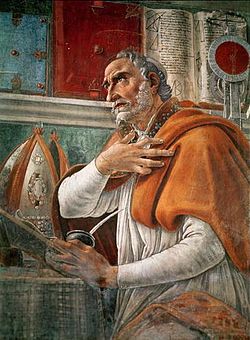
Saint Augustine of Hippo - 3 Cl.


Bishop, Confessor, Doctor of the Church.

Born at Thagaste in Africa in the year 354. As a young man he led an unsettled life both in the philosophy he professed and in his moral behaviour, but later, in the year 386, he was converted and then in 387 received baptism at Milan from the bishop Saint Ambrose. He came back to his own country and led the life of an ascetic. Elected Bishop of Hippo, for thirty-four years he was an exemplary bishop to his flock, teaching his people by his sermons and writings, striving to combat the errors of the time and to make the faith understood. He died in the year 430.

Collect:

Give heed, O almighty God, to our humble prayers, and since Thou givest us confident assurance in Thy loving kindness, deign to grant us, through the intercession of blessed Augustine, Thy Confessor and Bishop, the effect of Thy wonted mercy. Through our Lord...


'I charge thee, before God and Jesus Christ...preach the word: be instant in season, out of season: reprove, entreat, rebuke in all patience and doctrine.'

Comment:

It is no secret that I have a great devotion to the Doctor of Grace, whom I rank as the Greatest of the Fathers. I wish to consider myself, although a son of Holy Mother Church, first and foremost, as a disciple and follower of the Bishop of Hippo. So much could be said about him, but I wish to settle for a few lines concerning his life and how we can learn from the Divine Providence which guarded and protected him and brought him to the truth which set Augustine free.

1) Holy Augustine the Blessed, returned to the Faith that he 'had drunk in with his mother's milk' as an infant, Like the Virgin Mary and Saint Joseph, who found the Divine Child in the Temple where they had last met, Augustine found the truth and beauty he was seeking, in the name of Jesus that his loving mother had taught him since the start, in the Catholic Faith. He had abandoned the Catholic Church (although he was not baptised as an infant as per custom) as he believed certain teachings were irreconcilable with true thinking. After years of supposedly aimless pursuit for truth, Augustine found that he had possessed it right from the beginning. How many of us take for granted the great mysteries that have been handed on to us? How many of us have set aside the saving doctrine of Christ for the latest novelty? How many of us have refused to bend the knee to Jesus as we have been 'imprisoned in wickedness'?

2) One of the most profound discoveries Augustine made before his conversion was the books of the Platonists (of the 'neo' variety). Although devoid of the saving Name of Jesus Christ, and His unique role as Mediator between God and man, he found providentially a world view in which he could make sense of the Christian gospel. This discovery made possible the great passages he wrote concerning the 'nature' of evil, privation of the good, the deficient will etc. It is through God's ordering, in His Wisdom for His glory, that He brings man to Himself gradually, allowing His creatures to pursue error so that in the long term, he will be readily disposed to grace and conversion. Many of us nowadays, particularly of the traditionalist sort will have a very negative view of secular thinking and philosophy, however all that is truly good descends from the Father, the Source of all. All good is 'mined from the providence' of God and must be used for His honour. Let us not shrink back from a truth that secular wisdom has discovered, but let us appropriate it for the Gospel, for which it truly belongs. Augustine affirms this with a Scriptural illustration. When the Israelites departed from Egypt, that land of slavery, they dispossessed the natives of gold and silver. Such materials had previously been used for the construction of idols to be worshipped in vanity, yet the Good Lord had handed them over to His people, so that they might serve Him instead. Certain evangelical Protestants will assert that these items are of pagan 'origin', and must be discarded lest the Faith of Christ become polluted. We must never let such an attitude take hold of us. However, not all secular thinking is actually true, no matter how loudly and boldly they proclaim so. We must never appropriate a teaching that is contrary to the Holy Catholic Faith 'passed onto the saints once for all', but must promptly discard it as erroneous.

3) Lastly, Augustine came to realise that what is incorruptible is vastly superior to what is corruptible. We all know the sins of Augustine, so I do not wish to state them here, however his life manifests the truth that no matter what intellectual capacity you have been gifted with, you are able to be blinded to the divine light and cling to filth, Let us discern the divine traces in creation as they all proclaim infallibly the goodness and power of the Godhead. Often we will see a beautiful woman and our eyes are drawn irresistibly to her form, yet let us acknowledge that she only, in a very finite manner, participates in the Supreme Beauty, Which is God of His Essence. One day she will be returned to the dust, unrecognisable. He will continue as that 'Beauty so ancient and so new'. We are able to love Him only because He has loved us first, and called us to share in His divine trinitarian communion of Love and life. This is what the human spirit longs for, an acceptance according to truth and perpetual felicity and peace that the world is unable to give.

I wish to finish with a quotation from this holy Doctor concerning the souls pursuit for He Who is and then an extract from the Psalmist:

'You called and cried to me and broke open my deafness: and you sent forth your beams and shone upon me and chased away my blindness: you breathed fragrance upon me, and I drew in my breath and do now pant for you: I tasted you, and now hunger and thirst for you: you touched me, and I have burned for your peace.'

'O God, you are my God, for you I long.
For you my soul is thirsting.
My body pines for you
like a dry weary land without water...'


P.s. I believe this should be a First Class Feast (:

Wednesday, 11 August 2010

Distinction of Providence

Saint Augustine distinguishes two 'forms' of divine providence at work.

1) 'Natural' providence whereby the Lord works in a mysterious, inward manner to create, sustain and order according to natural processes. He writes:

'If all existing things would cease to be if form were taken from them, the unchangeable form by which all mutable things exist and fulfill their functions...is to them a providence. If it were not, they would not be'

2)'Voluntary' providence occurs most of all because of the plight of fallen man. In this 'form', He in His gracious mercy converts men from sin and turns them to Him through no merit of their own. He sustains order despite the corrupt nature of man and his predisposition to evil. He acts in space and time, to judge and punish evil, and to reward those who act according to justice. However, most importantly of all, He accomplices His saving work by sending prophets to preach repentance, and at the summit of the story of redemption, He sends the Logos to assume flesh in the womb of the Holy Virgin. Even today through His Catholic Church, He works by the interior illumination and cleansing of the Holy Spirit to bring men from the 'old man' to put on gradually the 'new man' Who is Christ Jesus. He in His wisdom orders creation to His glory and His will could never be frustrated.