Thursday, 6 May 2010
The Beauty Of The Liturgy
The modern world is often rushed, a rabble surrounds one constantly, a barrage of information attacks the ears, flashy lights dazzle the eyes. Anger and impatience is indicative of the culture, where one must be satisfied on request.
The Christian soul has somewhere to turn to in the midst of this pollution, someone to rely on. One is often lonely in a crowd, yet in the encounter that occurs between God and creature in the Sacrifice of the Mass, grace and infinite blessings are bestowed. The veil is pulled back separating heaven and earth. This is a foretaste of eternity, of knowing as one is known.
Christ, who calls us brothers and friends, dwells with us, and is offered up to the Eternal Father, by the priest who stands in His person. The priest must approach the Altar in fear and trembling, he will utter the most sacred words that will confect the Eucharist, the Sanctifier will transform mere bread and wine, into the body, blood, soul and divinity of the Redeemer and Lord of all, to give life to all who partake of the offering. His lips unclean from speaking evil, have the great grace of wispering in love and reverence, 'Hoc est enim corpus meum'. Not even the angels, exalted high above man in stature, intelligence and sinlessness, have been called to send up the most pure Sacrifice to redeem man. The priest must not take this solemn duty lightly, his salvation depends upon him becoming like the Sacrifice immolated infront of him. He truly is an alter Christus, he must have his mind, lips and heart conformed to the likeness of Jesus.

REGINA CAELI LAETARE ALLELUIA!
Let us join the angels in proclaiming the Resurrection of our Lord Christ, who has destroyed our death. Holy Mother of God, pray for us that we may be made worthy of the promises of God.
''The Church acknowledges Gregorian chant as specially suited to the Roman liturgy: therefore, other things being equal, it should be given pride of place in liturgical services.'' (Sacrosanctum Concilium 116)
He came to set the captives free...

Details, from CNS:
A hazy sun settling slowly behind Tucson's "A" mountain softly illuminated the 20 women in bright-orange uniforms who were gathered in the razor-fenced yard. Every face was aglow and smiling as they filed back into the prison. They had just taken part in an event unusual -- perhaps unprecedented -- at the minimum-security Southern Arizona Correctional Release Center: the full initiation of five inmates into the Catholic faith. Correctional officers looked on as Tucson Bishop Gerald F. Kicanas baptized and confirmed the five young women in outdoor ceremonies witnessed by the quintet's sponsors and friends, while other inmates at the 300-resident facility ate dinner and then relaxed in an adjacent yard. Carmelite Father Ron Oakham, pastor of St. Cyril of Alexandria Parish and a prison chaplain, assisted the bishop, after earlier listening to several confessions in a far corner of the yard. Deacon Oscar Chavez traveled from Yuma to play a guitar and lead the gathering in song. Tears flowed, along with holy water, as Bishop Kicanas baptized three of the inmates and anointed them with chrism, and all five were confirmed. The five are Ashley Ireson, Eve Medina, Tammy Judd, Hermelinda Arzate and Kimberly Antone.Photo by CNS/Bern Zovistoski, the New Vision
God wills for all men to be saved (his antecedent will), and wishes that no man be refused the message of the Gospel. There are so many poor souls, who are rejected for past errors, and are not regarded worthy of forgiveness. Those behind bars are often less imprisoned than us who claim to live a free life but are willing slaves to sin. Let us not abandon those in need of our assistance and prayers, even if they seem to be beyond redemption. They may be less wretched than we are. They are still our brothers.
'There is more rejoicing in heaven for one repentant sinner, than for ninety-nine righteous men in no need of repentance.'
Infallibility

The very word produces a great deal of confusion, hostility and misunderstanding among many people, even Catholics. How can one man or an institution claim infalibility when sin abounds, judgements are erroneous, and man is weak?
Our Good Lord promised to be with His Church, His Bride until the end of time, He would not leave His little ones to suffer from the prowling lions or the ravenous wolves. Once He had ascended to where He had come, He sent the Paraclete to enlighten the darkened minds of the Apostles to lead them into all truth and declare God's message of salvation to all nations. Christ cares for each soul, and if only one soul were to enter heaven, He would still have laid down His life for its salvation, therefore if the Church were to defect from the faith, the incarnation would have been in vain. As Scripture testifies to, the Church is the pillar and foundation of truth. The Angelic Doctor wrote, '"There are three things necessary for the salvation of man: to know what he ought to believe; to know what he ought to desire; and to know what he ought to do.". The Holy Spirit must then preserve the faithful from being polluted by errors that will the soul into hell. As the Church of Rome is the very foundation (built upon the true foundation of Christ), she must be guarded from heresy, and the faithful must cling to her with tenderness and submission.
This is what we mean by the charism of 'infallibility'. Let us not mistake this for 'impeccability', which is the ability of not sinning. The Holy Father, who I dearly love, has and can sin, he can cause scandal and put his soul at risk, yet the Holy Spirit protects the faithful from being bound to error.
Extraordinary Infallible Magisterium ("Solemn Magisterium"):
This can be either a papal announcement where the Roman Pontiff, who in his office of Successor to Saint Peter, the Prince of the Apostles, the Vicar of Christ, solemnly proclaims a matter of faith and morals to be bound upon all. Also attached to this is a warning that if any one were to dare to reject this teaching, they would be cut off from the Church since they have fallen away from the Faith and abandon eternal life. This is what we mean by 'ex cathedra', out of his seat, that is, his position of God-given authority as the earthly Head of the Church, the keeper of the keys.
The First Vatican Council states:
'We teach and define that it is a dogma Divinely revealed that the Roman pontiff when he speaks ex cathedra, that is when in discharge of the office of pastor and doctor of all Christians, by virtue of his supreme Apostolic authority, he defines a doctrine regarding faith or morals to be held by the universal Church, by the Divine assistance promised to him in Blessed Peter, is possessed of that infallibility with which the Divine Redeemer willed that his Church should be endowed in defining doctrine regarding faith or morals, and that therefore such definitions of the Roman pontiff are of themselves and not from the consent of the Church irreformable.'
The Roman Pontiff, can not contradict Sacred Scripture, Sacred Tradition or previous infallible pronouncements by predecessors. This charism is very rarely used however, and is not as some think, a license to assert whatever one wishes to advances one's temporal power.
A more common way to declare dogmas of the Faith is that of the Ecumenical Councils. In the history of the Church, there have been 21 Councils, beginning in AD325 in Nicea, until the Second Vatican Council in 1962-65. A Council in order to be considered infallible must have the approbation of the Supreme Pastor for any decrees, and within this assent, no matter how many bishops wish to proclaim something, it can not be done. The bishops, although sucessors to the Apostles, must be united under the Bishop of Rome. The truths proclaimed must be adhered to by the faithful, or will sufffer condemnation.
The Second Vatican Council was not, as some seem to assert, a super-council that trumps and exalts over all others. This Council was called for purely pastoral reasons and proclaimed no dogmas whatsoever that were not held previously by the people of God. Errors were in the documents, and a flattering acceptance of the supposed 'progress' of humanity is contained within. There are numerous ambiguities in which have brought about serious confusion and disorientation written in the documents.
Ordinary Infallible Magisterium ("Constant Magisterium" or "Universal Magisterium"):
When the popes, bishops and priests teach the faith in accordance with the deposit of faith (the faith delivered to the saints once and for all, until the death of the last Apostle, John), and with what has always and everywhere been taught by the Church.
Merely Authentic Ordinary Magisterium:
This is the everyday teaching of the popes, bishops, priests and those authorised to present the faith, and if it does not fall into either of the two above categories, it may contain error. An obedience is due to this teaching, as we cling to Holy Mother Church to preserve us from being tossed around by any wave of doctine, unless it contradicts Sacred Tradition or is harmful for the salvation of souls. Resistance must occur if any teaching contradicts the Faith.
Protestants believe that Paul, Matthew, Peter, Jude, John, Mark, Luke, David, Solomon, Isaiah, Moses etc were infallible from writings the Sacred Books, so why can not the Holy Spirit preserve the Pontiff from proclaiming error?
Protestants believe that Paul, Matthew, Peter, Jude, John, Mark, Luke, David, Solomon, Isaiah, Moses etc were infallible from writings the Sacred Books, so why can not the Holy Spirit preserve the Pontiff from proclaiming error?
Characteristics of the Just Man

According to Ecclesiasticus 39:6-14:
The Just Man will:
-love the Lord above all, and love all others for the sake of the One who created him.
- not mock the Lord by turning to Him as a last resort when all other sources of comfort have failed him. He will turn to Him earnestly early on.
- recognise the Most High as his only fortress, comfort, rock and strength. The help of mortal man is useless, the weakness of the Lord is infinitely greater than the power of sinners.
- receive mercy from God, who will content and satisfy him. He knitted his inmost being together in the womb, and is the end of human nature.
- confess his faith in the goodness and mercy of the Creator openly and will not mumble his hope half-heartedly in the darkness.
- acknowledge his iniquites and failings with honesty and turn immediately to beseech the Good Physician to heal him and bind up his wounds.
- receive the gifts of the Sanctificator, who will bestow upon him, graces and blessings. God is not outdone in generosity.
- come to know the intimate secrets of the deity. Only with a pure heart, can a man embrace the truth revealed to him. Those who linger in the company of sinners and seek the admiration of scorners will fumble in the darkness.
- have his received knowledge and wisdom shine forth as a light to the nations to comfort and give direction to those confounded.
- receive honour from the people of God, who will beseech his prayers, and will uncover the jewels within his writings.
- be remembered forever while the arrogant rich will return to the dust and leave their wealth to be squandered by their children.
...of the Greek Variety

Saint Maximus the Confessor on the universal jurisdiction of the Roman Pontiff:
'How much more in the case of the clergy and Church of the Romans, which from old until now presides over all the churches which are under the sun? Having surely received this canonically, as well as from councils and the apostles, as from the princes of the latter (Peter and Paul), and being numbered in their company, she is subject to no writings or issues in synodical documents, on account of the eminence of her pontificate .....even as in all these things all are equally subject to her (the Church of Rome) according to sacerdotal law. And so when, without fear, but with all holy and becoming confidence, those ministers (the popes) are of the truly firm and immovable rock, that is of the most great and Apostolic Church of Rome.''
Let us pray that the Patriach of Constantiple and the Eastern 'Orthodox' will return to the Faith of their fathers. Talks are currently ongoing which is optimistic, and with the assistence of the Holy Theotokos, all those who profess the name of Christian may be one under the Vicar of Christ.
St. Maximus, pray for us!
Wednesday, 5 May 2010
Fruits of Lectio Divina - May 5
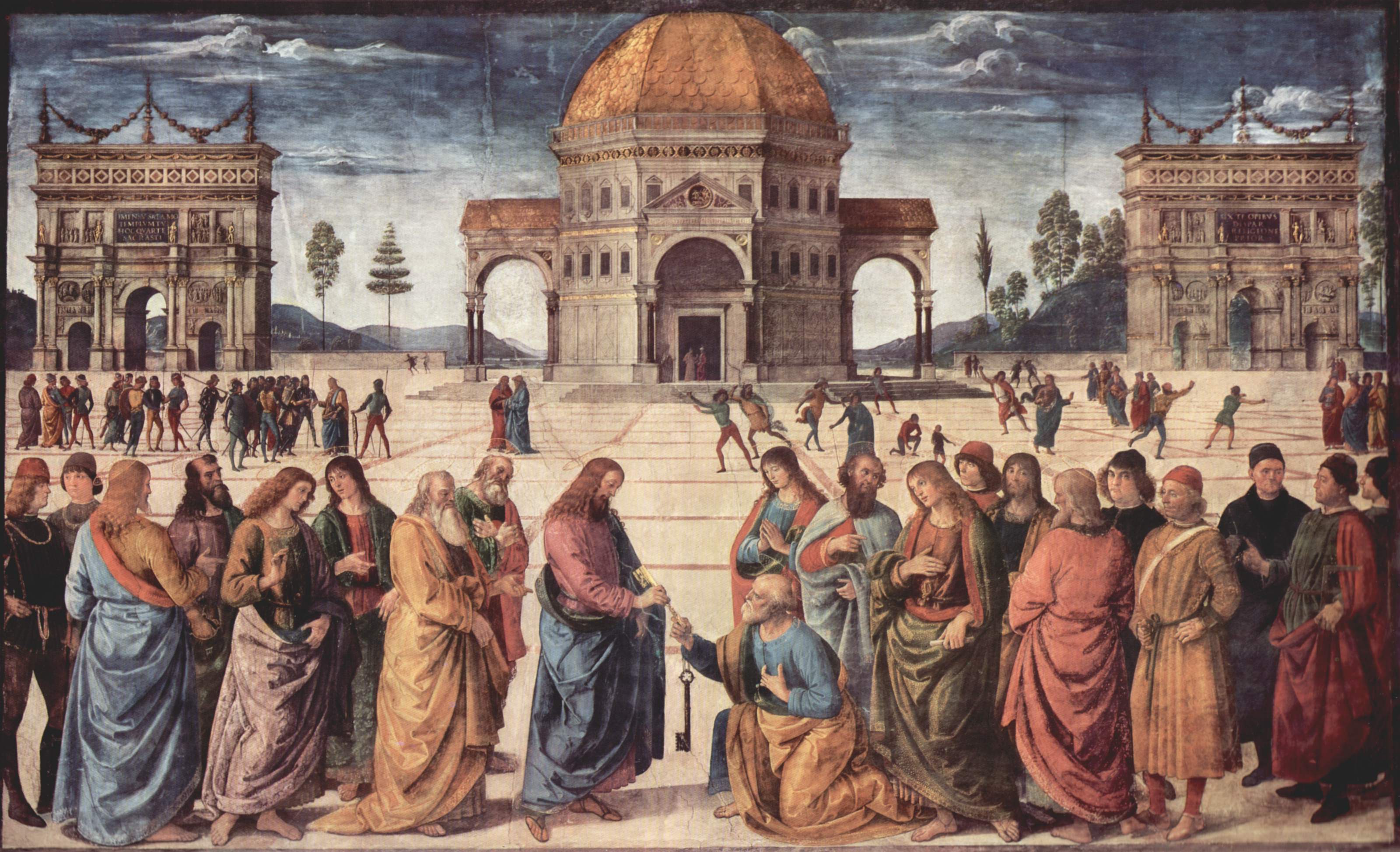
We honour the with great joy today, the holy Pontiff Pius V, a defender of the faith amidst confusion and error.
The Holy Gospel is taken from St. Matthew 16:13-19.
On a historical note, Caesarea Philippi was called Paneas, but in AD 14, Phillip the Tetrarch, renamed it in honour of the Emperor Caesar Augustus. Therefore, already in this scene we have the presence of Rome, the same city that will rule over the Christian world in charity.
'Jesus came into the quarters of Caesarea Philippi' initially I disregarded this phrase, it did not seem to me to have anymore relevance than mere locational information. Our Lord's whole life and every feature of it has teaching value.
Mere historical placement? Yet, St. John Chysostom highlighted a very significant aspect of this journey,which led me to a fuller meditation. Our Lord left the land of the Jews to enter in a territory named after the greek god for desolate places 'Pan'. In order to embrace the truth, to receive and nourish it with love, one must leave behind what is familiar, what seems natural, what seems secure A self abandonment must occur, a leap into the arms of the living God who created and redeemed us. A life of sanctity can not occur when one is submerged in the rabble and noise of the city, of the crowd. It was only while suffering hunger, thirst and despondency, that purification could transpire, which eventually led them into the promised land. Yet, we Christians have a greater hope, a treasure shored in our Father's house, where moth can not eat away at, or thieves break in and steal. Our Lord through the darkness of our night, wishes to cleanse the soul of all impurities, imperfections, to create a temple where the Blessed and Undivided Trinity can dwell.
The Apostles when asked who the Son of Man is, refer to him in existing patterns of Jewish thought. The world has attempted, and continues to do so, to mold our Lord and His unique mission into its image to suit specific ideologies, however something new has appeared on the earth. He was merely a prophet or a holy man. Nothing more.
Denis the Cathusian (1402 – 1471) believed they regarded our Lord as:
John the Baptist on account of His prodigies.
Elias because the Jews expected the holy man to return to them (Mal. Behold I will send you Elias. Because of His miracles and as a result of His zeal and determination for the truth.
Jeremiah, as He was regarded as saintly, and was sanctified in the womb before birth, and because of the great love of His brothers (He is a lover of brethren).
One of the prophets, namely Isaias, for His eloquence and His preaching of the truth.
Although surrounded by inadequacy in their opinions of Him, the Eternal Father reveals the truth concerning His beloved Son. Our Saviour expected the Apostles, the ones who had spent so much intimate time with Him, who had propounded the mysteries of the Kingdom to them, to believe more than the faithless Jews. He had conferred on them great power to heal the sick and cast out devils, yet their minds were still polluted by falsehood. Jesus, a prophet (the one promised in Deuteronomy) is more than one simply called and filled with the Holy Spirit as from without. He is the natural Son of the living and true God, from whom the Holy Spirit, the bond of love (copula), proceeds with the Father, and who does not participate in the divine life by grace but by His very essence. The other judgements are not worth the dignity of the incarnate Logos, and it is Peter alone who confesses the true faith. The Father ratifies what our Lord had already done when He called Peter 'Rock' earlier on in His ministry. The Unbegotten One elected from all eternity to place Saint Peter as the Prince of the Apostles, the man who would have the Church, the spotless bride of His Son, built upon himself. Even though, it is Peter who at divine prompting acknowledges the truth, yet how many of us would have chosen this weak, cowardly man to spread the message of the Good News to the rest of the world? Yet, one can not scrutinise the ways of the Most High, who chooses the foolish and pitiable in the world's eyes to shame the proud and the strong.
Let all nations look to the See of Peter, Rome, who rules with divine right over the Church, upon whom the people of God depend. This privilege (and burden) continues with the blessed Apostle's successors, and no man can be saved if he be unwilling to submit to the Roman Pontiff, the Vicar of Chirst. Within the sea of discontent, social changes, disorientation and turmoil, the Servant of the Servants of God valiantly confesses what God has handed on to the saints once and for all. If the Holy Roman Church be the very basis of the Church, She can never be counfounded, or fall into heresy, if so, what would happen to the little stones built upon her?
Our Good Master established His Church, His Body to announciate the salvation brought about by His Cross, and He pledged to guard her, as a good bridegroom, from all contamination of error. Jesus is intimately concerned for each of us, and through His divine power, will not abandon His Bride, the sacrament of salvation, 'the gates of hell shall not prevail.' As the Lord never deceives, nor can be deceived, His promise will never be reneged. The light shines forth from the First See, to convert the world to the love of the Redeeming Creator.
Although later given to the whole group of the Apostles, initially a right given freely to Peter, that is, to bind and loosen, is of great benefit. The Holy Father in virtue of his election to the Apostolic See, can bind souls, which is of greater importance than earthly kings who can only restrain and liberate limbs. This most sacred power may refer to absolution, excommunication, dispension of vows/promises and indulgencies among others.
May the Holy Mother of God, the Queen of Heaven, protect the Holy Father and guide him to proclaim the Faith with devotion and love.
God Bless our Pope, the great, the good.
Tuesday, 4 May 2010
Archbishop Sheen Commenting on Easter Sunday Mass
Let us continue to rejoice this Eastertide in the Resurrection of our Lord.
Regina Caeli, Laetare, Alleluia...!
Veiling

I found this well thought-out, articulate piece on http://www.fisheaters.com/:
For 2,000 years, Catholic women have veiled themselves before entering a church or any time they are in the presence of the Blessed Sacrament (e.g., during sick calls). It was written into the 1917 Code of Canon Law, Canon 1262, that women must cover their heads -- "especially when they approach the holy table" ("mulieres autem, capite cooperto et modeste vestitae, maxime cum ad mensam Dominicam accedunt") -- but during the Second Vatican Council, Bugnini (the same Freemason who designed the Novus Ordo Mass) was asked by journalists if women would still have to cover their heads. His reply, perhaps innocently enough, was that the issue was not being discussed. The journalists (as journalists are wont to do with Church teaching) took his answer as a "no," and printed their misinformation in newspapers all over the world. 1 Since then, many, if not most, Catholic women have lost the tradition.
After so many years of many women forgetting or positively repudiating the veil, clerics, not wanting to be confrontational or upset radical feminists, pretended the issue didn't exist. When the 1983 Code of Canon Law was produced, veiling was simply not mentioned (not abrogated, mind you, but simply not mentioned). However, Canons 20-21 of the 1983 Code of Canon Law make clear that later Canon Law abrogates earlier Canon Law only when this is made explicit and that, in cases of doubt, the revocation of earlier law is not to be presumed; quite the opposite:
Canon 20 A later law abrogates or derogates from an earlier law, if it expressly so states, or if it is directly contrary to that law, or if it integrally reorders the whole subject matter of the earlier law. A universal law, however, does not derogate from a particular or from a special law, unless the law expressly provides otherwise.
Canon 21 In doubt, the revocation of a previous law is not presumed; rather, later laws are to be related to earlier ones and, as far as possible, harmonized with them.
Canons 27 and 28 add to the argument:
Canon 27 Custom is the best interpreter of laws.
Canon 28 Without prejudice to the provisions of can. 5, a custom, whether contrary to or apart from the law, is revoked by a contrary custom or law. But unless the law makes express mention of them, it does not revoke centennial or immemorial customs, nor does a universal law revoke particular customs. 2
Christian veiling is a very serious matter, one that concerns two millennia of Church Tradition -- which extends back to Old Testament tradition and to New Testament admonitions. St. Paul wrote.
1 Corinthians 11:1-17:
Be ye followers of me, as I also am of Christ. Now I praise you, brethren, that in all things you are mindful of me and keep my ordinances as I have delivered them to you. But I would have you know that the head of every man is Christ: and the head of the woman is the man: and the head of Christ is God. Every man praying or prophesying with his head covered disgraceth his head. But every woman praying or prophesying with her head not covered disgraceth her head: for it is all one as if she were shaven. For if a woman be not covered, let her be shorn. But if it be a shame to a woman to be shorn or made bald, let her cover her head. The man indeed ought not to cover his head: because he is the image and glory of God. But the woman is the glory of the man. For the man is not of the woman: but the woman of the man [c.f. Genesis 2-3]. For the man was not created for the woman: but the woman for the man. Therefore ought the woman to have a power over her head, because of the angels. But yet neither is the man without the woman, nor the woman without the man, in the Lord. For as the woman is of the man, so also is the man by the woman: but all things of God. You yourselves judge. Doth it become a woman to pray unto God uncovered? Doth not even nature itself teach you that a man indeed, if he nourish his hair, it is a shame unto him? But if a woman nourish her hair, it is a glory to her; for her hair is given to her for a covering. But if any man seem to be contentious, we have no such custom, nor the Church of God [i.e., if anyone want to complain about this, we have no other way of doing things, this is our practice; all the churches believe the same way]. Now this I ordain: not praising you, that you come together, not for the better, but for the worse.
According to St. Paul, we women veil ourselves as a sign that His glory, not ours, should be the focus at worship, and as a sign of our submission to authority. It is an outward sign of our recognizing headship, both of God and our husbands (or fathers, as the case may be), and a sign of our respecting the presence of the Holy Angels at the Divine Liturgy. In veiling, we reflect the divine invisible order and make it visible. This St. Paul presents clearly as an ordinance, one that is the practice of all the churches.
Some women, influenced by the thoughts of "Christian" feminists, believe that St. Paul was speaking as a man of his time, and that this ordinance no longer applies. They use the same arguments that homosexualists make in trying to prove their case. In this quote, homosexualist Rollan McCleary, who believes that Jesus was "gay," tries to show that Paul's admonitions against homosexuality were culturally conditioned:
In the New Testament, the Apostle Paul writes about "men, leaving the natural use of the woman, burned in their lust for one another, men with men committing what is shameful, and receiving in themselves the penalty of their error which was due" (Romans 1:27).
Asked about these texts, McCleary said references in the Scriptures to homosexuality were misunderstood or taken out of context.
"In those days they didn't have kind of concept of homosexuality as an identity such as we have it," he argued. "It has much more to do with other factors in society ... homosexuality was associated with idolatrous practices."
In the case of Paul's writings, he continued, "does everybody agree with St. Paul on slavery [or] on women wearing hats? There is such a thing as historical context."
Of course we Catholics agree with St. Paul on slavery (St. Paul wasn't talking about chattel slavery, by the way), and on veiling, and on everything else! Please! But the liberal above makes a point: if Christians want to reject veiling, why not reject the other things St. Paul has to say? The traditional Catholic woman has the snappy comeback to the defiant homosexualist: "we do veil ourselves and don't disagree with St. Paul!" But what leg do the uncovered women have to stand on? And what other Scriptural admonitions can they disregard on a whim -- or because of following the bad example of a generation of foolish or misled Catholic women who disregarded them?
Now, I ask my readers to re-read the Biblical passage about veiling and note well that St. Paul was never intimidated about breaking unnecessary taboos. It was he who emphasized over and over again that circumcision and the entire Mosaic Law were not necessary -- and this as he was speaking to Hebrew Christians! No, the tradition and ordinance of veiling is not a matter of Paul being influenced by his culture; it is a symbol that is as relevant as the priest's cassock and the nun's habit.
Note, too, that Paul is in no way being "misogynist" here. He assures us that, while woman is made for the glory of the man even as man is made for the glory of God, "yet neither is the man without the woman, nor the woman without the man, in the Lord. For as the woman is of the man, so also is the man by the woman: but all things of God." Men need women, women need men. But we have different roles, each equal in dignity -- and all for the glory of God (and, of course, we are to treat each other absolutely equally in the order of charity!).The veil is a sign of our recognizing these differences in roles.
The veil, too, is a sign of modesty and chastity. In Old Testament times, uncovering a woman's head was seen as a way to humiliate a woman or to punish adultresses and those women who transgressed the Law (e.g.., Numbers 5:12-18, Isaias 3:16-17, Song of Solomon 5:7). A Hebrew woman wouldn't have dreamed of entering the Temple (or later, the synagogue) without covering her head. This practice is simply carried on by the Church (as it is also by Orthodox Christians and even by "Orthodox" women of the post-Temple Jewish religion today).
That which is Veiled is a Holy Vessel
Note what Paul says, "But if a woman nourish her hair, it is a glory to her; for her hair is given to her for a covering." We don't veil ourselves because of some "primordial" sense of femine shame; we are covering our glory so that He may be glorified instead. We cover ourselves because we are holy -- and because feminine beauty is incredibly powerful. If you don't believe me, consider how the image of "woman" is used to sell everything from shampoo to used cars. We women need to understand the power of the feminine and act accordingly by following the rules of modest attire, including the use of the veil.
By surrendering our glory to the headship of our husbands and to God, we surrender to them in the same way that the Blessed Virgin surrendered herself to the Holy Ghost ("Be it done to me according to Thy will!"); the veil is a sign as powerful -- and beautiful -- as when a man bends on one knee to ask his girl to marry him.
Now, think of what else was veiled in the Old Testament -- the Holy of Holies!
Hebrews 9:1-8
The former [Old Covenant] indeed had also justifications of divine service and a sanctuary. For there was a tabernacle made the first, wherein were the candlesticks and the table and the setting forth of loaves, which is called the Holy. And after the second veil, the tabernacle which is called the Holy of Holies: Having a golden censer and the ark of the testament covered about on every part with gold, in which was a golden pot that had manna and the rod of Aaron that had blossomed and the tables of the testament. And over it were the cherubims of glory overshadowing the propitiatory: of which it is not needful to speak now particularly. Now these things being thus ordered, into the first tabernacle, the priests indeed always entered, accomplishing the offices of sacrifices. But into the second, the high priest alone, once a year: not without blood, which he offereth for his own and the people's ignorance: The Holy Ghost signifying this: That the way into the Holies was not yet made manifest, whilst the former tabernacle was yet standing.
...The Ark of the Old Covenant was kept in the veiled Holy of Holies. And at Mass, what is kept veiled until the Offertory? The Chalice -- the vessel that holds the Precious Blood! And, between Masses, what is veiled? The Ciborium in the Tabernacle, the vessel which holds the very Body of Christ. These vessels of life are veiled because they are holy!
And who is veiled? Who is the All Holy, the Ark of the New Covenant, the Vessel of the True Life? Our Lady -- and by wearing the veil, we imitate her and affirm ourselves as women, as vessels of life.
This one superficially small act is:
so rich with symbolism: of submission to authority; of surrender to God; of the imitation of Our Lady as a woman who uttered her "fiat!"; of covering our glory for His glory; of modesty; of chastity, of our being vessels of life like the Chalice, the Ciborium and, most especially, Our Lady;
an Apostolic ordinance -- with roots deep in the Old Testament -- and, therefore, a matter of intrinsic Tradition;
the way Catholic women have worshipped for two millennia (i.e., even if it weren't a matter of Sacred Tradition in the intrinsic sense, it is, at the least, a matter of ecclesiastical tradition, which also must be upheld). It is our heritage, a part of Catholic culture;
pragmatic: it leaves one free to worry less about "bad hair days";
and for the rebels out there, it is counter-cultural nowadays, you must admit!
The question I'd like answered is, "Why would any Catholic woman not want to veil herself?"
Fruits of Lectio Divina - Fourth Sunday of Easter

The Holy Gospel is taken from John 16:5-14.
Our Lord Jesus Christ, true God and true God, united in one Person has completed His redeeming work on earth and awaits for the appointed time to return to His Heavenly Father, where the souls of the righteous will enter through the gates behind Him. 'Vado ad eum, qui misit me' (I go to Him that sent me).
What spiritual relevance has this for us today? Human beings have of their nature a longing to be fulfilled, a desire to reach happiness, a joy that transcends all created nature, who is God. He is our origin, as He created us out of nothing to show forth His glory through His Word, and He is our end, as He knows us imitately and He Himself is the completion of our being. But on account of the Fall of the first Adam, the way to God became blocked which only the Second Adam, the One who was heavenly could reconcile us to Him, through offering a perfect Sacrifice which we could not supply. The way to our end, which is also our origin, is therefore rocky, rugged, filled with disappointment. However this return to the divine is more blessed, a felix culpa, as we can call our Lord 'Saviour' and our path is animated by charity. This Way of the Cross troublesome as it is, traces the life of our divine Master, through His death to a share in His kingdom and glory.
'But because I have spoken these things, sorrow hath filled your heart'. Why were the Apostles sad? Were they beginning to comprehend the significance and mission of our Lord? Most likely not. As told by St. Luke in Acts, the Apostles manifest their earthly folly by asking whether this is the time when Jesus is going to restore the kingdom to Israel. Yet, Jesus would reign from on high seated at the right hand of the Unbegotten One, and not at the head of an army on horseback. A cleansing of confusion and Jewish pride must be replaced with light and service.
The reason (among many I am sure) is that they had no where else to go. They had given up all that they had, they had renounced earthly prizes in favour of following Christ, yet their minds were still polluted by earthly driven ambitions. Only the light of the Holy Spirit, the Paraclete (Advocate) would be able to drive out their errors and lead them into life.
'But when He, the Spirit of truth, is come, He will teach you all truth'. Heretics who foolishly spurn the regula fidei, will use this text to assert that the Son was ignorant or incapable of leading His Apostles to truth. He is the Truth Himself! He lacks nothing. Away with this nonsense. Blessed Augustine acknowledges the reality behind this statement of our Lord. The humanity of our Lord, His appearance in the flesh was a stumbling block to His chosen ones. As a result of their deficiency in faith and their inability to grasp heavenly truth, they could see very little past the mere man who appeared before them. He was mysterious to them certainly, but the existence of His divinity was beyond them.
The Holy Spirit enables us to proclaim Christ, as it is He who moves our heart to confess Jesus as Lord. He will 'convince the world of sin' as He brings us to a realisation of Jesus and His unique mission, which includes a recognition of our own sinfulness and the human condition. We can not attain to glory of our own power, but it is a grace of the Holy Spirit which first brings us to faith, which we must accept. Therefore faith is authentically human yet initiated by God.
'Of justice'. He has completed our reconciliation with the Father, and justice is the correct ordering of things, ultimately in our relation with the living and true God who deserves the worship of our very being.
'Of judgement'. The reign of Satan is at an end, he has been tossed from His throne, yet he continues to prowl the earth (with even greater menance and ferocity) in order to devour souls. As Simeon proclaims, it is Christ that makes possible our rise, but also the descent of others. Those who refuse to believe, die in their sins by ignoring the prompting of the Paraclete.
Christ will be glorified as the Spirit will move sunful men to confess the Cross of the Begotten One, which is His glory, whereby He drew all men to Himself by being lifted up, His 'hour'. His shame leads to our acceptance. He does not leave us orphans, He will be with us until the close of the age. In fact, it is by the power of the Spirit that Christ becomes present in the Mass, through the priest who stands in persona Christi, and is offered to the Heavenly Father. 'Veni Sanctificator omnipotens, aeterne Deus: et benedic hoc sacrificium tuo sancto nomini praeparatum'.
The 'immanent Trinity' is reflected by the 'economic Trinity' otherwise God would act in a manner contrary to His very nature. The Spirit receives His essence from the Son (with the Father as one principle) as 'He shall receive of Mine'. This refers not merely to the temporal mission, but the eternal procession of the Third Person.
Scottish Bishops on General Election 2010

''A general election has been called. The message the Bishops Conference of Scotland sends you is this: Make your faith count!
The political choices we face today are not the choices your parents and grandparents faced. They would never have voted for any candidate who refused to protect unborn human life, who supported experimentation on human embryos, or planned to assist unfortunate people to commit suicide. They would never have voted for a candidate who would undermine marriage and family in the way that has happened in recent years with cross-party support. They would never have voted for candidates who rejoiced in same sex unions. They would never have voted for candidates who would stop the Church offering adoption services. They would never have voted for candidates who were clearly hostile to the values they held dear. Your parents and grandparents voted for those they believed shared the same fundamental Christian values as they did. It is for us to do likewise to shape a society where the dignity of each individual and life itself is respected.
As Catholics we know the importance of protecting every human life and of the value that married family life gives to society. These values were once widely shared but times have changed. Many of those standing for election, of whatever party, do not share our basic principles and values. That is why we say to you: when you vote, make your faith count. Vote with your faith to protect human life; to support marriage and the family; to protect religious freedom; to protect Catholic education. Vote with your faith, and uphold the right of conscience and religious freedom.
In urging you to let your faith count at the ballot box, we ask you to think carefully before you cast your vote. Which candidate displays values closest to yours? Which candidate will best respect and protect your religious freedom and your freedom of conscience? Which candidate do you trust most to do a good job for you and your community?
As your bishops, it is not our intention to tell you which party to vote for. It is our duty to encourage you to engage with the political process and to vote for the candidate who best represents the values we, like our parents and grandparents before us, hold dear.''
I heard this on Sunday at Mass, and I was quite pleasantly surprised. Too often our bishops mess around with niceties, and subtle comments that would barely be noticed, burried beneath meaningless cliches. An added force is needed to shake the sleeping faithful. A lot is at stake on the 6th, and we Catholics should not just 'take into consideration' our faith, but make it the very foundation upon our choice.
I will not attempt to advocate one party in preference to another, as none of the main parties perfectly represent Christian values (although they regularly say they do).
With our bishops, I urge you to make your vote count, a vote for the family, a vote for marriage, a vote for life....a vote for Christ.
Monday, 3 May 2010
Further Reflection on Anglican Conversion to Rome

Anglican support for abortion, contraception, euthanasia, female ordination or any other secular novelty is not the problem. The real issue lies hidden within the very framework of Protestantism, in its essence, in its foundation. In Catholic apologetics, we often speak of a 'three-legged stool', id est, Sacred Tradition, Sacred Scripture and the Magisterium of the Church, yet the reformers attempted to do away with the popish inventions and their 'one-legged stool' (sola scriptura) tumbled. These moral issues are merely symptoms of a much more systematic error, one that can not simply be tweaked, it will self-destruct...in fact it already has.
All of these positions can be 'defended' (with some success at least) by a faulty reading of Scripture, which is divorced by the living Tradition and the guidance of the Pope and the bishops in communion with him. This evidently proves that without authoritative teaching ('how can I know if I have no one to teach me?' asked the Ethiopian eunuch), the revelation of God crumbles under the attempt of man to form in its own image. Souls are at stake. Anglicans: This nonsense will continue, what else will they attempt to justify using their modernist logic and worldview? One schism renders worthless the principles that hold us together, resulting in further division. Return to the faith of your fathers and salvation. May the Mother of the Church guide you to her Son.
All of these positions can be 'defended' (with some success at least) by a faulty reading of Scripture, which is divorced by the living Tradition and the guidance of the Pope and the bishops in communion with him. This evidently proves that without authoritative teaching ('how can I know if I have no one to teach me?' asked the Ethiopian eunuch), the revelation of God crumbles under the attempt of man to form in its own image. Souls are at stake. Anglicans: This nonsense will continue, what else will they attempt to justify using their modernist logic and worldview? One schism renders worthless the principles that hold us together, resulting in further division. Return to the faith of your fathers and salvation. May the Mother of the Church guide you to her Son.
Pope Quote Of The Week

Pope Saint Pius V
"All the evils of the world are due to lukewarm Catholics."
Comment: God gratuitously grants grace to mankind so that they may come to serve Him holy and blamelessly, yet our actions and omissions may render our neighbour less well disposed to accept that grace. Are you a channel of grace or a stumbling block?
Ut Unum Sint...the true sort of ecumenism

This is the true sort of ecumenism that the Faith calls for. It is not enough merely to hope for ''good will' between the Church and other faith communities, but a conversion to the Catholic Church, founded by our Lord upon St. Peter. The Pope is a fisher of men....gee, that's a shock.
''Leading bishops in the Church of England have secretly told Vatican officials they are ready to defect to Rome (for those of us familiar with history, it was their sexually incontinent king that left the Church and took them with him) it was claimed on Sunday.
Senior Anglican bishops met the Pope's advisers for 'cloak and dagger' talks about plans which would allow large numbers of clergy to convert to Catholicism (Deo Gratias).
Traditionalists have been angered over the introduction of women bishops, due to be debated at a crucial General Synod meeting in July.
A group of bishops travelled to Rome last week to hold face-to-face discussions with officials from the Congregation for the Doctrine of the Faith, the most powerful department of the Vatican.
The Rt Rev John Broadhurst, the Rt Rev Keith Newton and the Rt Rev Andrew Burnham, the bishops of Fulham, Richborough and Ebbsfleet, discussed how clergy could convert to Catholicism, it was reported
The move is likely to raise tensions between the two churches (the CoE is not truly a 'church', plus truth regularly causes anger), ahead of Pope Benedict's visit to Britain in September.
One bishop was said to have compared the summit to 'a declaration of war'. (a war that the weak, lifeless error driven secular Anglicans will not win)
More than 1,300 clergy have written to the Archbishop of Canterbury, Dr Rowan Williams (he will probably call them 'eccentric'...he loves that word), threatening to leave if women are consecrated as bishops (should read: if women have ordination attempted on them...).
The Church of England has voted in favour of female bishops but has yet to work out how the legislation will be implemented. (majority voting is not the best way to preserve truth and revelation)
Plans for the Pope's visit have already been mired in controversy because of the child abuse scandals (it seems some Anglicans are more interested in truth than media hysteria...) and the leaked Foreign Office memo, suggesting Pope Benedict launch a condom range and visit an abortion clinic during his time here (slaughter house is my prefered term).
An email sent by Bishop Burnham earlier this year revealed the degree of secrecy surrounding the Vatican talks.
'It has all felt a little bit like Elizabethan espionage,' he wrote. 'This is not known about fully in England and Wales... Hence the cloak and dagger.'
The Vatican opened the doors for Anglican clergy to convert last year, when it set out detailed plans to allow them to serve as Roman Catholic priests.''
http://www.dailymail.co.uk/news/article-1270639/Anglican-Bishops-met-Vatican-cloak-dagger-plan-convert-Catholicism.html
It must be acknowledged that the Anglicans approached His Holiness first. However, I wish to offer a warning. 'Swimming the Tiber' is not a quick fix solution to show outrage. The decision to return to the Faith must be for the reason of wishing to worship as God has revealed in His Church. It is necessary for the conversion to be based upon deeper principles, and not mere resentment at certain 'novelties' in the Anglican Communion, however these errors manifest the contradictions and falsehoods that the CoE is built upon.
It already seems that certain Catholic bishops of the liberal (used to be called heretical) variety are worried with an influx of liturgically reverent faithful who wish to adhere to the revealed truth of God.
Truly the Holy Father is the 'Pope of Christian Unity'.
Latin Doctor Quote Of The Day
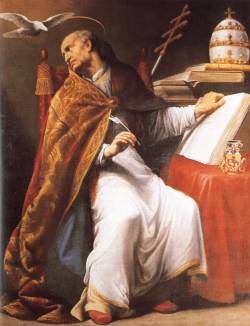
Pope Saint Gregory the Great
'He who would climb to a lofty height must go by steps, not leaps.'
The life of the Christian servant is one of struggle, toil and hardships, a strain towards renewing the likeness of God. This cannot happen by the repetition of a 'sinner's prayer', or a mere acknowledge of Christ as Saviour, but must be built upon the solid rock of faith, the walking (with frequent stumbling) of the Way of the Cross.
Thursday, 29 April 2010
Things our Lord did not say...

'Go forth and nationalise all industries...'
This is in response to a foolish comment that someone wrote to me concerning our Lord's political persuasion. No, he was not a socialist. His Holiness Pope Venerable John Paul II wrote:
''We have to add that the fundamental error of socialism is anthropological in nature. Socialism considers the individual person simply as an element, a molecule within the social organism, so that the good of the individual is completely subordinated to the functioning of the socio-economic mechanism. Socialism likewise maintains that the good of the individual can be realized without reference to his free choice, to the unique and exclusive responsibility which he exercises in the face of good or evil. Man is thus reduced to a series of social relationships, and the concept of the person as the autonomous subject of moral decision disappears, the very subject whose decisions build the social order. From this mistaken conception of the person there arise both a distortion of law, which defines the sphere of the exercise of freedom, and an opposition to private property. A person who is deprived of something he can call "his own", and of the possibility of earning a living through his own initiative, comes to depend on the social machine and on those who control it. This makes it much more difficult for him to recognize his dignity as a person, and hinders progress towards the building up of an authentic human community.'' (Centesimus Annus)
These leftists will need to think again then...
Fruits of Lectio Divina - April 29
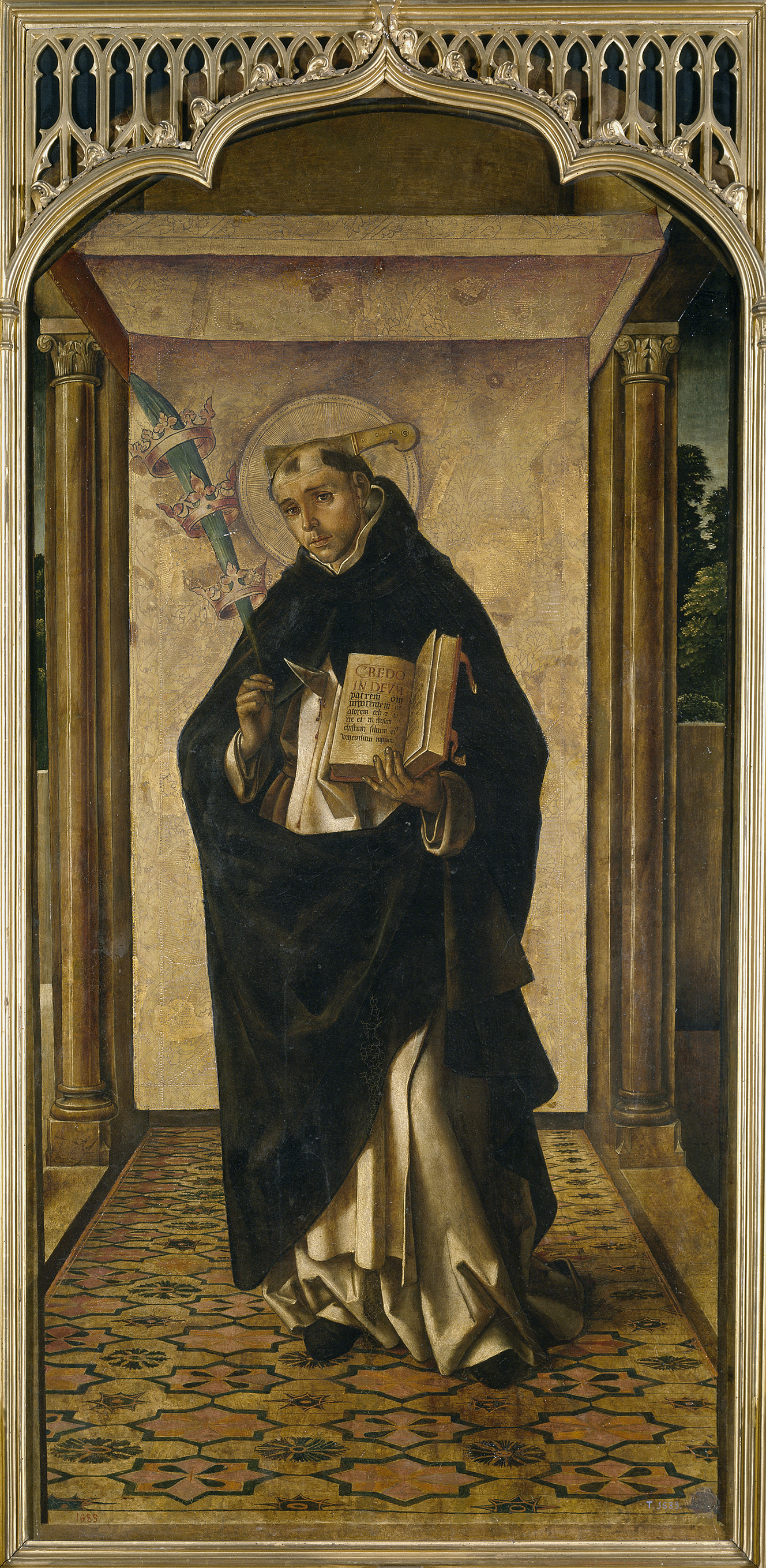
Let us poor sinners today cry out for the marvellous intercession of Saint Peter of Verona, so that we may be made worthy of the promises of Christ.
The Epistle is taken by the Second Letter of Blessed Paul the Apostle to Timothy, 2:8-10; 3:10-12.
Saint Paul, called by our Lord directly to become the Apostle to the nations has a timely message for us all even today. He reaffirms the truth that so many deny; Christ truly rose again from the dead after being put to death by sinful men.In fact, if He did not rise again, our faith would be in vain. He was 'of the seed of David', the promised one who would occupy the throne and exercise dominion over His kingdom, with His foes beneath His feet. He was and still is (He will never set aside His humanity) true God and true man. Consubstantial with the Father according to His divinity and of the same nature with us according to His assumed humanity, united in one existing subject, the Second Person of the Undivided Trinity.
Our Lord calls us out of sluggishness to follow Him, to turn aside from Egypt, to enter into a union of love with God and to be one with Him as He is with His Father. This is the purpose of the Christian life.
The human person shys away from difficulty, it is not becoming to the nature of man to toil. Yet as a result of man's Fall in Adam, suffering leading to death cannot be avoided. As the Apostle in his Epistle to the Romans rightly states though, all can be turned to good for those who love God. The Cross gains us salvation; the Way of the Cross leads us to it.
All earthly pains are as nothing compared to the glory that is to be revealed in us when the time comes. Let us meditate on our Master who went before us, even to death on a cross, but was exalted as He submitted to the Father's will. He set aside His glory, assumed the condition of a slave, all for you so that you may avoid the pains of hell and enjoy a more blessed mode of existence. His great love for sinners knows no bounds.
Do you suffer? Blessed be God. Do you toil? Blessed be God. Are you mocked by men? Blessed be God. Such a path was trod by our Saviour. He sanctified the way before us, making it possible for us to be inherit the kingdom prepared for us before the foundation of the world. Is the servant greater than the Master? Why do you turn aside by 'walking in the man'? Why do we wish to remodel the revelation of God to our own mind?
The grace to enable us to become saints receives its efficacy from the Cross of our Lord which will infallibly lead us onto life if we choose to accept it(an acknowledgement to Fr. Emerson for this). Out of the sleeping Adam, came His bride Eve; out from the sleeping Christ came the Church (the blood and water, the sacrament of salvation, outside of which no man can be saved. All graces pass through her, so if a man cuts himself from her or refuses to be united in the one vine, he will have no life in him.
Saint Paul begged for God to remove the thorn from his side, but the reply came as, 'My grace is sufficient for you', let us then accept whatever is given to us in order to increase our sanctity which comes through patience and resignation to the divine will.
The just man must suffer, however, 'he shall not be bruised: for the Lord putteth His hand under him. He showeth mercy and leadeth all the day long''. That means, our refuge and strength is in God alone, the help of man is in vain. So with this grace which is promised to us, as God is never outdone in generosity, let us become channels of grace so that the message of our salvation to others will not be impeded. How inspired must have been the early Christians when they noticed the hardships the Apostle was willing to undergo for their salvation! When a cross is loaded upon our shouldiers, let us embrace it joyfully in a manner befitting a servant of Christ. The hope we have in the Catholic Faith must emcompass, direct and inform our lives, no harm to our bodies can then injure our soul.
We must also beseech the mercy and most powerful intercession of the spotless Mother of God, the Mother of the Church, who will leads us always in her great love which surpasses all creatures to her Son.
Wednesday, 28 April 2010
Saint Louis Marie De Montfort

Today, the servants of Christ and His Mother honour the life of Saint Louis Marie de Montfort. A much forgotten saint, but one who has had considerable influence on the spiritual lives of recent Pontiffs and on my own. His love for Jesus, all through the Mother of God, shone through his writings, inspiring all who are blessed to read them, to approach with confidence the New Eve, Mary Immaculate. I wish to share with you some of his sayings:
"If you put all the love of all the mothers into one heart it still would not equal the love of the Heart of Mary for her children."
“We fasten our souls to Your hope, as to an abiding anchor. It is to Her that the saints who have saved themselves have been the most attached and have done their best to attach others, in order to persevere in virtue. Happy, then, a thousand times happy, are the Christians who are now fastened faithfully and entirely to Her, as to a firm anchor!”
''[Mary] is the safest, easiest, shortest and most perfect way of approaching Jesus and will surrender themselves to her, body and soul, without reserve in order to belong entirely to Jesus.''
His Holiness Pope Venerable John Paul II wrote in Apostolic Letter Rosarium Virginis Mariae concerning devotion to the spotless Virgin:
“Our entire perfection consists in being conformed, united and consecrated to Jesus Christ. Hence the most perfect of all devotions is undoubtedly that which conforms, unites and consecrates us most perfectly to Jesus Christ.
Now, since Mary is of all creatures the one most conformed to Jesus Christ, it follows that among all devotions that which most consecrates and conforms a soul to our Lord is devotion to Mary, his Holy Mother, and that the more a soul is consecrated to her the more will it be consecrated to Jesus Christ."
Let us then take up this exhortation and fly to the refuge of sinners, the Holy Virgin who will guard us from all error and corruption and lead us to her Son who is the Way to the Father.
Let the faithful praise the name of Mary, for the greater glory of God.
Ad Jesum Per Mariam
Holy Father To Create New Dicastery

From www.catholicnewsagency.com:
''Rome, Italy, Apr 26, 2010 / 10:31 am (CNA/EWTN News).- Pope Benedict XVI is about to release a letter announcing the creation of a new Vatican dicastery called the Pontifical Council for the New Evangelization. The new department will be aimed at bringing the Gospel back to Western societies that have lost their Christian identity.
Andrea Tornielli, the Vatican correspondent for the daily Il Giornale who is usually well-informed on new appointments at the Vatican, wrote today that “Benedict does not cease to surprise: in the upcoming week the creation of a new dicastery of the Roman Curia dedicated to the evangelization of the West will be announced, and be presided over by Archbishop Rino Fisichella.”
The new dicastery is aimed at evangelizing “countries where the Gospel has been announced centuries ago, but where its presence in their peoples' daily life seems to be lost. Europe, the United States and Latin America would be the areas of influence of the new structure,” Il Giornale says.
According to Tornielli, the new dicastery would be “the most important novelty of Pope Benedict’s pontificate, a Pope that, according to the expectations, was supposed to slim down the Roman Curia.”
Tornielli says that the idea of such a dicastery was first proposed to Pope John Paul II by Msgr. Luigi Giussani, the late founder of the Italian-born movement Comunione e Liberazione (Community and Liberation), but the idea did not move ahead.
In response to the question of how the idea resurfaced, Tornielli says, according to “authoritative sources,” the proposal of the dicastery comes from the Patriarch of Venice, Italy Cardinal Angelo Scola.
During his tenure as Rector of the Pontifical Lateran University, Cardinal Scola promoted intense reflection on the loss of Christian identity in Europe. The Patriarch of Venice was also a member of Communion and Liberation, and in his current position has shown significant concern for the de-Christianization of Europe and the Western world.
Fisichella, the currently embattled head of the Pontifical Academy for Life, succeeded Angelo Scola as Rector of the Lateran University and as such, shared the same concerns of his predecessor.''
The Roman Pontiff has been increasing worried about the decline of Christianity in nations who used to hold firmly to the faith. So he should be, as we all should too. Catholicism has receded into the background, and then openly mocked and scorned by liberals. What is to be done? We must abandon our practice of aggressive polemics. We must present the faith in a rational, systematic fashion, propounding the principles of Catholic truth, built upon solid catechesis. It will no longer do to cry out, 'that's wrong', 'that's a sin', we must show why precisely it is contrary to the will of God. What is the Church's teaching on marriage, family and sexuality? This must be presented rather than a mere decrying of homosexuality. This is essential if we wish to reclaim society for Christ.
Fruits of Lectio Divina - April 28

Today Holy Mother Church honours the merits of the great Saints Paul of the Cross and Louis-Marie de Monfort and begs for their most powerful intercession. The Epistle is taken from 1 Corinthians 1: 17-25:
A dichotomy is set up by the Apostle concerning the wisdom of God and the supposed wisdom of this passing world. The Cross of our Lord is mere folly for the scholars, intellectuals and the self-proclaimed wise, as who has ever heard of a crucified Messias?
The Old Testament states 'cursed is the man who hangs upon a tree', yet our Lord takes upon the curse, that is our death, the punishment of our first parent and redeems us through His most Precious Blood. Is death not a failure? Is it not the triumph of darkness over the human person who wishes to preserve himself? However, our Lord's perfect act of satisfaction confounds all categories of simple human thinking, classification and systematization. The ineffable Word of the Father sets aside the glory according to His Divine nature, takes on the form of a servant is beholded by men in the flesh.
Only those with the eye and mind of faith can accept this act of divine condescension. The image of the Crucified One is a folly of great treasure, whose worth is hidden to those who look only with eyes of flesh. On the other hand we must walk by faith and not by sight, as we have been called from all eternity from the lump of perdition (mass perditionis) deserving of punishment, to be holy and blameless before Him.
Anyone can be persuaded to adopt any kind of position. One can be convinced to become a Communist, a vegetarian, a teetotaller, yet it is only by the operation of the Holy Spirit that a creature of wrath by nature can cry out 'Abba, Father' and trust in the Cross of the Living One. Such is an encounter with a Person, an event, not an abstract system of thought. The Apostle shows this when he says that he was sent by the Lord to preach the Good News, 'not in wisdom of speech, lest the cross of Christ should be made void'. He put forward no display of oratory or philosophy, but preached with clarity and a virtuous life the mystery of divine love. This call to love, which forms our being, carries us out of Egypt, leaving behind the givens and norms of sinful society into an union through grace.
Such a reality defies human thought and must be embraced in silence with reverence and awe.
Latin Doctor Quote Of The Day

Saint Teresa of Avila
'There is no greater cause of straying from the path of faithful perseverance than letting up in prayer.'
Comment: How many friends have we lost through negligence in not talking with them? How can a relationship remain alive and meaningful when the other is dead to you? Yet our soul does not depend upon the number of our friends. However, if we depart from the Good Shepherd, we will quickly be devoured by the passing wolves.
Tuesday, 27 April 2010
Fruits of Lectio Divina

This ancient method of conversing with God through His written Word is of great benefit. Such intimacy with God has been achieved by the saints through a slow meditative and prayerful read of Sacred Scripture, therefore a treasure like this is not to be neglected. For my Lectio, I will be using the 1962 Missal, and its calendar.
Today, the 27th of April, we honour Saint Peter Canisius (Confessor, Doctor) and plead for his glorious intercession. The Gospel for today's Mass is taken from Saint Luke 10: 1-9.
Today, the 27th of April, we honour Saint Peter Canisius (Confessor, Doctor) and plead for his glorious intercession. The Gospel for today's Mass is taken from Saint Luke 10: 1-9.
'The Lord appointed' - Only those who are commissioned by Christ can go forth and proclaim His message of salvation. No man can take this office and responsability upon himself, just as Christ did not set Himself up as the High Priest but was sent by His Eternal Father. However, in virtue of our Baptism, our incorporation into the Church, the Mystical Body of Christ, we are called to be 'channels of grace' for others. That is, to show forth God's universal love and desire that all men be saved. Also, by our confirmation, we are strengthened by the grace of the Paraclete to be soldiers for our Lord. As our Master, appointed 72 disciples to go out, He has a great mission for all members of His Bride. It is not solely the duty of our bishops and priests to proclaim the folly of the Cross, but ours too, although this must be done in accordance with our state in life. After all, we live in and amongst unbelievers and fellow Christians, it must be our virtuous conduct, that sweet odour of praise rising up to God that will draw men to Him.
'Two and two' - Although at times, we are rejected and scorned by men, we are never without a friend. The Good Lord's grace is sufficient for us, while we are surrounded by a cloud of witness who have went the Way of the Cross before us.
'He himself was to come' - All men will undergo the judgement of God. No man can shelter himself from the Just Judge, therefore it is necessary for missionaries to be sent to the four corners of the world, to preach the Good News of our peace. The disciples two thousand years ago, prepared the ground for the Lord to preach by foot, now we are are called to preach as new Saint John the Baptists, to prepare men to face the Judgement Seat of God.
'The harvest indeed in great' - The wolrd is alive with a rich crop of souls, that long to be gathered up into the divine life. Those left alone will perish over time, as they have no protection from the storm. Let us therefore pray unceasingly for vocations to the sacred priesthood, our Lord will surely grant our request.
'Go, behold I send you out as lambs among wolves' - Those who belong to Christ, must act in gentleness, charity and humilty, yet with the Lord as our refuge, we have no need to fear. The wolves, that is the corruptions of this world, its lies, its deceits and its illusions. A soul who abandons the rest of the flock through idle curiousity will easily be devoured by the passing beasts, unless it remains under the watchful care of the Good Shepherd.
'Salute no man on the way' - This does not mean that we are to show a dislike or a scorn for others, but we must not be distracted by the whims and fancies of this passing world and its pleasantries. Our first duty is to God.
'Carry...nor shoes' - Shoes offer comfort from the rocky and dirty ground. Yet the Lord is our comfort, He is our refuge, He protects us from fallings into danger. He guards our way. Those who turn aside from Him to seek satisfaction are easily discouraged and no amount of earthly goods will rectify that.
Monday, 26 April 2010
The Genius of Joseph Ratzinger

'Only Christ gives meaning to the whole of our life...Christianity is not an intellectual system, a packet of dogmas, a moralism. Christianity is rather an encounter, a love story; it is an event. This love affair with Christ, this love story which is the whole of his life was however far from every superficial enthusiasm, from every vague romanticism. Really seeing Christ, he (Don Luigi Giusanni) knew that to encounter Christ means to follow Christ. This encounter is a road, a journey, a journey that passes also - as we heard in the psalm - through the 'valley of darkness'. In the Gospel, we heard of the last darkness of Christ's suffering, of the apparent absence of God, when the world's Sun was eclipsed. He knew that to follow is to pass through a 'valley of darkness' to take the way of the Cross, and to live all the same in true joy'.
The Holy Father on the Internet.

The internet has great potential for good and for evil. It is constantly in the minds of worried liberals that young people may come into contact with those of 'radical' tendencies and 'extremist' viewpoints, yet the mainstream media regularly use this method of communication to impose their 'orthodoxy' on the the people. The Holy Father warns of the dangers yet encourages the proper utilisation of this. From www.radiovaticana.org:
''24 Apr 10 – RV) The need to give the Internet a soul and humanize the dynamics of the digital world was at the heart of Pope Benedict XVI’s message Saturday to participants in a conference on modern means of mass communication.
Promoted by the Italian Bishops Conference, “Digital Witness” draws together experts in information technology, social networking, web journalism and blogging to focus on the language we use and the way we communicate as Christians in the online society.
Pope Benedict told participants that the task of every believer who works in media, is to ensure the “quality of human contact, guaranteeing attention to people and their spiritual needs”. “This is increasingly urgent in today’s world”, he said, at a time when Internet appears to have a “basically egalitarian” vocation, but at the same time, “marks a new divide", the "digital divide" that "separates the included from the excluded"
"The dangers of homologation and control, of intellectual and moral relativism are also increasing, as already recognizable in the decline of critical spirit, in truth reduced to a game of opinions, in the many forms of degradation and humiliation of the intimacy of the person"
Thus said the Pope we see, a "spiritual pollution" that brings us to no longer "look one another in the face”. So we must “overcome those collective dynamics that risk reducing people to "soulless bodies, objects of exchange and consumption”. The media must become a “humanizing factor”, focused "on promoting the dignity of persons and peoples". Only then, will "the epochal times we are experiencing be rich and fertile in new opportunities":
"Without fear we must set sail on the digital sea facing into the deep with the same passion that has governed the ship of the Church for two thousand years. Rather than for, albeit necessary, technical resources, we want to qualify ourselves by living in the digital world with a believer’s heart, helping to give a soul to the Internet’s incessant flow of communication".
I would also like to take this opportunity to inspire all Catholic bloggers to defend His Holiness as he is being consistently attacked unjustly by modernists and liberals. Let us make a great effort to present the truth with clarity....and charity.
...of the Greek Variety

Now and then, I wish for us to experience the beauty of the Greek/Eastern approach to theology which is spiritual enrichening also. On to Saint Cyril of Alexandria concering the Eucharist:
'Accordingly, the holy body of Christ endows those who receive It with life and keeps us incorrupt when it is mingled with our bodies. For it is not the body of anyone else, but is thought of as the body of Him who is Life by nature, since It has within Itself the entire power of the Word that is united to it, and is endowed with His qualities, or rather is filled with His energy, through which all things are given life and maintained in being' (Commentary on John 324d).
My comment: Why do you abstain from the Eucharist? I am not worthy, you respond. Yet how will you ever be worthy if you refrain from receiving Him who comes to you in great love in order to sanctify you and allow you to share in the divine nature? Such an attitude is not always of humility, but a rejection of what the Good Lord has ordained for the salvation of your soul. The intimate union of our being with the Eucharistic flesh and blood of Christ enables us to become one with Him, who is one with the Father and the Holy Spirit, thereby we are then lifted up to partake of the trinitarian life by grace.
My comment: Why do you abstain from the Eucharist? I am not worthy, you respond. Yet how will you ever be worthy if you refrain from receiving Him who comes to you in great love in order to sanctify you and allow you to share in the divine nature? Such an attitude is not always of humility, but a rejection of what the Good Lord has ordained for the salvation of your soul. The intimate union of our being with the Eucharistic flesh and blood of Christ enables us to become one with Him, who is one with the Father and the Holy Spirit, thereby we are then lifted up to partake of the trinitarian life by grace.
Limbus Infantium...some considerations.

I have posted over the past few days mostly on purely spiritual topics, therefore I would like to make an attempt to create a short discussion on an issue that has never been defined by the Church.
One must first of all, make a distinction between Limbus Patrum (Limbo of the Fathers) and the topic that I will try to outline.
Before Christ had completed His redeeming work and had entered Heaven, those who had died as friends of God under the Old Dispensation descended to the Bosom of Abraham (Lk. 15:22), (or were purified first if stain was present at the moment of passing) where they awaited in this 'prison' to be set free. As sin had created a chasm between God and sinful man, no one could enter Heaven and experience the beatific vision of the Living One. However, once Christ our Lord had died He visited the souls there (Eph. 4:9) in order to preach the Good News and release them (1 Pet. 3:18-20). This, basically, is what the Church teaches on this matter. This is the Limbus Patrum.
Now onto the Limbus Infantium (of the children). As a piece of trivia, the word 'limbo' comes from the Late Latin of Germanic derivation word for a 'hem', or a 'border', something that goes around the outside.
Limbo is an attempt, mere theological speculation which aims to solve a difficulty that arises as a result of a few Catholic teachings. Although it is the subject of theological speculation, it does not mean that it is a matter of irrelevance to the rest of us non-theologians. In fact, it is a pressing matter considering how many poor children do not see the light of day, as they are ruthlessly murdered by their own mothers, under the guise of a ‘fundamental human right’.
The New Testament itself does not outline the fate of those who die without undergoing the laver of regeneration, even though they have committed no mortal sin of their own. Yet, as the Church upholds the teaching that baptism (or the desire of it) is necessary for salvation (Jn 3:5) propounded by our Lord Christ, and she also maintains the truth that men are born into this world with original sin, we are left with a dilemma. Young children, who are especially dear to our Master, while dying un-baptised, are guilty of no actual sin, therefore it would be unjust for God to condemn them to the everlasting punishment prepared for the. Therefore can they enter into Heaven? Saint Gregory Nazianzen writes, ‘since he who deserves not honour and glory is not for that reason worthy of punishment , and on the other hand he who is not deserving of punishment is not for that reason worthy of glory and honour’ (On Holy Baptism). One must remember that the Good Lord is under no obligation to grant a soul the beatific vision, such an experience is a great privilege and a grace. One cannot accuse Him who created us freely out of nothing for His glory of being unjustified in refusing entry to those who have died in the state of original sin.
These very brief considerations set out, it would be worthwhile to explore the history of this theory and see what it truly offers and the divergent thoughts on Limbus Infantium.
There is no concrete evidence that any Father before the Great Saint Augustine believed that original sin brought about any greater punishment than that of exclusion from the beatific vision. Saint Gregory Nazienzen’s (as quoted above) position is that of a neutral state, without sensible punishment yet without the delight that the immediate and direct vision of God’s essence brings about, which is indicative of the Greek Fathers’ position.
For the West, Saint Ambrose believed that original sin carried no guilt but is rather a disposition to sin, and the un-baptised (through no fault of their own) have nothing to fear when they come before the Judgement Sear. On a theological side note, concerning original sin, like actual sin, there is some aspect of aversion and conversion. The lack of original justice, the pure state of Adam is the privation, whereas the conversion is the proclivity to sin, otherwise known technically as concupiscence. This concupiscence lies behind each post-Fall sin, which is deserving of condemnation as the sin is committed voluntarily. On the other hand, original sin does not admit of deliberate intent. Saint Thomas states, ‘of all sins original sin is the least, because it is the least voluntary; for it is voluntary not by the will of the person, but only by the will of the origin of our nature’, therefore as any right thinking person would agree, ‘a lighter punishment is due to original than to venial sin (ST Appendix 1. Q1. A1). What is this ‘lighter punishment’ of which he speaks?
Let us now move onto the position of the Doctor of Grace, my Patron, the blessed Augustine.
Initially he wrote, ‘it is superfluous to inquire about the merits of one who has not any merits. For one need not hesitate to hold that life may be neutral as between good conduct and sin, and that as between reward and punishment there may be a neutral sentence of the judge’ (De libero arbitrio III). Yet, not long after (during the Pelagian heresy) the Bishop discarded the previously held belief (which was more lenient?) and managed to persuade his fellow Africans in the episcopate to adopt the view that the un-baptised share in some kind of misery, although he grants that their condemnation (if it may be called that) will be the mildest of all (Enchir. XXIII). Saint Thomas commenting states, ‘but this would not be so, if they were tormented with sensible punishment, because the pain of hell fire is most grevious. Therefore they will not suffer sensible punishment’. If not sensible punishment, will they merely experience ‘loss’, or will they remain in a state of purely natural happiness? Both positions have their defects...
(The next part will be posted in a few days, where the later history will be outlined and the theological difficulties will be exposed.)
Pope Quote Of The Week
 Pope Venerable John Paul II
'As the family goes, so goes the nation and so goes the whole world in which we live.'
Comment: The family is rightly considered as the basic building block of society, the primary agent of socialisation. If the family is disregarded or distorted by liberals, the whole of society collapses.
Thursday, 22 April 2010
Latin Doctor Quote Of The Day

Saint Ambrose
'In some causes silence is dangerous'
Blogger's Comment: It is not love of another to allow a brother to sin. Love endures evil, but has no wish for another to commit it. Love for another in fact, is the will for them to attain to the highest good, who is God. Silence is often taken for approval.
Wednesday, 21 April 2010
The Woman I Love

I have not yet praised the merits and glories of the Most Holy Mother therefore I must do so now. As sinful creatures of wrath, we were not worthy to receive directly from the hands of the Heavenly Father, His only-begotten Son, so He out of His inestimable goodness and mercy, created the pure Virgin out of nothing. He bestowed on her all His graces and privileges, thereby preserving her from the stain of original sin, so that she would be the terrestrial paradise to shelter His soon-to-be incarnate Son. What other women out of the billions who have ever been conceived, can compare to the Holy Mother, the Ark of the Covenant? No other female has ever been chosen to bear the Redeemer of the World. It is true indeed, that through her, the New Eve, comes our peace and salvation.
Why should we beseech the intercession of our Most Holy Mother, why should we turn to her as devoted children and servants? For one reason; this was the path taken by our Lord. He came to this earth taking His human nature from her undefiled womb and being born from her while causing her no pain, and was made visible to sinners. He remained under her authority for thirty years, so why should we wretched evil-doers shy away from abiding with her?
Her Son, Jesus is our Messias, the One who takes away the sin of the world, He is our Way to the Father, yet He is not known in this world as He should be. Saint Louis-Marie de Montfort rightly says that this is so as His Mother is not honoured enough by men. Our prayers should always be to the Mother of God, beseeching her to bring us closer to her Son, as there is no saint nearer our Lord Christ than His Mother. He assumed her into Heaven, body and soul, upon the completion of her earthly existence and crowned her with righteousness. She received in advance the aim of all Christian men. She had beforehand remained at the foot of the Cross, gently crying, her tender heart had truly been pierced, yet she remained ever faithful and knew that He whom she did merit to bear would rise as He said.
Let us therefore humble ourselves before our Mother, the same one given by our Loving Redeemer to the most chaste Saint John, and ask her devoutly to bring us to Jesus.
''Let us not imagine that we obscure the glory of the Son by the great praise we lavish on the Mother; for the more she is honored, the greater is the glory of her Son. There can be no doubt that whatever we say in praise of the Mother gives equal praise to the Son." - St. Bernard of Clairvaux.
Latin Doctor Quote Of The Day

“Up now, slight man! flee, for a little while, your occupations; hide yourself, for a time, from your disturbing thoughts. Cast aside, now, your burdensome cares, and put away your toilsome business. Yield room for some little time to God; and rest for a little time in him. Enter the inner chamber of your mind; shut out all thoughts save that of God, and such as can aid you in seeking him; close your door and seek him.” (Proslogion, Prologue)
Bloggers Comment: How many people queue for hours to catch a glimpse and say a few words to their celebrity heroes at a book signing? They will stand out in the wind, snow and the Scottish cold to exchange mere pleasantries, yet how many will spend a few moments in prayer with the Creator of all? What a great gift and grace for us to be able to converse with our Lord as a friend and be assured of His most loving response and assistance. Make sure after receiving Holy Communion, you beseech our Lord and His Blessed Mother for the grace of final perseverence, so that one day you may be numbered along with Saint Anselm in the Kingdom.
Tuesday, 20 April 2010
Idiotic Piece of Ignorance of the Week
This could be a regular feature, in fact I am better just referring you all to the New York Times website:
''The first-century church was inclusive and democratic, even including a proto-feminist wing and texts. The Gospel of Philip, a Gnostic text from the third century, declares of Mary Magdalene: “She is the one the Savior loved more than all the disciples.” Likewise, the Gospel of Mary (from the early second century) suggests that Jesus entrusted Mary Magdalene to instruct the disciples on his religious teachings. '' (A Church Mary Could Love, Nicholas D Kristof)
Apart from the blantant historical inaccurancies of his writing, the obvious bias against the Church, the addiction to a earthly kingdom of brotherhood (and sisterhood) etc, it was quite amusing to read.
The liberals seem to believe that if a woman was running the show, all would be rosy. Except if that woman is Margaret Thatcher of course...
Monday, 19 April 2010
Latin Doctor Quote Of The Day

Saint Augustine of Hippo
''Sing to the Lord a new song'. 'But I do sing', you may reply. You sing, of course you sing, I can hear you; but make sure that your life sings the same tune as your mouth. Do you wish to speak the praise of God? Be yourselves what you speak. If you live good lives, you are His praise.''
Bloggers Comment: One of the main reasons why many reject the Catholic Faith is the actions of some of her faithless members. Our lives should be spotless sacrifices offered up to God, a sweet fragrance that ascends and draws all men who come near.
On Conversion

Conversion always comprises a confrontation and an embrace. A rejection and a welcome. A refusal and a submission. We must at the reception of grace and the divine light,turn aside from what we have always known, what we have always accepted, what we have always believed to be true. A stripping of falsity must occur. A removal of the masks that through the years, we have covered ourselves in. An emptying that leads to fullness. A renunciation to a share in the divine nature.
Saint Thomas On The Good Shepherd

From His Commentary on the Holy Gospel According to Saint John:
Here he mentions four actions of a good shepherd: the first being that he knows his sheep. He says, he calls his own sheep by name, which shows his knowledge of and familiarity with his sheep, for we call by name those whom we know familiarly: "I know you by name" (Ex 33:17). This is part of the office of a shepherd according to: "Be diligent to know the countenance of your flock" [Prv 27:23]. This applies to Christ according to his present knowledge, but even more so considering eternal predestination, by which he knew them by name from eternity: "He determined the number of the stars, he gives to all of them their names" (Ps 147:4); "The Lord knows those who are his" (2 Tim 2:19).
The second action of a good shepherd is that he leads them out, i.e., he separates them from the society of those who are evil: "He brought them out of darkness and gloom" (Ps 107:14).
The third is that having separated them from evil and having brought them into the sheepfold, he has brought out all his own, from the sheepfold. He does this, first, for the salvation of others: "I will send survivors to the nations" (Is 66:19); "Behold, I send you as sheep in the midst of wolves" (Matt 10:16), so that they can make sheep out of the wolves. Secondly, they are to show the direction and way to eternal life: "To guide our feet into the way of peace" (Lk 1:79).
Fourthly, the good shepherd goes before his sleep by the example of a good life; so he says, he goes before them, although this is not what the literal shepherd does, for he follows, as in "I took him from following the ewes" [Ps 78:70]. But the good shepherd goes before them by example, "not as domineering over those in your charge but being examples to the flock" (1 Pet 5:3). And Christ does go before them: for he was the first to die for the teaching of the truth - "If any man would come after me, let him deny himself and take up his cross and follow me" (Matt 16:24); and he went before all into everlasting life - "He who opens the breach will go up before them" (Mic 2:13).
Pope Quote Of The Week

Pope Saint Pius X
''Holy Communion is the shortest and safest way to Heaven''
Bloggers comment: Is our reception of Holy Communion each week at Mass, a mere ritual that we do without any thought? Do we truly believe (not simply conceptually) that the Sacred Host is our Lord's body, blood, soul and divinity?
Some Thoughts on Good Shepherd Sunday

In the Gospel for Sunday, Our Lord declares Himself to be the Good Shepherd, which refers back also to the well-known Psalm (22), 'The Lord is my shepherd', showing that Jesus is the one promised to the Jews as a fulfillment of their Law.
What use are sheep for us? Does each have an intrinsic value for us, which is more than the flavour of a few lamb dinners? If we were to lose a sheep from our fold, would we not simply say, 'it does not matter, I have ninety-nine left'? We look merely at a collection of animals, and only at the slight benefit they are to us in food, or as an economic unit to be traded.
Yet, this is not how Christ views us. For Him, each of us has a great value in His sight. Not because we can return anything of value to Him that He lacks, but because we are His creatures. Archbishop Fulton Sheen used to say that even if we were not loveable, God loves us as He puts His love into us. He laid down His life freely for us, so that we may have life and have it in abundance. As He said, 'there is more rejoicing in Heaven over one sinner who repents than over ninety-nine righteous men in no need of repentence'.
The Passion and Death of our Lord does not allow us to do whatever we wish, as we have the promise that He has it 'covered'. His Crucifixion and Death give us a great opportunity, one that must not be taken for granted. The sheep that stray from the shepherd, will easily be devoured by the passing wolves. We too, if we are not careful in remaining close to God, will be torn apart by the corruption of this world. We have no excuse when this happens, this is utterly of our own doing. Christ never departs from us and His Sacrifice will have infinite value before His Heavenly Father, but as Hebrews states, 'for if we sin willfully after we have received the knowledge of the truth, there is now left no sacrifice for sins' (10:26). Let us often then reflect on our standing before God, isf He the foundation of our lives? Or do we 'compartmentalise' our faith, dragging it out of its box on a Sunday or whenever someone dies? Christ gave His entire being for us without reserve, our ransom has not been paid for in anything corruptable, but by the precious blood of the Lamb.
Saint Augustine of Hippo wrote, 'God loves each of us as if there were only one of us.'
Saturday, 17 April 2010
Latin Doctor Quote Of The Day

Saint Hilary of Poitiers
'Faith ought in silence to fulfil the commandments, worshipping the Father, reverencing with Him the Son, abounding in the Holy Ghost, but we must strain the poor resources of our language to express thoughts too great for words. The error of others compels us to err in daring to embody in human terms truths which ought to be hidden in the silent veneration of the heart.' (On the Trinity: Bk2.2)
Subscribe to:
Posts (Atom)