Saturday, 11 January 2014
Reflection on Moral Arguments
It is astonishing that some believe that merely stating the year is a logical argument in support or rejection of something.

Reflection on Didacticism and the Vetus Ordo
The Tridentine Latin Mass is at the same time supremely didactic as it instructs man in the one thing necessary, the adoration of God Who has loved us first.
Friday, 10 January 2014
Reflection on Public Opinion
Public opinion is rarely ever authentic. It is constantly being molded and malformed by self-appointed activists. The opinion poll can only display the socially acceptable views of a particular class.
Reflection on Leftist Newspapers
It often amuses me that a liberal bourgeoisie newspaper considers itself a specialist in assisting the poor and how the Church should respond to squalor. Class war may be utilised by both parties of the divide.
Reflection on the Reform of the Church
Any valid reform of the Church can only be to challenge her members instead of reassuring them in their vices. Greater holiness must always be the objective. Let the reader examine the pontificate of Gregory VII.
Wednesday, 8 January 2014
Reflection on the Name of Jesus
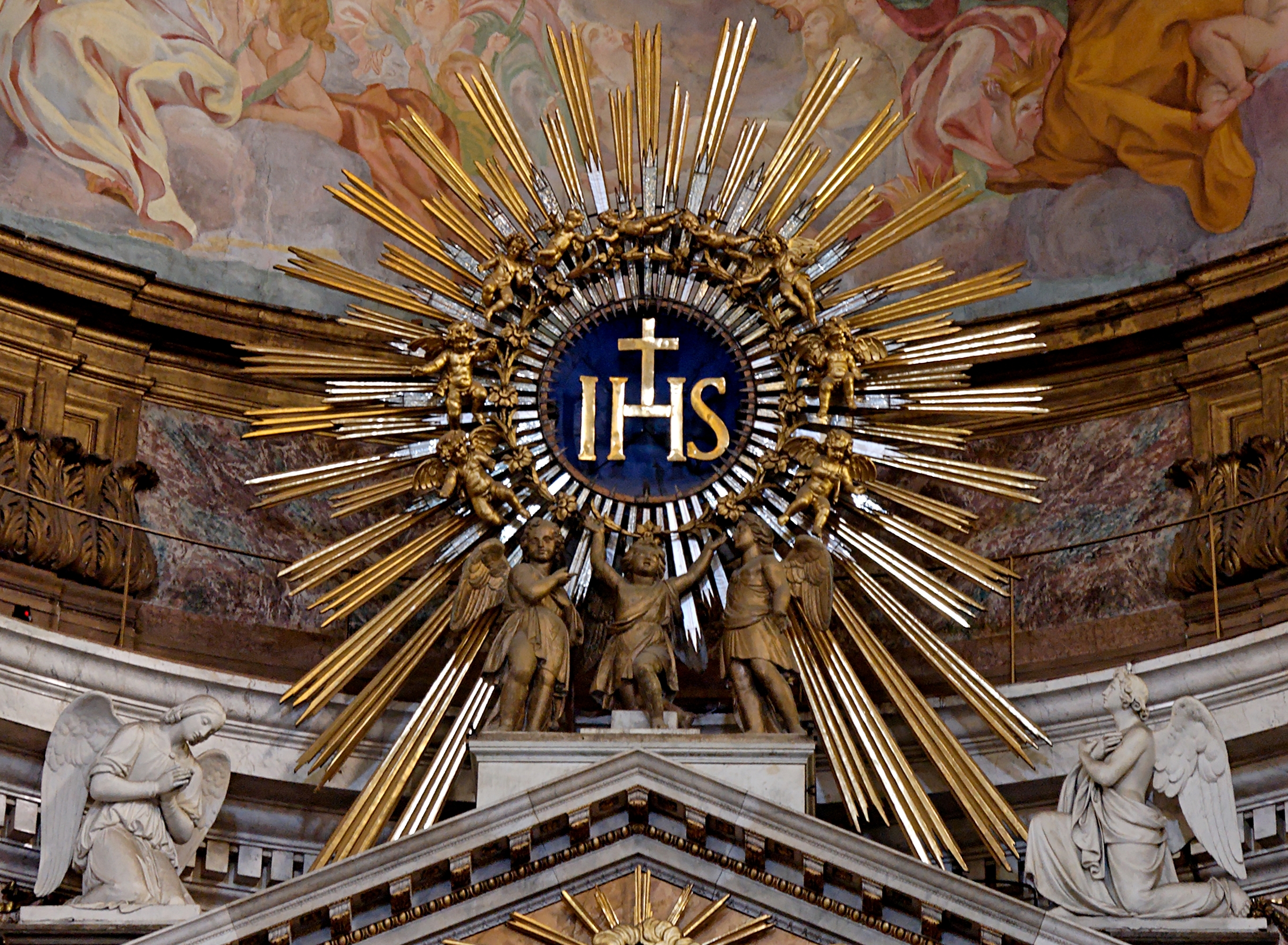
Many may have be known as Yehoshua but only One brought about what the Name signified. Truly, The Lord has saved His people.
Monday, 6 January 2014
Reflection on Honours

To refuse an honour while claiming the patronage of humility may arise from a love of show.
Sunday, 5 January 2014
Reflection on Liturgical Reform

Just as the principle of the organic development of the liturgy must obtain, so the necessity to preserve the sacred liturgy instead of tinkering with it in the light of current academic consensus must be held.
Reflection on the Holy Name of Jesus

If we proclaim God is love, to deny His gospel of salvation through Jesus to all men would be the most intolerable form of hatred and exclusiveness imaginable. Since there is only one Name that may save us, no platitude about charity could ever absolve us from the guilt incurred by reserving Christ to only some. We must not act as though the Name of Jesus is some oppressive burden but our sweetness and constant delight.
Friday, 3 January 2014
Why and How I Write
It almost axiomatic to the thinking men of our age that our civilization is in crisis. Not too much of what is truly civil remains, yet man persists in being aggressive in his pursuits and in his arrogance regarding the triumphs of modern society. Most recognise abhorrent behaviour and selfishness but few reach the underlying causes of such decay in the social interactions of men and women. We do not suffer from a crisis in behaviour but one that is far more fundamental to the disintegration of the Western world. Man has lost himself in his craving for freedom, and has bound himself to many demons. It is an intellectual and spiritual crisis that haunts our streets as men have abandoned God and grievously wounded themselves.
My intention in founding Filioque was to present my theological vision, combining the insights of Sts. Augustine and Thomas who comprise the best of the Roman Church's spiritual heritage. I may wish still to become a great theologian, proclaiming my profound knowledge of things divine at an ecumenical council but today, I can only offer more modest morsels. I am particularly irritated that the title of ''Exceptional and Pious Doctor'' has already been taken. In recent months, I have however dedicated myself to analysing the malaise of our society, a disease that as a young man I am unable to escape from. These 'aphorisms', as a generous priest has described them came about by accident, or at least through an interesting act of Providence. After damaging my laptop while in Spain and only having an Ipad to type with, which to be blunt is a nightmare, I resorted to writing short and often random reflections on the culture and Catholicism. My first acquaintance with the aphorism came through Nietzsche and I attempt through my contributions to overturn his errors and others like his. I do not write from a monastery, I do not have that luxury, but from experiences tied to this world in more ways that I wish. The greatest advice I could give a Catholic writer is to remain relevant. I read a particular piece of counsel from Cardinal Mercier of Belgium a while back which continues to be my inspiration.
''Always keep current; know what the modern world is thinking about; read its poetry, its history, its literature; observe its architecture and its art; hear its music and its theatre; and then plunge deeply into St. Thomas and the wisdom of the ancients and you will be able to refute its errors''
With the wisdom gained through my study of St Thomas I hope to counter some fundamental errors of society and why the rights of God must be upheld for the sake of man's freedom and dignity. The flaws in modern thinking are revealed all around us, in the pop songs that pervert our ears, the lewd images that bombard our eyes and the wicked speech on the tongues of our contemporaries. Yet the same people who help to cause the degradation of society are still made in the image of God and are worth saving. The longing for love and acceptance is still present at the core of their being and it is up to us to reveal the One they have been searching for, consciously or not.
I do not attempt to sentimentalise the Faith which may gain me more followers but no glory in heaven. The treasure of the Catholic Church is there for all to behold and love, which is a great consolation amid the mockery of many. It is from a knowledge and love of this Faith revealed by the authority of God and proclaimed by His Church that I attempt to refute the fallacies of this age which are so damaging to right thought and correct morals. From this fountain of wisdom, one can proceed to diagnose the ills of modern society, leading the infected back to God. I generally do not plan my writings, but through reading articles on current affairs, culture, politics, debates on social media and religion, certain thoughts come to me and I write them down in short form, hoping that they benefit some soul out there a little.The reflections are all my own, unless stated. What is good in them, give thanks to God. What is defective, correct me. Errors form our environment, in turn influencing the decision making of many who are generally thought to be good. As only a 23 year old layman, unknown to most, I can only have limited reach but the little good I hope to do may be enough to convert one soul which would be a great blessing.
Until He come,
Charles
My intention in founding Filioque was to present my theological vision, combining the insights of Sts. Augustine and Thomas who comprise the best of the Roman Church's spiritual heritage. I may wish still to become a great theologian, proclaiming my profound knowledge of things divine at an ecumenical council but today, I can only offer more modest morsels. I am particularly irritated that the title of ''Exceptional and Pious Doctor'' has already been taken. In recent months, I have however dedicated myself to analysing the malaise of our society, a disease that as a young man I am unable to escape from. These 'aphorisms', as a generous priest has described them came about by accident, or at least through an interesting act of Providence. After damaging my laptop while in Spain and only having an Ipad to type with, which to be blunt is a nightmare, I resorted to writing short and often random reflections on the culture and Catholicism. My first acquaintance with the aphorism came through Nietzsche and I attempt through my contributions to overturn his errors and others like his. I do not write from a monastery, I do not have that luxury, but from experiences tied to this world in more ways that I wish. The greatest advice I could give a Catholic writer is to remain relevant. I read a particular piece of counsel from Cardinal Mercier of Belgium a while back which continues to be my inspiration.
''Always keep current; know what the modern world is thinking about; read its poetry, its history, its literature; observe its architecture and its art; hear its music and its theatre; and then plunge deeply into St. Thomas and the wisdom of the ancients and you will be able to refute its errors''
With the wisdom gained through my study of St Thomas I hope to counter some fundamental errors of society and why the rights of God must be upheld for the sake of man's freedom and dignity. The flaws in modern thinking are revealed all around us, in the pop songs that pervert our ears, the lewd images that bombard our eyes and the wicked speech on the tongues of our contemporaries. Yet the same people who help to cause the degradation of society are still made in the image of God and are worth saving. The longing for love and acceptance is still present at the core of their being and it is up to us to reveal the One they have been searching for, consciously or not.
I do not attempt to sentimentalise the Faith which may gain me more followers but no glory in heaven. The treasure of the Catholic Church is there for all to behold and love, which is a great consolation amid the mockery of many. It is from a knowledge and love of this Faith revealed by the authority of God and proclaimed by His Church that I attempt to refute the fallacies of this age which are so damaging to right thought and correct morals. From this fountain of wisdom, one can proceed to diagnose the ills of modern society, leading the infected back to God. I generally do not plan my writings, but through reading articles on current affairs, culture, politics, debates on social media and religion, certain thoughts come to me and I write them down in short form, hoping that they benefit some soul out there a little.The reflections are all my own, unless stated. What is good in them, give thanks to God. What is defective, correct me. Errors form our environment, in turn influencing the decision making of many who are generally thought to be good. As only a 23 year old layman, unknown to most, I can only have limited reach but the little good I hope to do may be enough to convert one soul which would be a great blessing.
Until He come,
Charles
Reflection on Social Justice
Just as not everyone who says to Christ, 'Lord Lord' shall enter the Kingdom of Heaven, not all who proclaim 'Think of the poor!' are truly concerned about the vulnerable in society.
Reflection on Carrying the Cross
It falls to all men to carry a cross, but only those who lift it with their graze on Christ can hope for it to become the tree of life. As for the rest, the splinters will prove an intolerable and useless burden.
Reflection on Multiculturalism

The irony about multiculturalism is that is tends by necessity towards one singular dominant creed which is to govern society. In order for the various groups to exist within the nation, they must abandon their deeply held beliefs once they part the threshold of their private dwellings. For society to harmoniously function, the bare bones forming a common understanding must be adopted by all in the public sphere, which essentially is secular humanism. For all the lauding of diversity, in truth, only one belief system may be held. Furthermore it appears that they are much more motived by a hatred of Christianity than by a love of cultural diversity.
Thursday, 2 January 2014
Reflection on the Endurance of Truth
If as the modernists claim, "all is only valid in its time", then they have dealt themselves a most serious blow. A more enlightened assembly of thinkers will surely arise in a not too distant future and deride their most sacred doctrines as nothing more than chaff to be burnt.
Reflection on Error
The trouble with the modernist is that his ideas are not so modern after all. Being ever so ancient, they have been refuted many a time.
Wednesday, 1 January 2014
Reflection on "Being Pastoral"
More souls have been lost due to "being pastoral" than possibly could be through severity.
Tuesday, 31 December 2013
Reflection on Science and Excuses
The claims and dominions of science and reason are too often wielded as ideological tools today. Modern man has no use for nor knowledge of either but he will praise them as he attempts to escape from morality.
Monday, 30 December 2013
Reflection on Feminism
Feminism has done more to destroy the lives of baby girls than any oppressive system of patriarchy could ever hope to produce.
Reflection on Homosexual Persons
It should be considered far more hate filled to consider it impossible for homosexuals to live chastely and to become holy. Let us not seek to deprive them of the graces God wishes to lavish on them.
Reflection on Big Government
The biggest critics of government appear to be the strongest supporters of big government.
Sunday, 29 December 2013
Reflection on the Welfare State
An activist government masquerading as a pioneer in charity may alleviate the consciences of the political class but not the condition of those it is supposed to aid. All too often, the poor have been reduced to clichés and caricatures.
Reflection on Minority Groups
As a member of a minority group, being left handed, I am entirely free to insult who I wish, all in interest of fairness after all.
Reflection on Human Rights
It requires a great deal of faith to assert that a random aggregation of matter, unconsciously assembled possesses inalienable human rights.
Saturday, 28 December 2013
Reflection on Political Strategy
Ad hominem attacks and shrieks of victimisation combine to form a sound political strategy.
Reflection on Youth and Joy
A great fallacy has been perpetrated against our young people. The claim exists that if they throw off the restraints of Christianity, the youth shall be free to pursue their self-realization. Anyone who has spent any time on social media can easily see the confusion and dejection of so many young people, who take refuge in partying and drink to abandon their struggles.
Reflection on Celibacy
If marriage is to be defined as the union of two involving the exclusion of the rest, celibacy may be defined as the same.
Reflection on the Logical Consequences of Atheism
There is more to the definition of Atheism than the denial of belief in the existence of a God or gods. It requires an entire severing of man's understanding of the universe and his place in it. It will not do to simply continue on with a preverted knowledge of certain principles of Christendom as though nothing had fundamentally changed.
Friday, 27 December 2013
Reflection on Reexamining Dogma
To reexamine and reinterpret the perennial teachings of the Church on relations with other religions and with the Jews in particular in the light of recent historical events is to destroy the divine institution of the Faith.
Thursday, 26 December 2013
Reflection on Humility and Luxury
Those who advocate for a simpler liturgy in accordance with humility are attempting to salve their consciences from exuberance in other parts of their lives.
Reflection on Bigotry
Isn't it amazing that in the past few years I have become a hateful, intolerant bigot, all without changing any of my views?
Reflection on Being Good without Religion
One can conceivably be nice without religion, but hardly could be called good.
Monday, 23 December 2013
Reflection on Understanding Jesus
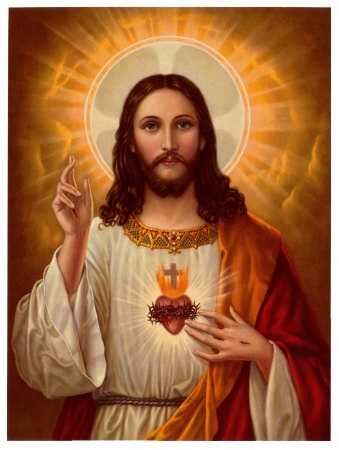
Our Lord must feel so lucky that He has the Guardian and the New York Times to finally understand Him.
Sunday, 22 December 2013
Reflection on Silence
It was in silence that He descended to us, it is by silence that we ascend to Him.
Saturday, 21 December 2013
Reflection on being Self-Righteous
Is there anything more self-righteous than accusing another of being it?
Reflection on Christmas and Children
Catholics should always rejoice in the presence of children as these little ones manifest to us a ray of the simplicity and purity of the Christ Child.
Friday, 20 December 2013
Reflection on Atheism
We are no more than aggregations of disparate matter, randomly assorted. There is no good, no right. There only "is".
Thursday, 19 December 2013
Reflection on Orthodoxy
The orthodoxy of a Catholic may be determined by his acceptance or not of the Syllabus of Blessed Pius IX.

Reflection on Liberal Logic
If the right were to promote homosexuality, the left would accuse them of misogyny.
Wednesday, 18 December 2013
Reflection on the Spirit of Christmas
In the spirit of Christmas, acknowledging man's reconciliation with God, let us be reconciled with one another. Not in a false understanding of humanity but in repentance together before our common Father.
Reflection on a Personal Relationship with Jesus
If faith is not the assent given by the intellect to truth revealed by the Divine Triad, any personal relationship with Jesus would be mere talking to oneself according to one's fancy.
Reflection on Conscience
We define conscience to be the application of the moral law to a particular situation and act. If we were to be so foolish to assert that man's conscience is his sole and allsufficing guide, what would his knowledge of good and evil be other than the taboos of society and the fear of shame among his peers?
Reflection on Human Rights and God
A proclaimed human right that impugns the sovereignty of God is to be rejected as demonic. No man has the right to error.
The Pope Speaks...
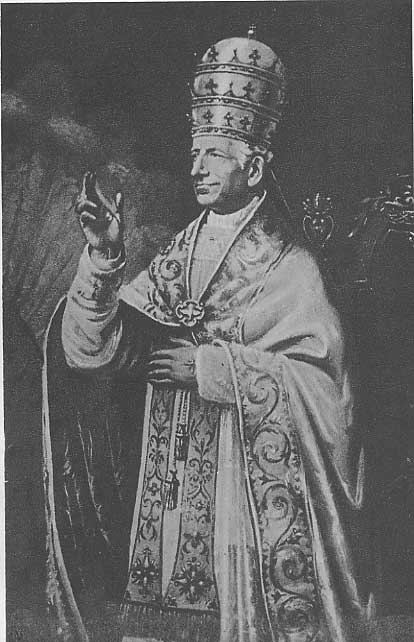
Leo XII on the necessity of the true religion as a basis for civil society.
''As a consequence, the State, constituted as it is, is clearly bound to act up to the manifold and weighty duties linking it to God, by the public profession of religion. Nature and reason, which command every individual devoutly to worship God in holiness, because we belong to Him and must return to Him, since from Him we came, bind also the civil community by a like law. For, men living together in society are under the power of God no less than individuals are, and society, no less than individuals, owes gratitude to God who gave it being and maintains it and whose everbounteous goodness enriches it with countless blessings. Since, then, no one is allowed to be remiss in the service due to God, and since the chief duty of all men is to cling to religion in both its teaching and practice-not such religion as they may have a preference for, but the religion which God enjoins, and which certain and most clear marks show to be the only one true religion -- it is a public crime to act as though there were no God. So, too, is it a sin for the State not to have care for religion as a something beyond its scope, or as of no practical benefit; or out of many forms of religion to adopt that one which chimes in with the fancy; for we are bound absolutely to worship God in that way which He has shown to be His will. All who rule, therefore, would hold in honor the holy name of God, and one of their chief duties must be to favor religion, to protect it, to shield it under the credit and sanction of the laws, and neither to organize nor enact any measure that may compromise its safety. This is the bounden duty of rulers to the people over whom they rule. For one and all are we destined by our birth and adoption to enjoy, when this frail and fleeting life is ended, a supreme and final good in heaven, and to the attainment of this every endeavor should be directed. Since, then, upon this depends the full and perfect happiness of mankind, the securing of this end should be of all imaginable interests the most urgent. Hence, civil society, established for the common welfare, should not only safeguard the wellbeing of the community, but have also at heart the interests of its individual members, in such mode as not in any way to hinder, but in every manner to render as easy as may be, the possession of that highest and unchangeable good for which all should seek. Wherefore, for this purpose, care must especially be taken to preserve unharmed and unimpeded the religion whereof the practice is the link connecting man with God.'' - Immortale Dei, 1885.
Note: As you can see, I have been undertaking the most rewarding task of reading the encyclicals of His Holiness Leo XIII, so willed with perennial Catholic wisdom and certainly would astonish the Neo-Catholics.
Reflection on the Rights of God in Society
To assure the rights of God in society is to uphold the sure liberty of each citizen, granting true peace to the commonwealth.
Tuesday, 17 December 2013
Reflection on the Duties of a Bishop
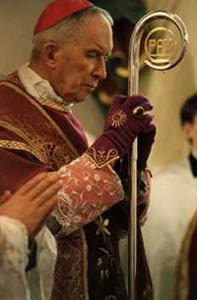
The bishop must steadily move between altar, pulpit and confessional in order to be a true pastor of souls. May the devil take the conferences and committees.
Monday, 16 December 2013
Reflection on Choosing God
Despite each stumble, each instance of curiosity, every wayward passion of youth, the desire for respect and security, the will to be free, the Christian must decide when the hour comes whether to choose the standard of Christ or that of Satan. Nothing else matters.
Reflection on the End of the Two Societies

Since God is the Author of nature and of grace, it follows that the temporal and spiritual spheres must run swiftly to His side, proclaiming His rights and our obedience to His moral law.
''Although the civil authority has not the same proximate end as the spiritual, nor proceeds on the same lines, nevertheless in the exercise of their separate powers they must occasionally meet. For their subjects are the same, and not infrequently they deal with the same objects, though in different ways. Whenever this occurs, since a state of conflict is absurd and manifestly repugnant to the most wise ordinance of God, there must necessarily exist some order or mode of procedure to remove the occasions of difference and contention, and to secure harmony in all things. This harmony has been not inaptly compared to that which exists between the body and the soul for the well-being of both one and the other, the separation of which brings irremediable harm to the body, since it extinguishes its very life.'' - Libertas, Pope Leo XIII.
The Pope Speaks...

Pope Leo XIII on a true understanding of equality.
''In like manner, no one doubts that all men are equal one to another, so far as regards their common origin and nature, or the last end which each one has to attain, or the rights and duties which are thence derived. But, as the abilities of all are not equal, as one differs from another in the powers of mind or body, and as there are very many dissimilarities of manner, disposition, and character, it is most repugnant to reason to endeavor to confine all within the same measure, and to extend complete equality to the institutions of civic life. Just as a perfect condition of the body results from the conjunction and composition of its various members, which, though differing in form and purpose, make, by their union and the distribution of each one to its proper place, a combination beautiful to behole, firm in strength, and necessary for use; so, in the commonwealth, there is an almost infinite dissimilarity of men, as parts of the whole. If they are to be all equal, and each is to follow his own will, the State will appear most deformed; but if, with a distinction of degrees of dignity, of pursuits and employments, all aptly conspire for the common good, they will present the image of a State both well constituted and conformable to nature.''
- Humanum Genus, 1884.
Reflection on Pope Francis and the Liturgy

If we were to embrace Eastern Orthodoxy, the Pope would laud our ancient and reverent liturgy as a treasure to be retained.
Sunday, 15 December 2013
Reflection on the Mercy of God
Let us be reminded always of the mercy of The Lord, a mercy leading to sanctification and not to toleration.
"Be conforted, be conforted, O my people: thy Saviour shall come quickly. Why hath grief devoured thee? Why hath sorrow disfigured thee? I will save thee: fear not: for I am The Lord thy God, the Holy One of Israel, thy Redeemer."
"Be conforted, be conforted, O my people: thy Saviour shall come quickly. Why hath grief devoured thee? Why hath sorrow disfigured thee? I will save thee: fear not: for I am The Lord thy God, the Holy One of Israel, thy Redeemer."
Thursday, 12 December 2013
Reflection on the Heresy of Judas
To verbally obsess about the poor, transforming real people into cliches is to succumb to the heresy of Judas.
Reflection on the Personality of the Pope
The Neo-Catholic and the secularist are alike in their obsession with the personality of individual popes.
Wednesday, 11 December 2013
The Definition of a Neo-Catholic and Some Philosophical Foundations
Let us proceed more directly to the heart of this issue in order to critique the fundamental flaws of their reasoning and of their general assumptions. Contrary to what they proclaim, the philosophical or political understanding that they possess, whether they are fully conscious of it or not. does not derive from Catholicism. Neither does it proceed from a source compatible with Catholicism that may be utilised to the glory of God in a new age. Certainly, our age is confronted with its own dilemmas as well as great triumphs, particularly in the realm of the natural sciences and technology which require a sound and faithful response to the challenges that arise. According to Maurice de Wulf of Louvain, Scholasticism encountered difficulties and exposed itself to ridicule when it encountered material advances that its thinkers refused to confront. It was due not to the system itself that Scholasticism declined but it was as a consequence of the mediocrity of those who claimed to be faithful to it. The world had opened up the human mind to new experiences and developments, while these men of ill talent closed their eyes and repeated the same syllogisms and expanded ad nauseam their sub distinctions of negligible value. In a future article I will attempt to set out what can offer a faithful and coherent response to the fundamental questions of this age, but here I wish to expose the inadequateness of the thought of the Neo-Catholics. They seek to do something new while claiming to be faithful to dogma and good morals.
The Neo-Catholic may claim to present Christianity is its positivity and joy but on closer inspection one notices a shell of an edifice. I am not opposed to another system of philosophy simply for it being another system of thought. What troubles me is that it renders Catholicism almost obsolete and is constructed on shaky foundations. The genius of St. Thomas was to take the 'common sense' and moderate realism philosophy of Aristotle and show how it was compatible with our Faith in its fundamental principles. By unifying it with Catholicism, the coherence and the truth within the Stagirite's philosophy could reach new heights, while its errors were being corrected in the light of Revelation. Aristotle did not set out to contradict the principles and assumptions of Catholicism which he could not have known, therefore his understanding of man and the universe may be considered on its own merits. The philosophical underpinnings of the Neo-Catholic, consciously or not, derives from the tenants and beliefs of the Enlightenment. There are certain advances that the Christian may embrace as all that is good and beautiful belongs rightly to God and His worship but caution must be our approach. Out of Egypt, the Israelites brought the gold and silver that had formally been in the service of idols so that they may be converted to the adoration of the one true God. This must be our project, however the principles of the Enlightenment are not to be shared by the faithful Catholic.
I can understand the concern to be considered moderate and up-to-date, however this desire is most applicable to matters of fashion and not to universal principles. Errors in political philosophy may not mean much if they remain restricted to articles in theoretical academic journals but too often in the Neo-Catholic they encroach on matters theological. I have already mentioned in the first part to this article the importance of the American background of a number of these prominent writers and speakers which must not be ignored. The creation of the United States of America was entirely unique. The rebellion was not simply against a king. That nation was built upon a series of ideas. In the Iberian peninsula, the Catalans may have rebelled against the Castilians but they continued to hold the same religious beliefs and the same understanding of society. They were forced back by Madrid and life went on. On the contrary, the principles that underlay the American Revolution and the framing of the Constitution derive from the Enlightenment, a period entirely hostile to Catholicism and its sure understanding of the world and man's place in it. All was turned upside down. A new world was forged. I am in particular referring to a certain understanding of natural rights, freedom of religion (essentially religious indifferentism), freedom of speech (no matter the content), representative democracy and that the government must reflect the will of the people who in turn grant it legitimacy. The US Constitution is fundamentally agnostic on matters of religion. The Declaration of Independence certainly refers to the 'Creator' but there is no certainty that this goes beyond a Deistic or Masonic understanding of God, rendering Him utterly irrelevant. The first amendment of the Constitution can only be accepted by Catholics as a practicality in a multi-confessional state where Catholics are in the minority. Unfortunately, our Neo-Catholic friends has exalted the value of freedom to idolatrous heights. We on the other hand, praise goodness and truth. The Constitution in its Bill of Rights sets out a particular understanding of the human person and claims that we each possess inalienable rights as human beings and here the Neo-Catholic stumbles into grave error. Human beings created in the image and likeness of God certainly possess a great value, greater than we could know, but we must not stray outside the boundaries. Human beings can only have rights in relation to God. We have not been created and abandoned, set apart to find our own way in this vast universe where self-realisation is fundamental to fulfilling our potential. No Catholic may accept such an erroneous understanding of his vocation and duties toward God. The entire universe was created for Him, because of Him and He is its end. Let this be the root of our understanding of the rights of man and his liberty.
These false ideas have filtered through to the average man and he accepts them implicitly, believing them to be entirely common sense, without ever having heard of Thomas Paine or his ilk. This is what is most insidious about their reasoning. It is due to this that Catholics and a few other brave Christians have struggled to combat the HHS mandate regarding contraception and abortifacient drugs as part of Obamcare. They have sought to seek exemptions and declarations of unconstitutionality whereas this is entirely the wrong track to take. The Catholic opposes such things as they are evil, intrinsically, not due to them violating constitutional rights. All that they have done is to trade right off against right and have suffered for it. Maybe the Supreme Court which has elected to hear a particular case may grant them their wish but let us not be satisfied with wavers but with goodness. Their claimed right of religious freedom has clashed with another supposed right of reproductive freedom. Furthermore in a society that tends now to condemn religion for forcing itself on another's morality there is only going to be one winner. Let us not seek victory and a safe place from oppression but the total transformation of society under the Kingship of Christ. The US is not entirely a democracy but a constitutional republic but it is clear that laws and fundamental norms can be, and have been, transformed in the light of public opinion. All authority comes from God and the government must seek to uphold the natural law and divine law in society for the true harmony of the nation. The USA has a fundamental flaw as it has not solved sufficiently the question of religion other than that man should be left alone.On the basis of voting, God may be adored or He may be mocked. He has no rights unless we grant them to Him. The Neo-Catholic is utterly unaware of the condemnations of these principles in the wise encyclicals of the pontiffs of the 19th century and the early part of the 20th century. Apparently their veneration of popes is restricted to a recent handful.
On such an understanding of rights, naked of orientation, subject to the dictates of whims disguised as reason, the Neo-Catholic is unable to challenge evil in his society. If he has a right to worship God, another has a right to mock Him. Practicality as a minority religion may have to tolerate this but they consider these rights of religious liberty to be God-given. He assumes that this understanding of rights is one that is completely compatible to Catholicism but it appears that he has exalted the American experiment in nation building and placed God second to man.
Let us now consider how the Neo-Catholic approaches matters of the Faith in the third and final part of this article.
The Neo-Catholic may claim to present Christianity is its positivity and joy but on closer inspection one notices a shell of an edifice. I am not opposed to another system of philosophy simply for it being another system of thought. What troubles me is that it renders Catholicism almost obsolete and is constructed on shaky foundations. The genius of St. Thomas was to take the 'common sense' and moderate realism philosophy of Aristotle and show how it was compatible with our Faith in its fundamental principles. By unifying it with Catholicism, the coherence and the truth within the Stagirite's philosophy could reach new heights, while its errors were being corrected in the light of Revelation. Aristotle did not set out to contradict the principles and assumptions of Catholicism which he could not have known, therefore his understanding of man and the universe may be considered on its own merits. The philosophical underpinnings of the Neo-Catholic, consciously or not, derives from the tenants and beliefs of the Enlightenment. There are certain advances that the Christian may embrace as all that is good and beautiful belongs rightly to God and His worship but caution must be our approach. Out of Egypt, the Israelites brought the gold and silver that had formally been in the service of idols so that they may be converted to the adoration of the one true God. This must be our project, however the principles of the Enlightenment are not to be shared by the faithful Catholic.
I can understand the concern to be considered moderate and up-to-date, however this desire is most applicable to matters of fashion and not to universal principles. Errors in political philosophy may not mean much if they remain restricted to articles in theoretical academic journals but too often in the Neo-Catholic they encroach on matters theological. I have already mentioned in the first part to this article the importance of the American background of a number of these prominent writers and speakers which must not be ignored. The creation of the United States of America was entirely unique. The rebellion was not simply against a king. That nation was built upon a series of ideas. In the Iberian peninsula, the Catalans may have rebelled against the Castilians but they continued to hold the same religious beliefs and the same understanding of society. They were forced back by Madrid and life went on. On the contrary, the principles that underlay the American Revolution and the framing of the Constitution derive from the Enlightenment, a period entirely hostile to Catholicism and its sure understanding of the world and man's place in it. All was turned upside down. A new world was forged. I am in particular referring to a certain understanding of natural rights, freedom of religion (essentially religious indifferentism), freedom of speech (no matter the content), representative democracy and that the government must reflect the will of the people who in turn grant it legitimacy. The US Constitution is fundamentally agnostic on matters of religion. The Declaration of Independence certainly refers to the 'Creator' but there is no certainty that this goes beyond a Deistic or Masonic understanding of God, rendering Him utterly irrelevant. The first amendment of the Constitution can only be accepted by Catholics as a practicality in a multi-confessional state where Catholics are in the minority. Unfortunately, our Neo-Catholic friends has exalted the value of freedom to idolatrous heights. We on the other hand, praise goodness and truth. The Constitution in its Bill of Rights sets out a particular understanding of the human person and claims that we each possess inalienable rights as human beings and here the Neo-Catholic stumbles into grave error. Human beings created in the image and likeness of God certainly possess a great value, greater than we could know, but we must not stray outside the boundaries. Human beings can only have rights in relation to God. We have not been created and abandoned, set apart to find our own way in this vast universe where self-realisation is fundamental to fulfilling our potential. No Catholic may accept such an erroneous understanding of his vocation and duties toward God. The entire universe was created for Him, because of Him and He is its end. Let this be the root of our understanding of the rights of man and his liberty.
These false ideas have filtered through to the average man and he accepts them implicitly, believing them to be entirely common sense, without ever having heard of Thomas Paine or his ilk. This is what is most insidious about their reasoning. It is due to this that Catholics and a few other brave Christians have struggled to combat the HHS mandate regarding contraception and abortifacient drugs as part of Obamcare. They have sought to seek exemptions and declarations of unconstitutionality whereas this is entirely the wrong track to take. The Catholic opposes such things as they are evil, intrinsically, not due to them violating constitutional rights. All that they have done is to trade right off against right and have suffered for it. Maybe the Supreme Court which has elected to hear a particular case may grant them their wish but let us not be satisfied with wavers but with goodness. Their claimed right of religious freedom has clashed with another supposed right of reproductive freedom. Furthermore in a society that tends now to condemn religion for forcing itself on another's morality there is only going to be one winner. Let us not seek victory and a safe place from oppression but the total transformation of society under the Kingship of Christ. The US is not entirely a democracy but a constitutional republic but it is clear that laws and fundamental norms can be, and have been, transformed in the light of public opinion. All authority comes from God and the government must seek to uphold the natural law and divine law in society for the true harmony of the nation. The USA has a fundamental flaw as it has not solved sufficiently the question of religion other than that man should be left alone.On the basis of voting, God may be adored or He may be mocked. He has no rights unless we grant them to Him. The Neo-Catholic is utterly unaware of the condemnations of these principles in the wise encyclicals of the pontiffs of the 19th century and the early part of the 20th century. Apparently their veneration of popes is restricted to a recent handful.
On such an understanding of rights, naked of orientation, subject to the dictates of whims disguised as reason, the Neo-Catholic is unable to challenge evil in his society. If he has a right to worship God, another has a right to mock Him. Practicality as a minority religion may have to tolerate this but they consider these rights of religious liberty to be God-given. He assumes that this understanding of rights is one that is completely compatible to Catholicism but it appears that he has exalted the American experiment in nation building and placed God second to man.
Let us now consider how the Neo-Catholic approaches matters of the Faith in the third and final part of this article.
Reflection on Time Person of the Year 2013
May we only rejoice at the praise of the Pope when he is extolled by those who proclaim the Social Kingship of Christ. Otherwise, suspicion should be our restraint.
Reflection on Metaphysics
A coherent and accurate system of metaphysics covers a great multitude of theological errors.
A Definition of a Neo-Catholic and Some other Thoughts 1)
It is a particular term that I have only recently started to adopt. I had previously considered it rather disparaging towards well-intentioned souls who may be overgenerous in their defence of individual popes but who were otherwise orthodox in theology and morals. These types were my first contact with Catholicism, or dare I say it, a particular brand of Catholicism, so I may subconsciously retain elements of their thinking to my detriment. Let my readers correct me in charity.
The term itself is known from a book by Mr Ferrara and Mr Woods, 'The Great Façade'. I will not go into their arguments in this post for the simple reason that I am utterly ignorant of their work, having not read it. An awareness of the great differences between the self-identified 'Traditionalist Catholic' and those who claim to be Catholic, loudly proclaiming their obedience to the Magisterium, only made a real impression on me in the past few years. I was staying at the Scots College in Salamanca, Spain for a week and I had a few discussions on 'contentious' issues relating to the Council with two seminarians, one of which I had previously known. Likely now he has tried to pretend not to have had that privilege. My understanding of divergences had been entirely superficial, it was ultimately related to the question of personal preference concerning the liturgy. Admittedly I was generally aware of criticisms directed towards 'religious liberty' or ecumenism but it was to my mind, a matter of practicality in lieu of principle. It was through these late night conversations, interspersed with games of pool and soft drinks that I learnt that something more fundamental was the core issue. Their entire philosophy was skewed. I am not here to blast their mental processes as I actually still like them and they did treat this odd convert and two-time Faith conference attendee with courtesy. On the other hand, I now consider the philosophy of the Neo-Catholic to be utterly fatal to Catholicism.
The Neo-Catholic is fond of quoting the Fathers and it was through their apologetics material, often utilising the great men of the nascent Church, that I finally decided to convert. Yet, I continue to wonder what singular bishops like Father Augustine and the man who baptised him, St. Ambrose would have thought of their social and political philosophy. A number of years ago I read a letter from St. Augustine in reply to a pagan civil official who wrote to the Doctor pleading for his intercession in order to save some riotous pagans from severe punishment. Nectarius, the official, commends the bishop for his love of 'country' in the opening of his plea. In response Augustine responds that Nectarius may love his 'country' too but it is far better to love the 'heavenly city' of God. The rest of the letter is a call for our friend Nectarius to convert to Catholicism which quite amused me when I first read it due to what appeared to me as the sheer cheekiness of the part of my patron saint. Now that I meditate on his words I am astonished by the profundity of them. The 'commonwealth' can only truly be loved and honoured when the one true God is loved and honoured. Society has a higher purpose than the merely practical and economic demands of a societal animal. It is through society, the primary society being the family, that man comes to know God and His moral law. The coexistence of two distinctly thinking peoples can not form a true society.
It was for this reason that Spain treated heresy so harshly under their Inquisition. No society can be truly whole, existing for a greater good than that which believes the same and cherishes the same moral imperatives. Otherwise, society becomes a aggregation of individuals living in their own self-selected cells. As a result of this, we proclaim the Social Kingship of Christ. All individuals of whatever condition or original confession, groups, institutions, nations, agencies, powers must acknowledge His reign of justice and peace. I do not pray to God that I may be allowed to be left alone to worship with a close group of fellow believers but that the entire nation may join me in adoration. It is perfectly desirably to long for a Catholic confessional state where the rights of God are upheld and His commandments are taught and adhered to in public. Unfortunately, the Neo-Catholic would baulk at such a suggestion. It appears that they are completely wedded to their current form of society and its implicit principles. They are unable to imagine a good society apart from a liberal or social democracy which is inevitably pluralistic. Furthermore, they continue to be bemused that society can adopt such abhorrent mores all the while being ignorant of the fact that such a form of society generates actually it. Traditional Catholics have pointed out the Protestant background of such men, but since the best Catholics are generally converts (I proclaim seriously with a proud grin), it is the significance of their nationality and social formation that I wish to highlight.
To be continued...
The term itself is known from a book by Mr Ferrara and Mr Woods, 'The Great Façade'. I will not go into their arguments in this post for the simple reason that I am utterly ignorant of their work, having not read it. An awareness of the great differences between the self-identified 'Traditionalist Catholic' and those who claim to be Catholic, loudly proclaiming their obedience to the Magisterium, only made a real impression on me in the past few years. I was staying at the Scots College in Salamanca, Spain for a week and I had a few discussions on 'contentious' issues relating to the Council with two seminarians, one of which I had previously known. Likely now he has tried to pretend not to have had that privilege. My understanding of divergences had been entirely superficial, it was ultimately related to the question of personal preference concerning the liturgy. Admittedly I was generally aware of criticisms directed towards 'religious liberty' or ecumenism but it was to my mind, a matter of practicality in lieu of principle. It was through these late night conversations, interspersed with games of pool and soft drinks that I learnt that something more fundamental was the core issue. Their entire philosophy was skewed. I am not here to blast their mental processes as I actually still like them and they did treat this odd convert and two-time Faith conference attendee with courtesy. On the other hand, I now consider the philosophy of the Neo-Catholic to be utterly fatal to Catholicism.
The Neo-Catholic is fond of quoting the Fathers and it was through their apologetics material, often utilising the great men of the nascent Church, that I finally decided to convert. Yet, I continue to wonder what singular bishops like Father Augustine and the man who baptised him, St. Ambrose would have thought of their social and political philosophy. A number of years ago I read a letter from St. Augustine in reply to a pagan civil official who wrote to the Doctor pleading for his intercession in order to save some riotous pagans from severe punishment. Nectarius, the official, commends the bishop for his love of 'country' in the opening of his plea. In response Augustine responds that Nectarius may love his 'country' too but it is far better to love the 'heavenly city' of God. The rest of the letter is a call for our friend Nectarius to convert to Catholicism which quite amused me when I first read it due to what appeared to me as the sheer cheekiness of the part of my patron saint. Now that I meditate on his words I am astonished by the profundity of them. The 'commonwealth' can only truly be loved and honoured when the one true God is loved and honoured. Society has a higher purpose than the merely practical and economic demands of a societal animal. It is through society, the primary society being the family, that man comes to know God and His moral law. The coexistence of two distinctly thinking peoples can not form a true society.
It was for this reason that Spain treated heresy so harshly under their Inquisition. No society can be truly whole, existing for a greater good than that which believes the same and cherishes the same moral imperatives. Otherwise, society becomes a aggregation of individuals living in their own self-selected cells. As a result of this, we proclaim the Social Kingship of Christ. All individuals of whatever condition or original confession, groups, institutions, nations, agencies, powers must acknowledge His reign of justice and peace. I do not pray to God that I may be allowed to be left alone to worship with a close group of fellow believers but that the entire nation may join me in adoration. It is perfectly desirably to long for a Catholic confessional state where the rights of God are upheld and His commandments are taught and adhered to in public. Unfortunately, the Neo-Catholic would baulk at such a suggestion. It appears that they are completely wedded to their current form of society and its implicit principles. They are unable to imagine a good society apart from a liberal or social democracy which is inevitably pluralistic. Furthermore, they continue to be bemused that society can adopt such abhorrent mores all the while being ignorant of the fact that such a form of society generates actually it. Traditional Catholics have pointed out the Protestant background of such men, but since the best Catholics are generally converts (I proclaim seriously with a proud grin), it is the significance of their nationality and social formation that I wish to highlight.
To be continued...
Tuesday, 10 December 2013
Reflection on Labelling
If you object to the description of "Neo-Catholic" as insulting, try being called a "self-absorbed promethean neopelagian".
Reflection on the Immaculate Conception
No man can ever write more beautifully than when he communicates his love for the Blessed Virgin. The affection towards a mother and the devotion towards a beloved most perfectly embrace in his words.
Reflection on Multiculturalism
Multiculturalism: You can have any culture you want as long as it is a liberal, secular democracy. Henry Ford would be proud.
Monday, 9 December 2013
On Neo-Catholics and the Pope

As a traditional Catholic it is often my desire to retreat into my study and imagine myself at the University of Paris in the 13th century. Alas, I must emerge to confront some hysteria that has been unleashed in the past few days regarding some of the Holy Father's comments in his Apostolic Exhortation, Evangelii Gaudium. I will limit myself to some remarks considering certain Neo-Catholics' responses to criticism of Francis' words in that document in lieu of attacking the argument presented by the Pope in his latest writing. The position I have in mind is Francis' comments on 'trick-down economics' which was blasted by the American conservative radio host Rush Limbaugh as 'pure Marxism'. It turns out that, if we assume that the Castilian edition of Evangelii Gaudium is the original language, the English translation suffers from a mistranslation in that section. The substitution of ''inevitably'' for the original ''por sí mismo'' (by itself) certainly leads to the confusion and has increased the polemics. I have no desire in this article to tackle the issue ''de por sí'' (in itself) but one which is far more worrying and fundamental.
It may be considered honourable and loyal to defend the Pope from charges and assaults but it is not always required. On occasion, it is a grave disservice to the Vicar of Christ to bow at every word or action simply as you wish to be obedient sons of the Holy Father. I can understand the concern but as Catholics called to worship the one true God and spread His Gospel of redemption, our priorities should be much greater. The Pope himself is the servant of the Faith, the 'servant of the servants of God'. His is a heavy burden, one which will be his eternal glory or his eternal damnation. Let us shudder at that thought. I would address these staunch defenders of the words of Pope Francis and ask how they would have dealt with the heretical sermons of Pope John XXII in the 14th century? Would they have kept quiet? Would they have attempted to adopt a spurious defence of his theological position? Would they have condemned the theologians who resisted John? Would they then have praised Benedict XII who defined the contrary position? Tossed about on the waves of personal loyalty, they would have made fools of themselves. It was through the protestations of the theologians that John recanted. Maybe they saved his soul.
At times it is necessary to defend a pontiff's words from being misinterpreted by the media who are so eager to latch on to any scrap that conforms to their agenda. Pope Emeritus Benedict XVI has not been immune from ambiguity and often quite troubling words. We understand that the Faith is hated by the world and that Catholicism is the last bastion, the last rampart against secularism and a culture of death or aimless license. I understand the devotion that Catholics feel towards the person of the Holy Father and such love should be fostered. As a Scotsman it is appealing to honour the Bishop of Rome in a protestant land. Yet, let us not be fools in this matter. It is our duty to pray for the Pope each day, asking God to grant him prudence and wisdom in his actions and words as well as for health and security. That is the response of a Catholic who truly loves the Pope because he loves the Faith first. Papolatry and the adulation of the crowd will not save a soul and will blind one to many missteps and errors.
I have often read the apologetical articles written by prominent Neo-Catholics and I have found much of great value. In fact, it was through their works that I studied the Faith before I converted. In approaching historical difficulties concerning papal infallibility, they seem to be in accord with the mind of the Church when they recognise explicitly the restrictions and limits of ''Pastor Aeternus'' of the First Vatican Council. Unfortunately when they are not dealing with issues raised by Popes Liberius, Honorius and Alexander VI, they seem to lose their objectivity and clear understanding. It was my belief that Ultramontanism had died out. However it seems to have resurfaced under the pretext of obedience to the Magisterium. These may be harsh words but it is not the person of the Pope that we are called to proclaim and defend but the Faith handed onto us by God through Jesus Christ. The Pope has the same obligation but one which is must greater and more urgent. His infallibility does not extend to issues relating to the economy, the natural sciences, medicine or geography. If error that is damaging to the Faith is committed by the Bishop of Rome there is a need to resist him. Have they actually considered his words or have they spontaneously reacted with abhorrence towards the fact that someone has criticised the Pope?
The Faith has an objective content that may be presented and explained without the necessity of the Pope of the hour interpreting it. We are not required to suspend judgement on matters of faith and morals already defined until a future pontiff 're-examines them in the light of the Second Vatican Council'. The fickleness towards the Faith exhibited by these, albeit well-intentioned, individuals makes a mockery of the Apostolic Doctrine. The hysterical reaction of some including the ludicrous headline ''The thing that used to be used conservatism has put out a hit on your pope'' is a grave danger to souls understanding the Catholic Faith. It is almost like we are defending 'policies' of a current pope which would soon be altered, assuring the vociferous support of those who defended the contrary simply as the pope said it. On a side note, I am often amused by the self-identified 'conservatives' in the USA, whereas from my perspective as a European Catholic monarchist, they appear rather left-wing. A radio host like Limbaugh who defends the US constituion can only be called right-wing in relation to the modern day Democrats who espouse all sorts of nonsense. From a European context, at least historically, the US constitution is remarkably liberal. Based on the principles of the Enlightenment and Freemasonry it could in no way be described as conservative. In an American context, I am sure the Neo-Catholics devoted to religious liberty are utterly oblivious to that truth.
We must be cautious in ascribing error to the Pope in matters but we must be aware of how authoritative the comments or words are. Off-the-cuff remarks by a careless speaker may be worrying but we must recognise them for what they are. Let us not feel compelled to rise to the defence of the Pope on matters outside of faith and morals because we as Catholics feel somehow obliged. Yet when the Faith is proclaimed by Francis, let us answer 'amen' and refuse to give up his body to the liberal media. Francis is a plaything for the media who will soon abandon him when they have extracted as much capital out of him as possible. Caution instead of cynicism should be our preferred attitude. I miss the days of Gregory VII and Innocent III but I have not been placed by God in the 11th or 12/13th centuries, I can only work out my salvation in fear and trembling in the here and now. It appears that Francis is open to criticism and that is to be welcomed because our concern is for the Kingdom of Heaven and its righteousness above all things and then we shall truly honour the Pope.
Until He come,
Charles.
Reflection on Sacred Scripture
Sacred Scripture without the strengthening of Sacred Tradition will crumble formlessly.
Saturday, 7 December 2013
Reflection on the Bishop of Christ and Saint Ambrose
Who could give a Christian in the midst of wickedness greater consolation than a manly bishop clad in the armour of Christ? Who among the episcopate would bar the doors of the Church to unworthy politicians and other enemies? A bishop formed according to the image of Ambrose is rare to be found.
Wednesday, 4 December 2013
Reflection on Orthodoxy and Morals
The reduction of orthodoxy to morals is deeply dangerous. An atheist could assert the same positions.
Reflection on Appreciating Beauty
If one has no understanding of art, architecture, music, in effect, all that is beautiful, at least let him appreciate it.
Monday, 2 December 2013
Reflection on the Neo-Catholic
Onwards with the Crusade! The Pope wills it. Set up the Inquisition! The Pope approves. Censor books! The Pope demands it. On to Assisi! The Pope encourages it. Attend ecumenical services! The Pope recommends it. Dialogue with unbelievers! The Pope desires it.
Saturday, 30 November 2013
Reflection on Freethinking
If you are a liberal secularist in this culture, you are not a free thinker but a conformist.
Tuesday, 26 November 2013
The Definition of Modernism
The essential notes of modernism are: naturalism, rationalism and subjectivism.
Reflection on Modernism
Modernism is the inversion of man's relation to God and ultimately the abolition of it.
Monday, 25 November 2013
Reflection on the Cross and the Christ
Christianity devoid of the Cross devolves into a sentimental socialism.
Reflection on The Guardian
I never feel more dirty than when I catch myself reading an article from the Guardian online. Yet, one must be aware of Satan's tactics presented there.
Sunday, 17 November 2013
Reflection on Papal Doubt
Absence of dogmatism is fatal for a Roman Pontiff. He is not to be a seeker of the truth but the faithful guardian and transmitter of it.
Saturday, 16 November 2013
Reflection on Humanism
Oh to the days when humanists were devoted to literary and scholarly excellence instead of being petty, self-obsessed bores!
Friday, 15 November 2013
Reflection on Free Speech
Has there ever been another age in which freedom of expression has been so championed but such horror at its actual exercise?
Thursday, 14 November 2013
Reflection on Preaching
Preaching not based on a solid understanding of theology is liable to lead the people astray. Pious sounding words can only flatter the preacher. It was for this reason that St. Dominic wanted his brothers to study and know the truth first before they could communicate it to those in need.
Wednesday, 13 November 2013
Reflection on the Crisis in the Church
The entire crisis in the Church concerns an understanding of the very identity of the Church.
Reflection on the Private Sphere
To relegate religion to the private sphere is to relegate it to irrelevance.
Tuesday, 12 November 2013

Monday, 11 November 2013
Reflection on Catholic Culture
Catholic culture may be likened to a silent sermon, communicating eternal truths in a temporal setting.
Reflection on Exploitation
It is to be wondered who confiscates more of our wealth, the so-called greedy corporations or an activist and compassionate government?
Reflection on Islam
How far astray have those Catholics gone who express admiration for Islam! To leap praise upon a religion that denies the divinity of Christ and His passion and Resurrection is to abandon the Faith entirely.
Reflection on Faith and Morals
It is not incidental that men leave the Church for matters of morals. The call may go out to alter a particular sexual moral teaching but who would clamour for an acceptance of Monothelitism? This shows that the primary objections to the Faith are not intellectual or rational but rather the refusal of man to submit himself to a truth that directly affects him.
Reflection on the Identity of Jesus Christ
Each age may be defined as how it interprets the person and purpose of Christ.
The Importance of a Catholic Culture and on the Spirit of Spain

Doctor Fray Francisco Barbado Viejo O.P entering Salamanca, Spain as he takes possession of his new diocese. Taken in 1942 in the Plaza Mayor.
Pax Christi in Regno Christi.
The preservation of an authentic Catholic culture is vital for the faithful handing on of the doctrine of the Church. The culture is the environment in which a soul is taught, nourished and grows. It is the sensible vehicle of the transmission of the Faith until our days, handed on once to the saints. It will not do for us to simply consider the Faith as a personal matter, reserved to the inner consciences of a group of believers. It may seem pious to claim that the believer should only shut himself up in his room and pray alone but we must be wary of such deceptive thinking. Our Lord taught us to do that it is true, but the motives of these people are to deny the public acknowledgement of God and His holiness. So the culture, so the soul. I have seen Catholic souls who were zealous for the Faith become polluted by our pagan culture and its allurements. I have waned so often in any devotion as our culture is enticing and it presents an easy façade to each unfortunate soul who pays too much attention to it. It is not surprising that a soul who is bombarded with these false values will end up ignoring the eternal. One is unable to evade one´s environment and how it teaches us. Often I do feel rather alone in adhering to the Faith. I do not see fidelity or purity on the television, on the radio or music channels, in the street, or in the lecture hall. Hardly even in the home. Etsi Deus non daretur. We live with the basic assumption that God does not exist. If for sentimental reasons we recall Him, it goes no further than that. You may consider the flourishing of the martyrs in the nascent Church when men and women, young and old (I am particularly struck the virgin martyrs who also seem an insult to our age) preferred nothing to Christ and His glory. The Faith was transmitted throughout the 300 years of persecution, hostility and paganistic allurements. These souls had to be brave and be confident in the hope that was promised to them through the preaching of the apostles. The faithful are much more numerous nowadays but the fire of divine charity is merely a flicker. Christianity in this post-Christian world is like failed experiment to our common man. Adherence to its doctrines is considered an outrageous assault on Enlightenment principles and the greater 'achievements' that man takes pride in.
I was only born in 1990 and although the culture was well on its way to death, so many of today's assumptions and demands must have seemed bizarre. How blessed must the faithful of Doctor Fray Francisco Barbado Viejo have felt to see their learned and pious prelate process throughout the streets of that venerable city where God was once worshipped. This was during the days of the beginning of Franco's dictatorship in Spain. Salamanca was then a fiercely nationalistic city, now the bookshops are filled with tomes recounting how terrible El Generalísimo was. Without a doubt, El Caudillo was a deeply unpleasant fellow but I firmly believe his cause for the preservation of a Catholic Spain was entirely just. To be frank, I would have needed to support him as I am sure the Republicans would have happily shot me. Those years, a triumph of the Faith but one in which daily life was particularly difficult, in fact to this day, they are known as los años de hambre (the years of hunger). Spain now has lost the spirit of Catholicism and in turn has lost herself. It is easy to be fooled by the visible manifestations of the Church in Spain. Her churches are glorious, processions during Holy Week are well attended where a great deal of time and money is spent by the brotherhoods that organise them, and the populace are generally baptised into the Catholic Faith. Morally speaking, the nation is bankrupt. Licentiousness, abortion, fornication and drunkenness among the youth abound. The Spaniards are a deeply passionate people, strongly regional, distrustful of certain groups, and often this spirit can be unleashed rather violently, as was seen in the run up to the Civil War and during it.
Spain was created by Catholicism. It was the Faith that united the disparate groups of the Christian incipient kingdoms that emerged after the Muslim invasion by Tariq in 711. The scandal of the Reconquest of the Iberian peninsula, to recover the ´´unity´´´achieved by the Visigoths, was that it took so long. 700 or so years! With much infighting between the Christian monarchs and often stern warnings from the Roman Pontiffs to sort themselves out for the sake of Christendom. To us today, the fight to restore the Faith seems too radical, obscurantist, intolerant and not worth the effort. Surely, our knowledge of the truth has fled from us. The love of that truth has died in our breast.
The assumptions and the world view that we posses are completely shaky and devoid of the knowledge of God. Man forms moral judgements about what must be done on the basis of what he believes to be important. With an entirely secular understanding of morality and man´s place in the universe, it is nigh impossible to present a defence of traditional values. It appears absurd to the average person, even to the so-called 'good'. I understand how men have the moral law in them and therefore are without excuse on the day of judgement, yet that foundation has been splintered through sinful living and a new edifice of ´progress´and ´reason´ has been erected. Our axioms, world view and end are infused with error and fallacy.
Will we return to an authentic Catholic culture? I honestly do not believe so, unless the world reaches its ultimate depravity and ends up destroying itself. It may then look back fondly on the sweet certainty of the Catholic Faith.
Until He come again, ¡Viva Cristo Rey!
In Domino,
Charles
Saturday, 9 November 2013
From La Torre - Francisco de Quevedo

Withdrawn to this solitary place,
With a few but learned books,
I live conversing with the dead,
listening to them with my eyes.
Open always, if not always understood,
they amend, they enrich my affairs:
in rhythms of contrapuntal silence,
awakened, they speak to the dream of life.
O Don José, for those great souls
absconded by death, the learnéd
press avenges time´s slanders.
In irrevocable flight the hour flees:
but it can be counted fortunate
when we better oursevles by reading.
- Francisco de Quevedo
Reflection on Feminism and the Speculation about the first Female Cardinal
It is to be wondered whether feminists wish to abolish power structures....or simply to join them.
Thursday, 7 November 2013
Traditional Latin Mass in Salamanca
While studying in Salamanca, Spain, I had the good fortune to assist at the Holy Sacrifice according to the authentic Roman rite. During the first semester it was offered once a month by a priest of the SSPX, a newly ordained young French man. For the second semester we had a greater blessing as the SSPX came up twice a month to offer Mass for us. I wish to share some pictures here of the church where once again the Mass of saints such as Juan de Avila, Teresa, Juan de la Cruz was offered to the Father Almighty.
As you can see the church was built in the gothic style with the customary ribbed vaults. However, the current structure from the 16th century replaced the building constructed in the 12th in the Romanesque style.


Wednesday, 6 November 2013
Reflection on Dejection
It is particularly difficult nowadays for one not to have the desire to spit towards the west and flee to the desert.
Reflection on the Wickedness of the World
Often I wonder if the whole world is rotten because of silence...or consent
Subscribe to:
Posts (Atom)